
Best Pipe Bender for Exhaust: 3 Models Compared

For most exhaust work, VEVOR 16-Ton Hydraulic Pipe Bender is the best fit because its eight dies cover 1/2 to 3 inches and its hydraulic stroke is 10 inches. Choose 16-Ton Hydraulic Pipe Bender, 1/2–2 in if your tubing is no larger than 2 inches and you want a shorter-stroke hydraulic frame; VEVOR 14-Die Manual Bending Machine uses a different manual bending setup and lists limits for several pipe shapes.
We earn a commission if you buy through links on this page. As an Amazon Associate I earn from qualifying purchases. Products are compared on manufacturer specifications, not hands-on testing.
- Best overall: VEVOR 16-Ton Hydraulic Pipe Bender – Eight dies span 1/2 to 3 inches, with a 10-inch hydraulic stroke.
- Best for compact tubing: 16-Ton Hydraulic Pipe Bender, 1/2–2 in – Its die range tops out at 2 inches and the stroke is 5.12 inches.
- Best for manual shape work: VEVOR 14-Die Manual Bending Machine – Fourteen dies and limits for flat stock and several tube shapes distinguish its design.
| Product | Best for | Die range | Hydraulic stroke | Bend angle | Shop |
|---|---|---|---|---|---|
| VEVOR 16-Ton Hydraulic Pipe Bender | Wide die range | 1/2–3 in | 10 in | 90–180° | Check Price on Amazon |
| 16-Ton Hydraulic Pipe Bender, 1/2–2 in | Smaller tubing | 1/2–2 in | 5.12 in | 90–180° | Check Price on Amazon |
| VEVOR 14-Die Manual Bending Machine | Mixed stock shapes | Round dies: 1–3 in | — | Up to 200° | Check Price on Amazon |
Pipe Benders for Exhaust Compared
Match the die range and bending mechanism to the exhaust tube diameter and shape you need to form.
VEVOR 16-Ton Hydraulic Pipe Bender

VEVOR 16-Ton Hydraulic Pipe Bender covers the widest die range among the hydraulic options here, from 1/2 to 3 inches, with a 10-inch stroke. The manual hydraulic frame includes eight precision-cast dies, adjustable rollers with six positions, and a return spring system. Its adjustable height spans 13.5 to 23.4 inches, which matters when positioning longer sections of pipe. The 107.9-pound weight is a practical limitation for anyone who needs to move the tool frequently; it suits a fixed workshop better than a mobile setup. Its angle range is 90° to 180°, so it is not the choice for bends below 90°.
Bottom line: Choose this for hydraulic bending when your exhaust tube diameter falls within its 1/2- to 3-inch die range.
16-Ton Hydraulic Pipe Bender, 1/2–2 in
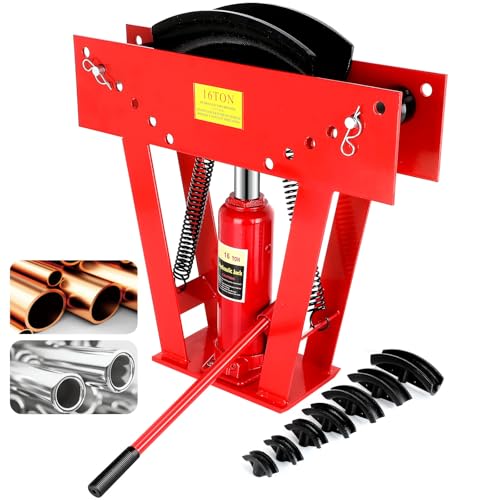
16-Ton Hydraulic Pipe Bender, 1/2–2 in is the shorter-stroke hydraulic alternative, with a 5.12-inch stroke and an adjustable frame height from 12.9 to 18.1 inches. Its eight-die range runs from 1/2 to 2 inches, so it fits smaller tubing projects but cannot cover the 2.5- and 3-inch sizes included with VEVOR 16-Ton Hydraulic Pipe Bender. A hydraulic and rebound system and adjustable rollers support bends from 90° to 180°. The narrower maximum diameter is the key constraint for exhaust work: confirm your tube’s outside diameter falls within the included die sizes before selecting it.
Bottom line: Pick this when your exhaust tube is 2 inches or smaller and you prefer a lower-stroke hydraulic unit.
VEVOR 14-Die Manual Bending Machine

VEVOR 14-Die Manual Bending Machine differs from the hydraulic pipe benders because it is a manual bending machine built around 14 dies for round and square tube work, plus flat stock. Its limits include 0.65-inch outside-diameter hollow round pipe, 1-inch outside-diameter round steel tube, and low-carbon steel under 0.2 inches thick; the die set itself lists sizes from 1 to 3 inches. The maximum bend angle is 200°. The mixed-shape capacity can suit a fabrication task that includes more than exhaust tubing, but its hollow-pipe limit makes it a poor match for larger exhaust tube than that limit.
Bottom line: Consider this for mixed-shape manual fabrication when the tube and material fit its limits.
How to choose an exhaust pipe bender
Choose a bender by tube outside diameter, wall thickness, material, and bend radius—not by tonnage alone. These hydraulic tools use a die to push the tube into a curve; a die that does not match the tube can flatten or kink it. Measure the tube’s outside diameter with calipers and check the wall thickness before choosing a die. Exhaust tubing commonly uses mandrel bending for smoother, less restrictive bends; a shop press-style bender does not necessarily provide mandrel support. For a first screen, select only a tool whose die range includes your measured outside diameter, then verify that its bending method suits the finished exhaust part.
Die size and exhaust tube fit
Die size must match the tube’s outside diameter, while the bend radius must suit the routing space and avoid excessive flattening. A practical decision rule is to rule out a tool if the measured tube diameter exceeds its largest included die: that excludes the 1/2- to 2-inch model for a 2.5-inch tube. These supplied die sizes are not a universal exhaust-size chart, since vehicles and custom systems use different diameters and wall thicknesses. Also account for clearance around the bender’s frame and rollers; the tube’s length and the angle of the bend affect whether a long section can be positioned without hitting nearby parts.
The table separates mechanisms and limits so you can narrow the choice by the tube or stock shape.
| Tool type | Useful for | Key limit |
|---|---|---|
| Hydraulic die bender | Tube sizes covered by its dies | Die match and bend radius |
| Manual multi-shape bender | Several stock shapes | Shape and material limits |
| Mandrel exhaust bender | Maintaining tube cross-section | Usually a shop machine, not a portable press |
Hydraulic press versus mandrel bending
A hydraulic press-style bender forms a bend by loading the tube against a die, while mandrel bending supports the tube internally as it curves. Internal support helps preserve the tube’s cross-section through tighter bends; unsupported bending can produce a flattened or wrinkled area. That difference matters on exhaust runs where flow area and clearance are important. The hydraulic tools give die sizes, stroke, and angle range, but those figures alone do not establish a mandrel process or a minimum bend radius. For a tight route or a finished system where keeping the tube round is critical, choose a tool specifically designed for mandrel bending rather than assuming a high tonnage solves the issue.
Safe setup and common bending mistakes
Keep hands clear of the die and rollers while applying hydraulic force, and secure the frame on a stable, level surface before loading a tube. Sixteen tons of force can create pinch and crush hazards even in a manual tool. The common fit mistake is choosing a die by nominal pipe size instead of confirming the tube’s actual outside diameter; exhaust tube is often specified by outside diameter. A second mistake is making a sharp bend without checking radius and wall thickness, which can collapse thin-wall tubing. Use a test piece of the same material and dimensions when possible, and stop if the tube slips or begins to buckle.
Frequently Asked Questions
How do I measure exhaust tubing for a bender?
Measure the tube’s outside diameter with calipers, then compare it with the bender’s die sizes. Check wall thickness too, because thin-wall tubing can flatten more readily during a tight bend.
Can a hydraulic pipe bender make mandrel bends?
Not necessarily; a press-style hydraulic bender and a mandrel bender are different mechanisms. Mandrel bending uses internal support to help maintain the tube’s cross-section through a curve.
Why does exhaust tubing flatten during bending?
Flattening can occur when the die radius is too tight, the die fit is poor, or the tube lacks internal support. A mandrel process is useful when preserving the tube’s round shape is important.
Is 16 tons enough for exhaust tubing?
Tonnage alone does not determine whether a bender suits exhaust tubing; die fit, material, wall thickness, and bend radius also matter. Match the die to the tube outside diameter before applying force.
What safety precautions matter with a manual hydraulic bender?
Keep fingers away from the die and roller pinch points while applying force, and place the frame on a level, stable surface. Stop if the tube slips or buckles rather than increasing force.