
Warping Point Pickleball Paddles Compared by Fit

For a general-purpose Warping Point pickleball paddle, the Neon Gen 3 stands out for its 16 mm EdgeFusion core and thermoformed frame. Choose the Aether for its 3K carbon-fiber face and control-oriented design, or the Ascent if its shorter 15.75-inch length better suits your reach.
Pickleball paddles are solid-faced rackets used to hit a perforated plastic ball; grip fit and how the paddle feels through a swing matter alongside its features.
We earn a commission if you buy through links on this page. As an Amazon Associate I earn from qualifying purchases. Products are compared on manufacturer specifications, not hands-on testing.
- Best overall: Warping Point Neon Gen 3 – Its 16 mm EdgeFusion core and thermoformed frame set it apart for players seeking a mix of control and power.
- Best for control: Warping Point Aether 16MM – The Aether pairs a 3K carbon-fiber face with a wide-cell honeycomb core.
- Best for shorter reach: Warping Point Ascent – At 15.75 inches long, the Ascent is shorter than the other two paddles.
| Product | Best for | Length | Width | Core | Shop |
|---|---|---|---|---|---|
| Warping Point Neon Gen 3 | Balanced play | 16.4 in | 7.55 in | 16 mm polypropylene honeycomb with EVA | Check Price on Amazon |
| Warping Point Aether 16MM | Control and spin | 16.18 in | 7.68 in | 16 mm; 10 mm wide-cell honeycomb | Check Price on Amazon |
| Warping Point Ascent | Shorter paddle reach | 15.75 in | 7.7 in | 16 mm Hexa polymer | Check Price on Amazon |
Warping Point pickleball paddles
Compare the three paddles by size, core construction and the features that shape their intended playing feel.
Warping Point Neon Gen 3

The Neon Gen 3 is the only paddle here whose features specify a thermoformed frame and an EVA-reinforced perimeter around its 16 mm polypropylene honeycomb core. Warping Point says this EdgeFusion construction is intended to support edge stability, rebound and a broader sweet spot. Its 16.4-inch length and 7.55-inch width give it a slightly narrower profile than the other options. The maker identifies it as UPA-A approved for sanctioned play. Choose it if you want the perimeter reinforcement; players who prioritize a carbon-fiber face should compare the Aether or Ascent instead.
Bottom line: Pick this if perimeter reinforcement and a 16 mm core are your priorities.
Warping Point Aether 16MM
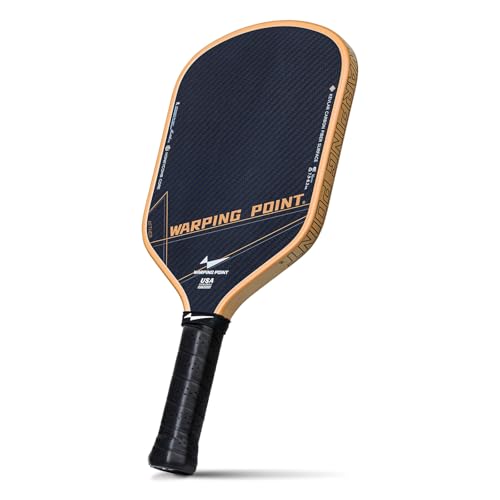
The Aether is the only option with a specified 3K carbon-fiber face and 10 mm wide-cell honeycomb structure. Warping Point says its textured face is designed to increase ball dwell time for spin, while its head-heavy hybrid shape and arm-friendly design target controlled play. The paddle measures 16.18 inches long and 7.68 inches wide, and the maker identifies it as USAP approved. Its wider shape may appeal to players who want a broader face, but the specifications do not give a grip circumference, so players choosing by hand fit should confirm that measurement before ordering.
Bottom line: Choose this if the 3K carbon face and wide-cell core match your control priorities.
Warping Point Ascent

The Ascent is the shortest paddle in this group at 15.75 inches, with a 7.7-inch width and a 16 mm Hexa polymer core. Its features also specify a textured grit surface and an aero-throat design. Warping Point claims the airflow channels reduce drag by 18%; treat that as a maker performance claim rather than a measurement to compare directly with the other paddles. The specifications identify the Ascent as USAPA approved. Its shorter length is a useful distinction for reach preferences, but its claims do not include a face material, unlike the Aether’s specified 3K carbon fiber.
Bottom line: Choose this if you prefer the shortest overall paddle length in this comparison.
How to choose a Warping Point paddle
Choose by face feel, core construction and fit rather than by approval wording alone. A 16 mm core is common among control-oriented paddles, while a thinner core often feels more direct and a thicker core can soften impact; the exact feel also depends on face material and construction. Textured carbon faces are intended to help players impart spin, but technique and contact point still matter. For the three models here, compare the Aether’s 3K carbon face, the Ascent’s textured grit surface and the Neon Gen 3’s reinforced perimeter. If control at the kitchen line matters most, prioritize a comfortable grip and predictable touch over a claimed swing-speed increase.
Paddle dimensions and hand fit
Pickleball paddle length and width affect reach and the area available for contact. USA Pickleball rules cap combined length and width at 24 inches, with a maximum paddle length of 17 inches; all three paddles’ supplied length and width figures fall below those limits. A longer paddle may add reach, while a wider face can provide more lateral coverage, but either shape can alter swing feel. Use a ruler to compare overall dimensions and hold a paddle in playing position if possible. Measure your hand from the middle crease of the palm to the tip of the ring finger as a starting point for grip sizing; common grip circumferences run about 4 to 4.5 inches. None of these product entries supplies grip circumference, so confirm it before ordering if hand fit is decisive.
Core and face types compared
Polymer honeycomb is a common paddle-core construction because the cells provide a lightweight structure beneath the face. Cell size and perimeter reinforcement can change the feel, but core material alone does not predict control or power. Carbon-fiber faces and textured grit are surface choices, not core types; they describe the ball-contact side and may support spin when the player brushes the ball. Use this table to separate the construction features that actually differ:
| Construction choice | Potential fit | What to compare |
|---|---|---|
| Honeycomb polymer core | Players comparing impact feel | Core thickness and cell design |
| Carbon-fiber or grit face | Players prioritizing textured contact | Face material and texture |
| Reinforced perimeter | Players focused on edge construction | Frame and perimeter materials |
Use construction terms to narrow choices, then decide by the paddle’s dimensions and your comfort in a real grip.
Approval and safe paddle use
For sanctioned play, check the current approved-paddle list maintained by the event’s governing body before entering; a manufacturer’s approval claim is not a substitute for confirming current eligibility. The specifications identify the Neon Gen 3 as UPA-A approved and the Aether and Ascent as USAP or USAPA approved. A paddle also needs to remain in safe condition: inspect the face and edge before play, and stop using it if a crack, loose component or sharp damaged edge develops. Keep the paddle clear of other players when swinging, especially in doubles, where court spacing is tight. Do not modify a face or add a covering without checking the event rules, since surface changes can affect whether equipment is permitted.
Frequently Asked Questions
What paddle length is allowed in pickleball?
USA Pickleball limits a paddle to 17 inches long and 24 inches in combined length and width. Measure the outside dimensions, including any edge guard, when checking a paddle for sanctioned play.
Does a 16 mm paddle core suit beginners?
A 16 mm core can suit beginners who want a controlled feel, but comfort and grip fit matter just as much. Try for a grip circumference around 4 to 4.5 inches as a common starting range, then adjust to your hand.
How often should a pickleball paddle be replaced?
There is no fixed replacement interval; inspect the paddle before each session and replace it if the face cracks, the edge becomes sharp or the handle loosens. Heat and repeated impact can accelerate wear, so avoid leaving a paddle in a hot car.
Can a textured paddle face create more spin?
A textured face can help grip the ball during a brushing stroke, but technique and contact point determine the spin you produce. Surface texture and friction must also remain within the applicable event equipment rules.
How do I check a pickleball paddle grip size?
Measure from the middle crease of your palm to the tip of your ring finger, then compare the result with the handle circumference. Many paddles use grips around 4 to 4.5 inches, and a grip that feels too large can make quick wrist adjustments harder.