
Yogurt Maker Temperature Control: 5 Models Compared

For most households, Digital Yogurt Maker, 8 Jars is the most flexible starting point because its adjustable range runs from 68°F to 127°F and its timer reaches 48 hours. A yogurt maker holds milk and starter at a controlled fermentation temperature; choose a different format if you want a single large batch rather than individual jars.
Temperature range matters most when a recipe specifies a target, while container capacity determines how much yogurt you can make at once.
We earn a commission if you buy through links on this page. As an Amazon Associate I earn from qualifying purchases. Products are compared on manufacturer specifications, not hands-on testing.
- Best overall: Digital Yogurt Maker, 8 Jars – Its 68°F–127°F range and 48-hour timer cover a broad span of fermentation settings.
- Best for large batches: Ultimate Probiotic Yogurt Maker XL – It holds up to 1 gallon across two 2-quart containers.
- Best for precise settings: ANZKTOS Yogurt Maker, 6 Jars – Its probe is specified within ±2°F, with a 68°F–122°F range.
| Product | Best for | Temperature range | Maximum timer | Container setup | Shop |
|---|---|---|---|---|---|
| Digital Yogurt Maker, 8 Jars | Flexible temperature range | 68°F–127°F | 48 hours | 8 × 6-oz jars | Check Price on Amazon |
| Ultimate Probiotic Yogurt Maker XL | Large batch capacity | — | 48 hours | 2 × 2-qt containers | Check Price on Amazon |
| ANZKTOS Yogurt Maker, 6 Jars | Probe precision | 68°F–122°F | 48 hours | 6 × 6-oz jars | Check Price on Amazon |
| HOPERAN Yogurt Maker, 8 Jars | Automatic shutoff | 68°F–131°F | 48 hours | 8 × 6-oz jars | Check Price on Amazon |
| Euro Cuisine YM260 | Two-quart glass jar | 78°F–132°F | — | 2-qt glass jar | Check Price on Amazon |
Yogurt Maker Temperature Control Options
Compare temperature ranges, timers and vessel formats against the recipes and batch sizes you plan to use.
Digital Yogurt Maker, 8 Jars
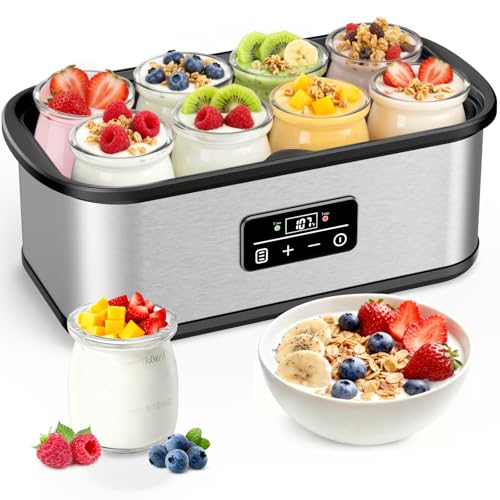
Digital Yogurt Maker, 8 Jars pairs a wide 68°F–127°F setting range with eight individual 6-ounce glass jars, making it a flexible option for households portioning batches. The timer runs up to 48 hours, and the maker says it has automatic shutoff when the cycle ends. A clear top lid lets you see the jars during fermentation. This format suits cooks whose recipes call for different temperatures and who prefer single servings. Its total jar capacity is 48 ounces, so it is less suited to making a full gallon in one batch.
Bottom line: Choose it if you want broad temperature adjustment and individually portioned jars.
Ultimate Probiotic Yogurt Maker XL

Ultimate Probiotic Yogurt Maker XL stands apart for batch size: its two 2-quart containers hold a combined gallon, rather than a set of small jars. The maker says it can hold a steady temperature for up to 48 hours, which suits recipes requiring long fermentation cycles. The rectangular containers also let you divide one batch into two vessels. Choose this model when capacity is more important than individual jar portions. The temperature range is a key selection factor for culture-specific recipes, so confirm that the intended recipe’s target is supported before choosing this unit.
Bottom line: Pick it when a gallon-sized batch matters more than small individual jars.
ANZKTOS Yogurt Maker, 6 Jars

ANZKTOS Yogurt Maker, 6 Jars is the jar-format option with a probe precision of ±2°F, plus a six-jar set totaling 1 quart. Its adjustable range is 68°F–122°F and the timer can run for as long as 48 hours, making the settings relevant to recipes that call for lower temperatures or extended cycles. The maker says the probe helps hold temperature within its precision. This smaller batch size suits one or two people or occasional fermentation. It offers fewer jars and less total capacity than the eight-jar models.
Bottom line: Choose it for a small batch and a specified ±2°F probe tolerance.
HOPERAN Yogurt Maker, 8 Jars

HOPERAN Yogurt Maker, 8 Jars has the highest upper temperature limit among the products with ranges, reaching 131°F, and includes eight 6-ounce glass jars. Its controls allow up to 48 hours of run time, and the maker says the unit shuts off automatically. The maker describes the jars as BPA-free and dishwasher-safe. This is a fit for cooks who want individual portions and a higher available setpoint than the other jar models with known ranges. Its 48-ounce total jar capacity is smaller than the gallon-sized container setup in Ultimate Probiotic Yogurt Maker XL.
Bottom line: Pick it for eight portions and an adjustable range reaching 131°F.
Euro Cuisine YM260

Euro Cuisine YM260 uses one 2-quart glass jar rather than several portion-size jars, with a temperature range of 78°F–132°F. The included thermometer and cotton strainer bag support temperature checking and straining after fermentation. Its larger single vessel suits cooks who want to portion yogurt after making it or prepare strained yogurt. The available temperature range begins 10°F higher than the lowest range among the other models, so it may not suit recipes requiring a lower setpoint. Check the recipe’s fermentation temperature against that 78°F minimum.
Bottom line: Choose it if you prefer one 2-quart jar and want the included strainer bag.
How to Choose a Yogurt Maker Temperature Range
For standard thermophilic yogurt, a target near 110°F is common, with many recipes using roughly 105°F to 115°F. The culture and recipe determine the exact setting, so compare that target with the appliance’s adjustable range rather than assuming every yogurt uses the same temperature. Mesophilic cultures ferment at cooler room temperatures and generally do not need the same warm incubation; confirm the culture’s instructions before using a heated appliance. For a recipe targeting 110°F, a maker whose range includes that setpoint is a basic fit, but a wide range is useful only if your recipes call for it. Avoid selecting by the maximum temperature alone: a higher ceiling does not establish that a model can hold every lower target precisely.
Timer Length and Long Fermentation
A 24-hour or longer fermentation is not unusual for some culture recipes, and the products here with maximums reach 48 hours. Long runtime is useful only when the temperature matches the recipe; time cannot compensate for an unsuitable setpoint. A practical rule is to choose a timer that exceeds the recipe’s fermentation time by at least an hour, so the device can complete the cycle without needing a restart. Extended fermentation can make yogurt more tart and change its texture as acidity increases. Use a recipe designed for the particular culture rather than extending a standard recipe by guesswork, and refrigerate finished yogurt promptly. Timer features describe appliance operation, not a guarantee of a particular taste or culture outcome.
Jar and Container Capacity Compared
Container layout affects portioning more than fermentation: jars make individual servings, while one or two larger vessels keep the batch together. The table compares the formats and capacities supplied with these makers; a container capacity is not necessarily the amount you should fill to the rim. Leave room for handling and check that the recipe’s batch volume fits the vessel setup.
| Need | Container format | Capacity |
|---|---|---|
| Small portions | Six 6-oz jars | 1 quart |
| More portions | Eight 6-oz jars | 48 ounces |
| Large batch | Two 2-quart containers | 1 gallon |
| Single vessel | One 2-quart glass jar | 2 quarts |
For example, choose a setup with at least the volume of your planned recipe and select jars if you want portions ready to chill separately. A one-vessel batch may be easier to strain, but it requires portioning after fermentation.
Safe Fermentation and Common Temperature Mistakes
Keep the milk preparation and incubation stages distinct: many home recipes heat milk to about 180°F, then cool it to roughly 110°F before adding a conventional starter. Adding culture while milk is too hot can damage the live culture; use a food thermometer rather than judging by touch. During incubation, keep the appliance on a stable, dry surface and avoid moving the jars, since sloshing can disrupt setting. Once fermentation is complete, refrigerate yogurt at 40°F or below. Do not treat a long timer or a precise display as proof that food was handled safely; clean utensils and containers and sound milk handling still matter.
Frequently Asked Questions
What temperature is best for making regular yogurt?
Many conventional thermophilic yogurt recipes incubate near 110°F, commonly within about 105°F to 115°F. Use the culture recipe’s target when setting a temperature-controlled maker.
Can I make yogurt at a lower temperature?
Yes, if the chosen culture and recipe call for a lower temperature; some cultures ferment at room temperature rather than the warm range used for conventional yogurt. Make sure the maker can set the recipe’s target, since a 78°F minimum will not reach every lower setting.
How long can yogurt ferment in a maker?
Many recipes use several hours, while some long-ferment recipes specify 24 to 36 hours. Select a timer that can run at least as long as the recipe requires, and expect extended fermentation to change tartness and texture.
Why did my homemade yogurt turn runny?
Common causes include an unsuitable incubation temperature, a weak or inactive starter, or moving the batch before it sets. For a conventional recipe, verify the milk is cooled to around 110°F before adding starter and keep the vessels still during fermentation.
How should homemade yogurt be stored?
Refrigerate finished yogurt at 40°F or below and use clean, covered containers. Chill it promptly after fermentation rather than leaving it warm while portioning or straining.