
No More Nails Adhesive: Tubes and Cartridges Compared

For indoor mounting with a solvent-free formula, UniBond No More Nails Original 234 g is the clearest match; its 234 g tube is intended for household DIY and repair. Choose UniBond No More Nails Cartridge 365 g instead if you prefer a 365 g cartridge, while Kraken Bond Clear Polyurethane Adhesive, 12 Pack is a different polyurethane formula for indoor and outdoor use.
Mounting adhesive bonds surfaces without nails or screws, but the right choice depends on the materials, exposure and package format.
We earn a commission if you buy through links on this page. As an Amazon Associate I earn from qualifying purchases. Products are compared on manufacturer specifications, not hands-on testing.
- Best overall: UniBond No More Nails Original 234 g – A 234 g solvent-free tube for interior mounting and repair.
- Best for cartridge format: UniBond No More Nails Cartridge 365 g – A 365 g cartridge with the same interior purpose as the tube.
- Best for indoor and outdoor use: Kraken Bond Clear Polyurethane Adhesive, 12 Pack – A polyurethane adhesive described for indoor and outdoor projects.
| Product | Best for | Format | Package amount | Intended use | Shop |
|---|---|---|---|---|---|
| UniBond No More Nails Original 234 g | Interior mounting | Tube | 8.3 oz | Interior use | Check Price on Amazon |
| UniBond No More Nails Cartridge 365 g | Cartridge application | Cartridge | 12.9 oz | Interior use | Check Price on Amazon |
| Kraken Bond Clear Polyurethane Adhesive, 12 Pack | Outdoor projects | 12-pack | 12 × 10.1 fl oz | Indoor and outdoor | Check Price on Amazon |
| Visbella Nail Free Glue, 3-Pack | Precision dispensing | 3 pieces | 3 × 4.4 oz | Indoor and outdoor | Check Price on Amazon |
No More Nails adhesive options
Compare the adhesive type, package format and stated use before choosing a formula for your project.
UniBond No More Nails Original 234 g

For a familiar interior mounting format, this UniBond formula comes in a 234 g tube rather than a cartridge. The maker describes it as solvent-free and intended for heavy-duty DIY and repair, with use on wood, ceramic, metal, concrete, brick, plaster and stone; plastic is also mentioned with an asterisk, so check compatibility for the specific plastic before use. The maker also names skirting boards, coving, window ledges and coat hooks as examples. Its indoor-use focus makes it a poor choice for a project exposed to outdoor weather.
Bottom line: Choose this for indoor household mounting when a tube and solvent-free formula suit the job.
UniBond No More Nails Cartridge 365 g
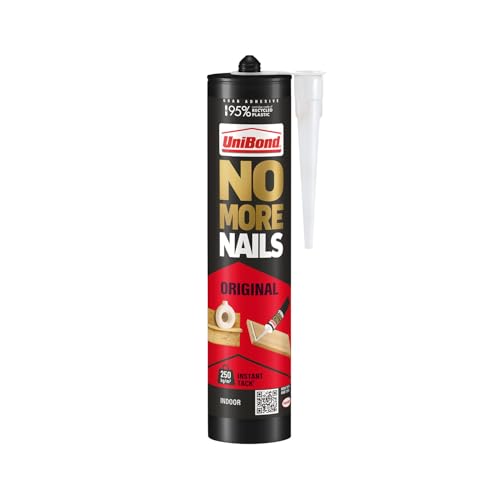
The cartridge format sets this option apart from the smaller tube: it contains 365 g and is described for interior mounting and repairs. The maker calls it solvent-free and names wood, concrete, plaster, brick, stone, metal, ceramic and plastic among the materials it can bond; check the specific plastic type before committing to a joint. Suggested household uses include skirting boards, polystyrene mouldings, window ledges and coat hooks. This is not the choice for work requiring an outdoor-rated adhesive, since its purpose is indoor use.
Bottom line: Pick this when you want the larger cartridge format for interior mounting.
Kraken Bond Clear Polyurethane Adhesive, 12 Pack

Unlike the UniBond options, this is a clear polyurethane construction adhesive sold as a 12-pack of 10.1 fl oz units. The maker describes it as waterproof and suitable for indoor and outdoor use, including applications on wood, concrete, metal, ceramic, marble, granite, rubber and other materials. That broader weather-use claim may fit exterior projects better than an interior-only formula, but the pack is a substantial quantity for a one-off repair. Check substrate compatibility and whether the product suits the exact joint before applying it.
Bottom line: Choose this for projects needing a polyurethane formula and indoor/outdoor use.
Visbella Nail Free Glue, 3-Pack

A precision nozzle distinguishes this three-piece nail-free glue set from the tube and cartridge formats. Each unit is 4.4 oz, and the maker describes the adhesive as suitable for indoor and outdoor projects on wood, metal, ceramic and plastic, with examples such as hooks, frames, shelves and decorative items. The maker also says it sets quickly, but gives no timing in the specifications, so do not plan a load-bearing installation around an assumed set time. Its smaller units may suit several modest jobs better than a single large application.
Bottom line: Pick this for controlled dispensing across smaller mounting jobs.
How to choose a mounting adhesive
Choose by the surface materials, exposure and format before comparing package sizes. A solvent-free interior adhesive is suited to indoor mounting, while a polyurethane construction adhesive may be an option for projects needing indoor and outdoor use; verify the specific product’s compatibility with each surface. Adhesives bond best when surfaces are sound and free of dust, oil and loose paint, so clean and dry the joint unless the product directions say otherwise. A practical decision rule is to use an indoor-only formula only where the joint will remain indoors; choose an outdoor-suitable product for weather exposure. For heavy or overhead objects, support the work mechanically while the adhesive cures rather than relying on an immediate grab.
Tube, cartridge and multi-pack formats
Choose the package format by the amount of adhesive and the way you need to dispense it. A tube is a compact format for smaller jobs; a cartridge is designed for a compatible applicator gun and can make longer beads easier to lay consistently. Multi-packs make sense when the same type of adhesive will be used on several projects, but they leave more product to store after opening. For a neat bond, apply a controlled bead rather than flooding the joint, then press the surfaces together as the maker directs. Keep the nozzle clear between uses and close the container promptly; dried adhesive at the opening can obstruct later application.
Surface fit and load support
Surface compatibility is more important than a broad label such as “multi-surface.” Smooth, nonporous materials such as metal or glazed ceramic may need a different preparation or formula than porous plaster, brick or wood, and plastic types can behave differently from one another. Test fit and bond suitability on a small, inconspicuous area when the surface finish matters. Adhesive mounting also depends on contact: uneven walls, gaps and dusty paint reduce the area that can bond. Do not treat “instant grab” as permission to hang a heavy or overhead object immediately; support the item until the product’s specified cure period has passed, and use mechanical fasteners where the load or consequences of failure demand them.
Application and curing mistakes to avoid
Most mounting failures begin with poor preparation, insufficient contact or loading the joint too soon. Remove dust, grease and loose material, and make sure the surfaces meet without rocking; a bead cannot compensate for a weak or crumbling substrate. Follow the package’s directions for bead placement, pressing and cure time because formulas differ, and avoid moving the item during that period. Ventilate the work area and keep adhesive away from skin and eyes; polyurethane products can require additional handling precautions, so read their safety directions before use. Store unused adhesive sealed and within the temperature range on its container to limit premature drying or damage.
Frequently Asked Questions
How long should mounting adhesive cure before loading it?
Use the cure time printed for the specific formula; many construction adhesives need about 24 to 48 hours for a full cure, and cool or humid conditions can extend that time. Support the item in place until the period has passed.
Can mounting adhesive stick to painted walls?
It can bond to sound, firmly adhered paint, but it cannot make peeling paint or weak drywall paper stronger. Remove loose coating and test an inconspicuous spot, since removal may damage the paint or wall surface.
Does a solvent-free adhesive work outdoors?
Solvent-free describes the formula, not its weather rating. Use an adhesive specifically intended for outdoor exposure; the UniBond options here are described for interior use, while the polyurethane option is described for indoor and outdoor projects.
Do I need a caulking gun for adhesive cartridges?
A cartridge format is generally used with a compatible caulking gun, unlike a squeeze tube. Check that the gun fits the cartridge before starting, and cut the nozzle opening small enough to control the bead.
Can mounting adhesive hold a heavy shelf by itself?
Do not assume adhesive alone can safely carry a heavy shelf, particularly overhead or on a weak wall surface. Use fasteners into suitable structural material when the load is substantial, and support the shelf while adhesive cures.