
Gravel Grader for ATV: 4 Drag Harrows Compared

For most ATV owners, VEVOR 48-inch Drag Harrow is the straightforward choice because its 48-inch frame and 50-pound load capacity suit routine gravel grading without the larger footprint of a wider model. Choose VEVOR 6-foot Drag Harrow instead if you want a 6-foot-long frame and 80-pound capacity; choose Garvee 8-foot Drag Harrow or 4-foot Drag Harrow with 5-foot Chain if their design or included towing parts better match your setup.
A drag harrow is a tow-behind frame that breaks up and spreads loose surface material as it is pulled across it. Confirm the hitch connection and tow-vehicle limits before grading.
We earn a commission if you buy through links on this page. As an Amazon Associate I earn from qualifying purchases. Products are compared on manufacturer specifications, not hands-on testing.
- Best overall: VEVOR 48-inch Drag Harrow – Its 48-inch frame and 50-pound added-weight capacity make it a practical match for routine driveway passes.
- Best for added weight: VEVOR 6-foot Drag Harrow – Its 80-pound load capacity is the highest among these drag harrows.
- Best for adjustable towing: Garvee 8-foot Drag Harrow – Its features specify a 6-foot adjustable chain and a 4-foot working width.
| Product | Best for | Frame length | Width | Added-weight capacity | Shop |
|---|---|---|---|---|---|
| VEVOR 48-inch Drag Harrow | Routine driveway grading | 48.03 in | 19.69 in | 50 lb | Check Price on Amazon |
| VEVOR 6-foot Drag Harrow | Higher weight capacity | 72.44 in | 19.49 in | 80 lb | Check Price on Amazon |
| Garvee 8-foot Drag Harrow | Adjustable chain setup | 95.67 in | 19.69 in | 50 lb | Check Price on Amazon |
| 4-foot Drag Harrow with 5-foot Chain | Included towing parts | — | 4 ft | — | Check Price on Amazon |
Gravel Graders for ATV Use
Compare frame dimensions, working width and stated weight capacity to find a drag harrow that fits your grading needs.
VEVOR 48-inch Drag Harrow

At 48 inches long with a 50-pound load capacity, VEVOR 48-inch Drag Harrow is a compact drag harrow for gravel driveways and smaller grading areas. Its chain-drawn design and steel frame are intended to keep the rake grounded, and the manufacturer says added weight can increase downforce. The frame measures 19.69 inches wide. Choose it when a shorter frame is easier to maneuver than a longer grader; its 50-pound capacity is lower than VEVOR 6-foot Drag Harrow’s, so it is not the pick for buyers who need the highest added-weight limit.
Bottom line: Choose this for a shorter frame and a 50-pound added-weight limit.
VEVOR 6-foot Drag Harrow

VEVOR 6-foot Drag Harrow has the highest added-weight capacity here at 80 pounds, and its 72.44-inch length gives it a longer frame than VEVOR 48-inch Drag Harrow. It uses a chain-drawn steel frame, and the manufacturer says extra weight can improve downforce while grading ruts and uneven areas. The 19.49-inch dimension is its width. Its longer frame and 115.3-pound product weight are worth considering if storage space or tight turns matter; choose it for the higher load capacity rather than assuming the longer frame means a wider working path.
Bottom line: Pick this when its 80-pound capacity matters more than a shorter frame.
Garvee 8-foot Drag Harrow

Garvee 8-foot Drag Harrow stands out for its 6-foot adjustable chain and green powder-coated steel frame. Its features give a 4-foot working width and capacity for up to 50 pounds of added weight, while the product name identifies it as an 8-foot drag harrow. The dimensions are 95.67 inches long by 19.69 inches wide. The manufacturer says the coating resists rust. This is a fit for buyers prioritizing an adjustable towing chain; note the 4-foot working width when planning coverage, rather than treating the 8-foot name as the grading width.
Bottom line: Choose this if the adjustable 6-foot chain and 4-foot working width fit your setup.
4-foot Drag Harrow with 5-foot Chain
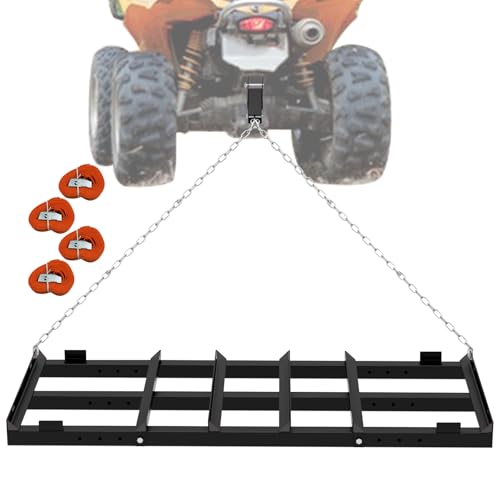
4-foot Drag Harrow with 5-foot Chain is the only option whose components include four safety belts and two adjustable bars, alongside a 5-foot chain. Its grading width is 4 feet, and its carbon-steel frame has a black powder-coated finish; the chain and connecting rings are galvanized. The manufacturer presents it for gravel, sand, lawn, soil and hay.
Bottom line: Pick this when the included belts, adjustable bars and 5-foot chain suit your towing arrangement.
How to choose an ATV gravel grader
Match the grader’s working width and weight capacity to the area and surface you need to maintain. A wider pass can cover more ground, but a larger frame may be harder to turn or store; for a narrow driveway or frequent tight turns, favor a shorter frame over maximum coverage. Added weight presses a drag harrow into the surface, but use only the capacity the manufacturer gives and secure any added load so it cannot shift. A drag harrow smooths loose gravel; it is not the same as a box scraper, which contains material with side plates. For regular driveway maintenance, begin with lighter passes and reassess the surface before adding weight or making deeper cuts.
Working width and frame dimensions
Working width determines how much of the driveway a pass can cover, while frame length and overall dimensions affect turning and storage. These measurements are not interchangeable: a model described as 8 feet may specify a 4-foot working width, so use the working-width figure when estimating coverage. Measure the narrowest gate, turn and storage space before choosing a long frame. Typical private driveways vary widely, so there is no universal grader width that fits every ATV route. Compare the working width with the width you can safely tow, and leave room to turn without dragging the frame into obstacles. Product dimension labels can describe different parts; resolve any ambiguity before purchase.
| Need | Choose based on |
|---|---|
| More added weight | Stated load capacity |
| More coverage per pass | Working width, not name alone |
| Tighter turning or storage | Shorter frame dimensions |
ATV towing and grading safety
Keep the tow load within the ATV manufacturer’s towing limit, which can differ by vehicle, terrain and hitch setup. A drag harrow is a towed implement, not a passenger attachment; keep people clear of the chain, frame and added weights while moving. Use a hitch connection intended for towing and make sure the chain cannot contact tires or other moving parts through a turn. Start at a low speed on level ground, then inspect whether gravel is being spread evenly before continuing. Avoid steep slopes and abrupt turns, which can destabilize a tow vehicle or shift unsecured weight. Stop before adjusting the chain or load.
Preparing a gravel driveway for grading
Drag harrows work on loose surface material, so remove large debris and fill major potholes before smoothing the surrounding gravel. Grade when the surface is not deeply saturated or extremely dry and hard; wet gravel can clump, while very dry material can be dusty and resist leveling. Make overlapping passes at a steady pace, then inspect the crown and drainage rather than dragging material to the driveway edges. A driveway needs water to shed away from its center; flattening the crown can encourage standing water and erosion. If rut depth or drainage problems exceed what a light surface drag can correct, a harrow alone may not restore the base.
Frequently Asked Questions
How wide should an ATV gravel grader be?
Choose by the working width you can tow through the narrowest part of your route, not by a model name alone. A 4-foot working width covers a narrower path than a wider implement but can be easier to place on confined driveways.
Can an ATV pull a weighted drag harrow?
An ATV can tow a drag harrow only when the implement and added load stay within the ATV maker’s towing limits. Capacity limits on a grader describe its permitted added weight, not the tow rating of the ATV.
How much weight should I add to a drag harrow?
Stay at or below the grader’s capacity and add weight only if the surface is not smoothing with the unweighted frame. The models here with limits allow 50 or 80 pounds; secure the load so it cannot shift during turns.
Should gravel be wet before grading?
Gravel should be workable rather than deeply saturated or very dry and hard. Saturated gravel can clump under a drag, while dry gravel may be dusty and resist leveling.
How do I keep a gravel driveway from washing out?
Preserve a slight crown so water drains toward the sides instead of collecting in the center. A surface drag can redistribute loose gravel, but it will not by itself correct a failed base or severe drainage problem.