
Sewing Machines for Shoes: 4 Models Compared

For shoe repairs that need adjustable needle spacing and a foot that turns to follow the seam, choose DODOQ Manual Shoe Sewing Machine. A cobbler-style patcher guides footwear beneath its needle; choose ColouredPeas 10-Bearing Hand Patcher instead if its 0.48-inch maximum thickness is the deciding factor.
We earn a commission if you buy through links on this page. As an Amazon Associate I earn from qualifying purchases. Products are compared on manufacturer specifications, not hands-on testing.
- Best overall: DODOQ Manual Shoe Sewing Machine – Adjustable needle spacing up to 6 mm and a foot that turns for sewing in different directions.
- Best for thicker work: ColouredPeas 10-Bearing Hand Patcher – The maker gives a maximum sewing thickness of 0.48 inches.
- Best for manual control: Manual Leather Cobbler Machine – Manual drive lets the operator pause and control the sewing pace.
| Product | Best for | Drive | Maximum thickness | Shop |
|---|---|---|---|---|
| DODOQ Manual Shoe Sewing Machine | Flexible stitch direction | Manual | — | Check Price on Amazon |
| ColouredPeas 10-Bearing Hand Patcher | Thicker materials | Hand-operated; motor-compatible | 0.48 in | Check Price on Amazon |
| ColouredPeas 110V Cobbler Machine Set | Motor-assisted setup | Manual with 110V, 250W motor | 0.48 in | Check Price on Amazon |
| Manual Leather Cobbler Machine | Simple manual repairs | Manual | — | Check Price on Amazon |
Sewing Machines for Shoes Compared
Compare the drive style and stated sewing limits before matching a machine to the seam and material.
DODOQ Manual Shoe Sewing Machine

DODOQ Manual Shoe Sewing Machine stands out for adjustable needle spacing and a foot that turns, which can help when a shoe seam changes direction. The machine works with cotton or nylon line and is intended for footwear as well as bags, clothing and other leather goods. Choose it when stitch spacing and maneuverability are more important than a published thickness limit. Its fit for a particular repair still depends on reaching the seam with the machine’s working area, so check the shoe’s shape and access before committing.
Bottom line: Choose this when adjustable spacing and turning the work are priorities.
ColouredPeas 10-Bearing Hand Patcher

ColouredPeas 10-Bearing Hand Patcher is the choice here with a maximum sewing thickness: 0.48 inches. Its hand-operated design has 10 switchable axes, and the maker says its revised spindle shape is intended to reduce friction and jamming. It can also be matched with a motor to improve efficiency. The hand-finished machine may show hammer marks, so its surface may not look as uniform as a molded machine. Choose it when the thickness limit matters; check seam access separately because material capacity does not guarantee the machine can reach every part of a shoe.
Bottom line: Choose this when the 0.48-inch maximum is the deciding specification.
ColouredPeas 110V Cobbler Machine Set

ColouredPeas 110V Cobbler Machine Set pairs a manual cobbler machine with a 110V, 250W motor and stainless-steel base. The maker cautions that the electric mode provides only a little power and that thick leather may still require manual operation. Its maximum sewing thickness is 0.48 inches, making it similar to ColouredPeas 10-Bearing Hand Patcher on that measure, but its motor-assisted setup is the distinction. Choose it if you want the motor included while retaining manual operation. Do not treat the motor as a substitute for hand control on thick leather.
Bottom line: Choose this if you want an included motor for lighter sewing while keeping manual control.
Manual Leather Cobbler Machine
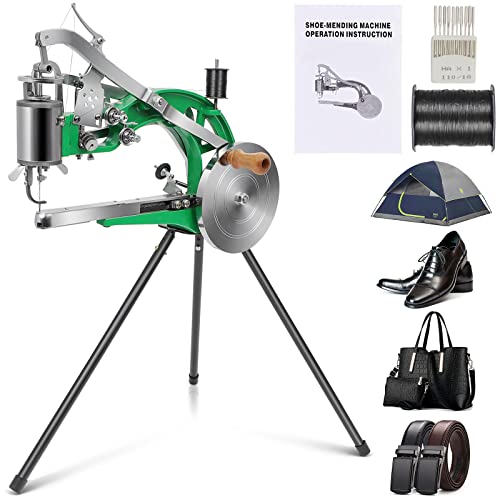
Manual Leather Cobbler Machine uses manual drive and an aluminum-alloy construction, with cotton or nylon line for sewing shoes, clothing, zippers and tents. Manual operation allows the operator to pause and control the drive, which suits repairs where careful positioning matters more than powered feeding. The maker does not give a maximum thickness or adjustable spacing, so this is a less defined match for unusually thick work or a precise stitch-width requirement. Choose it for general hand-driven repair tasks when those limits are not central to the job.
Bottom line: Choose this for general repairs where manual control is more important than a thickness limit.
How to Choose a Shoe Sewing Machine
Start with seam access, material thickness and drive style; a machine that cannot reach the seam is the wrong fit regardless of its power. Cobbler-style patchers are built to handle footwear and other awkwardly shaped work, but shoe openings, heels and soles can block the needle path. Measure the thickest part of the seam, including folded material, and compare it with a maximum. A 0.48-inch limit is about 12.2 mm; do not assume a machine without a published limit accepts that thickness. For stitch spacing, distinguish adjustable spacing from a fixed stitch length, and confirm the machine supports the thread you plan to use.
Manual and Motor-Assisted Shoe Machines
Manual drive gives direct control over starting, stopping and stitch placement, while motor assistance can reduce effort on suitable materials. The motor included with ColouredPeas 110V Cobbler Machine Set is described by its maker as providing only a little power, and thick leather may still need manual operation. That makes motor presence a poor shortcut for estimating capacity. Machine speed is also not the same as usable control around a curved toe or heel; slowing down helps maintain placement. Choose manual-only operation when exact positioning is the priority, and treat a small motor as assistance rather than evidence of industrial power. For substantial leather stacks, let the thickness limit—not the motor label—decide.
Measure Shoe Seam Access Before Buying
Measure the repair location as well as the material stack: throat clearance, arm reach and shoe shape determine whether the needle can arrive at the seam. A straight strip of leather may fit beneath a machine while the same thickness inside a heel does not. Mark the seam’s path and consider whether the workpiece can rotate; DODOQ Manual Shoe Sewing Machine specifically has a foot that turns and adjustable needle spacing up to 6 mm. Cotton and nylon line are both supported on DODOQ Manual Shoe Sewing Machine and Manual Leather Cobbler Machine, but thread choice should also match the material and seam’s intended use. A frequent mistake is choosing by thickness alone and overlooking how the shoe must be positioned.
Compare Shoe Sewing Machine Types
Use the drive and capacity together: a hand-operated patcher favors direct pace control, while a motor-assisted set adds powered help without necessarily removing manual work. The 0.48-inch limit applies to ColouredPeas 10-Bearing Hand Patcher and ColouredPeas 110V Cobbler Machine Set, not automatically to every shoe machine. A machine with no supplied thickness figure needs confirmation if the repair approaches that limit. The table separates documented capacity from drive style so buyers can identify where a known limit exists; a dash means the specifications give no value for that comparison.
| Need | Compare | Choice cue |
|---|---|---|
| Adjustable spacing | Up to 6 mm | DODOQ Manual Shoe Sewing Machine |
| Known thickness limit | 0.48 in | ColouredPeas 10-Bearing Hand Patcher or ColouredPeas 110V Cobbler Machine Set |
| Manual drive | Hand-operated | DODOQ Manual Shoe Sewing Machine, ColouredPeas 10-Bearing Hand Patcher or Manual Leather Cobbler Machine |
| Motor included | 110V, 250W; maker says limited power | ColouredPeas 110V Cobbler Machine Set |
Frequently Asked Questions
How thick can a shoe sewing machine sew?
The maximum varies by machine and material; ColouredPeas 10-Bearing Hand Patcher and ColouredPeas 110V Cobbler Machine Set give a limit of 0.48 inches, or about 12.2 mm. Measure the compressed stack at the seam, since folded edges can be thicker than the surrounding material.
Can a shoe sewing machine sew around a heel?
It can only sew a heel seam if the machine’s arm and throat can reach it and the shoe can be positioned under the needle. Check access at the exact repair point before buying; turning ability helps with direction but does not guarantee clearance.
Should I use nylon or cotton thread for shoe repairs?
Both nylon and cotton line are supported by DODOQ Manual Shoe Sewing Machine and Manual Leather Cobbler Machine. Match thread to the material and the seam’s demands, and test the tension and stitch on a similar scrap before sewing the shoe.
Does a motor make a cobbler machine fully automatic?
No; a motor does not guarantee powered sewing through every material. The maker of ColouredPeas 110V Cobbler Machine Set says its 110V, 250W motor provides only a little power and thick leather may still need manual operation.
What should I measure before buying a shoe patcher?
Measure the material stack at its thickest point and the space needed to reach the repair seam. For example, compare a stack near 0.48 inches with the explicit limit on ColouredPeas 10-Bearing Hand Patcher or ColouredPeas 110V Cobbler Machine Set, then check whether the shoe can fit around the machine’s arm.