
Hoover Linx Cordless Battery: 4 Replacements Compared

For a Hoover Linx cordless vacuum, Zpubnor 5.5Ah 18V Replacement is the capacity pick, with 5.5Ah and compatibility claims covering several BH50000-family models. The products here are replacement batteries, not Hoover-branded batteries.
Choose a lower-capacity option if its model compatibility better matches your vacuum or you prefer a replacement with a matching charger claim; confirm your vacuum’s model number before ordering.
We earn a commission if you buy through links on this page. As an Amazon Associate I earn from qualifying purchases. Products are compared on manufacturer specifications, not hands-on testing.
- Best overall: Zpubnor 5.5Ah 18V Replacement – The 5.5Ah rating is the largest capacity among these 18V replacements.
- Best for charger match: JYJZPB 4.0Ah 18V Replacement – It explicitly names compatibility with Hoover charger BH50005/302736001.
- Best for 3.0Ah capacity: CaliHutt 3.0Ah 18V Replacement – Its 3.0Ah rating is the lowest capacity among these options.
| Product | Best for | Capacity | Compatible models | Shop |
|---|---|---|---|---|
| Zpubnor 5.5Ah 18V Replacement | Higher capacity | 5.5Ah | BH50000, BH50010, BH50015, BH50020 | Check Price on Amazon |
| JYJZPB 4.0Ah 18V Replacement | Charger compatibility | 4.0Ah | BH50000, BH50010, BH50015, BH50020, BH50020PC | Check Price on Amazon |
| TenHutt 4.0Ah 18V Replacement | Recharge-cycle claim | 4.0Ah | BH50000, BH50010, BH50015, BH50020 | Check Price on Amazon |
| CaliHutt 3.0Ah 18V Replacement | Lower capacity | 3.0Ah | BH50000, BH50010, BH50015, BH50020 | Check Price on Amazon |
Hoover Linx cordless battery replacements
Compare capacity and the vacuum models and charger each replacement says it fits before choosing.
Zpubnor 5.5Ah 18V Replacement
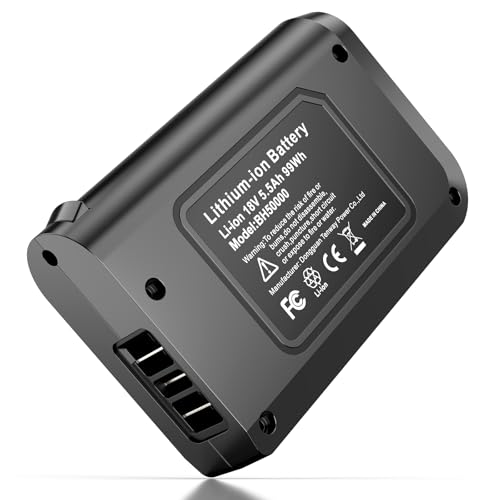
At 5.5Ah, this is the highest-capacity option here, for buyers prioritizing capacity over a smaller rating. It is an 18V replacement for Hoover Linx models BH50000, BH50010, BH50020 and BH50015. The maker claims up to twice the runtime of Hoover’s 2.0Ah LiNX battery; actual runtime depends on vacuum condition and cleaning conditions. Its features describe safeguards for overcharging, overheating, short circuits and overcurrent.
Bottom line: Choose this if the Hoover model matches and the highest capacity matters most.
JYJZPB 4.0Ah 18V Replacement

Unlike the other options, this replacement explicitly names compatibility with Hoover charger BH50005/302736001, which matters if you want to keep using that charger. Its 4.0Ah, 18V battery is listed for BH50000/302723001 and vacuum models BH50010, BH50015, BH50020 and BH50020PC. The maker claims twice the runtime of the original 2.0Ah battery. The trade-off is capacity: it is below the 5.5Ah option, so buyers focused on the largest capacity may prefer Zpubnor 5.5Ah 18V Replacement.
Bottom line: Choose this if your vacuum model and BH50005/302736001 charger match.
TenHutt 4.0Ah 18V Replacement

This 4.0Ah replacement stands out for its cycle-life and low-self-discharge claims rather than a higher capacity than JYJZPB 4.0Ah 18V Replacement. It is listed for 18V Hoover Linx battery model BH50000/302723001 and vacuum models BH50010, BH50015 and BH50020. The maker claims up to 1,000 recharge cycles and a 1% self-discharge rate. Those figures are manufacturer claims, not a guarantee of service life.
Bottom line: Choose this if its model fit works and the maker’s cycle-life claims matter to you.
CaliHutt 3.0Ah 18V Replacement

At 3.0Ah, this is the lowest-capacity option in the group, making it a fit for buyers who do not need the largest rating. It is an 18V lithium-ion replacement listed for Hoover Linx models BH50010 and BH50020, with broader compatibility claims also naming BH50000/302723001 and BH50015. The maker claims three times the runtime of the original battery and half the weight, but gives no weight figure here to compare directly. Its limitation is the lower capacity, which may not suit buyers seeking the maximum capacity listed.
Bottom line: Choose this if the 3.0Ah rating and listed model fit suit your needs.
How to choose a Hoover Linx cordless battery
Start with the vacuum’s model number and battery voltage, then compare capacity and charger fit. These options are all 18V replacements, but capacity ranges from 3.0Ah to 5.5Ah; amp-hours measure charge capacity, not a guaranteed runtime. A larger Ah rating can support longer use between charges under comparable conditions, while vacuum condition, floor type and power use also affect runtime. Check the model label on the vacuum or battery against the replacement’s compatibility list. If the vacuum uses charger BH50005/302736001, choose an option that explicitly names that charger or confirm compatibility before ordering.
This table summarizes the key choice by buyer need.
| Need | What to compare |
|---|---|
| Known vacuum fit | Match the exact model number |
| More rated capacity | Compare Ah values |
| Keep current charger | Match its model number |
What battery capacity means for runtime
A battery’s amp-hour rating measures stored charge capacity, not a fixed number of cleaning minutes. Among these options, 3.0Ah, 4.0Ah and 5.5Ah provide distinct capacity ratings at the same 18V, so capacity is a useful comparison when model and charger fit are already confirmed. Actual runtime can change with battery age, suction load, flooring and cleaning habits; maker runtime multipliers are claims rather than guaranteed results. For a practical decision, if a current battery’s runtime is inadequate and the model fits, consider a higher Ah rating, while keeping the physical and electrical compatibility requirements unchanged. Do not assume that a higher Ah battery charges faster; charger output and battery design determine charging time.
Check model and charger compatibility
Matching the battery’s voltage alone is not enough: verify the exact vacuum model and battery interface before replacing it. The replacements name Hoover Linx models in the BH50000, BH50010, BH50015 and BH50020 families, but individual lists vary. A battery may also fit the vacuum while the charger match remains a separate question. If keeping an existing charger is important, compare its model code with the replacement’s named charger compatibility; only JYJZPB 4.0Ah 18V Replacement explicitly names BH50005/302736001. Keep the battery contacts clean and dry, and stop using a pack that is swollen, cracked, unusually hot or leaking. Lithium-ion packs should be charged with a compatible charger, away from heat and combustible clutter.
Care and storage for lithium-ion vacuum batteries
Lithium-ion batteries lose capacity with age and heat, so cool, dry storage helps protect service life. Avoid leaving a battery in a hot car or beside a heater, and do not store or charge a visibly damaged pack. For storage lasting months, a partially charged battery is generally preferable to leaving it fully depleted; check the maker’s guidance for the particular pack. Keep terminals free of metal objects that could bridge the contacts, and carry or store the battery so it cannot short against keys or tools. If a pack becomes damaged, hot, or swollen, discontinue use and follow local battery recycling or hazardous-waste rules rather than putting it in household trash.
Frequently Asked Questions
Can I use a 5.5Ah battery in a Hoover Linx vacuum?
A higher Ah rating can be suitable if the replacement is designed for the exact vacuum model and has the correct voltage and physical interface. The 5.5Ah option names several BH50000-family models, so match your model code before choosing it.
Does a higher Ah battery charge more slowly?
Not necessarily; charge time depends on the charger’s output and the battery’s charging design as well as capacity. Use a charger confirmed compatible with the battery rather than judging fit by its Ah rating.
How should I store a lithium-ion vacuum battery?
Store it in a cool, dry place away from heaters and direct heat. For storage lasting months, avoid leaving the pack completely depleted, and do not store a swollen or damaged battery.
What should I do if a battery gets unusually hot?
Stop charging or using a battery that becomes unusually hot, swollen, cracked or leaking. Keep it away from combustible materials and follow local battery recycling or hazardous-waste guidance.