
Best Ultrasonic Glasses Cleaner: 5 Models Compared

Magnasonic 20-oz Ultrasonic Cleaner suits most people seeking an ultrasonic glasses cleaner because its five cleaning modes offer more cycle choices than the two-mode options. Choose another model if adjustable power or a larger tank is more important than multiple cleaning modes.
Ultrasonic glasses cleaners use high-frequency sound waves in liquid to loosen debris from small crevices. Before cleaning coated lenses, glued components or delicate frames, confirm that the eyewear maker or an optician considers ultrasonic cleaning safe.
We earn a commission if you buy through links on this page. As an Amazon Associate I earn from qualifying purchases. Products are compared on manufacturer specifications, not hands-on testing.
- Best overall: Magnasonic 20-oz Ultrasonic Cleaner – Five cleaning modes provide a wider choice of cycles than the two-mode alternatives.
- Best for adjustable power: onlikin 20-oz 45-kHz Cleaner – Three power levels let you select a cleaning intensity, alongside five preset durations.
- Best for larger tank capacity: VisiClean 800-ml Ultrasonic Cleaner – Its 800-milliliter tank is the largest capacity among these options.
| Product | Best for | Frequency | Tank capacity | Cleaning modes | Shop |
|---|---|---|---|---|---|
| Magnasonic 20-oz Ultrasonic Cleaner | Cycle variety | 42,000 Hz | 20 oz | 5 modes | Check Price on Amazon |
| onlikin 20-oz 45-kHz Cleaner | Power adjustment | 45,000 Hz | 20 oz | 3 power levels; 5 timers | Check Price on Amazon |
| VisiClean 800-ml Ultrasonic Cleaner | Larger capacity | 42,000 Hz | 27 oz | — | Check Price on Amazon |
| OSLTWI 350-ml Ultrasonic Cleaner | Two simple modes | 48,000 Hz | 350 ml | 2 modes | Check Price on Amazon |
| KUNPHY 400-ml Ultrasonic Cleaner | Quiet operation | 48,000 Hz | 13.5 oz | 2 modes | Check Price on Amazon |
Best ultrasonic glasses cleaners
Compare frequency, capacity and controls to find a cleaner that suits your eyewear and cleaning routine.
Magnasonic 20-oz Ultrasonic Cleaner

Five cleaning modes set this model apart for buyers who want more cycle choices than a simple quick-or-deep setting. Its 20-ounce stainless steel tank and 42,000-hertz ultrasonic waves are intended for eyeglasses as well as jewelry, watches and retainers. The maker says tap water is enough for its cleaning cycles, and the product does not remove tarnish. This is a useful pick for households cleaning several kinds of small items, but the specifications do not give interior tank dimensions, so confirm your frames fit before choosing it.
Bottom line: Choose this if you want five preset cleaning modes for eyeglasses and other small items.
onlikin 20-oz 45-kHz Cleaner
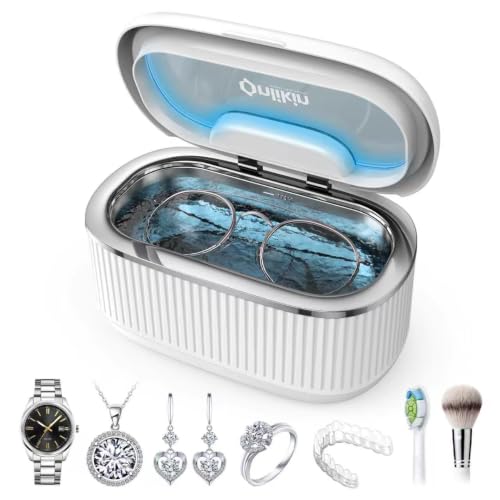
Three power levels distinguish this cleaner from the models with only fixed cleaning modes. It pairs 45,000-hertz ultrasonic operation with a 20-ounce tank and five preset durations from 90 to 480 seconds. Buyers who want a choice of intensity may prefer this option; those seeking a simple one-touch routine may find the extra selection less convenient. Check eyewear compatibility before cleaning coated lenses or delicate frame parts.
Bottom line: Pick this if adjustable cleaning intensity matters more to you than one-touch simplicity.
VisiClean 800-ml Ultrasonic Cleaner
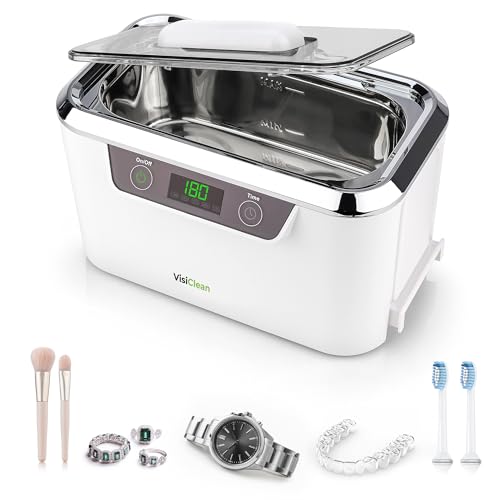
The 800-milliliter, or 27-ounce, stainless steel tank gives this model the greatest capacity in this group. VisiClean also specifies a 42,000-hertz frequency and dual ultrasonic transducers, and says users can clean with water or add a small amount of dish soap. Its larger capacity may suit buyers who want to clean eyewear alongside other small objects, but tank capacity alone does not establish whether a particular frame fits flat or remains clear of the tank walls. Verify eyewear compatibility and fit before use.
Bottom line: Choose this if the largest tank capacity is your priority.
OSLTWI 350-ml Ultrasonic Cleaner

This cleaner offers a straightforward choice between a 5-minute gentle cycle and a 7-minute intensive cycle. Its 350-milliliter tank is made from 304 stainless steel, and the maker says water alone powers cleaning. The 48-kilohertz frequency is higher than the other frequencies in this comparison, but frequency alone does not establish cleaning results or suitability for every pair of glasses. Its two preset cycles suit buyers who prefer fewer controls; the smaller stated capacity may be limiting if you want to clean larger items at the same time.
Bottom line: Pick this if two preset cycles and a compact-capacity tank suit your routine.
KUNPHY 400-ml Ultrasonic Cleaner

KUNPHY specifies operation below 45 decibels, making quiet operation its clearest distinction among these options. The 400-milliliter tank, 48,000-hertz waves and one-touch control are paired with 5-minute and 10-minute cycles. The maker says the cleaner is intended for glasses, retainers and jewelry. Buyers who want a longer deep-clean cycle may appreciate the 10-minute setting, while those wanting several intensity levels should consider a model with adjustable power. As with any ultrasonic cleaner, check that your lens coatings and frame components are suitable before use.
Bottom line: Choose this if quiet operation and a longer preset cycle fit your priorities.
How to choose an ultrasonic glasses cleaner
Choose by control options and tank capacity, not frequency alone. These cleaners span 42,000 to 48,000 hertz, but the figures do not establish which one cleans best; cycle choices, power settings and safe fit also matter. A 20-ounce or 27-ounce tank offers more stated capacity than a 350- or 400-milliliter tank, though capacity does not tell you the usable interior length or width. For glasses, compare the frame’s dimensions with the cleaner’s usable tank space and ensure the lenses and frame do not press against the sides. If you want to tune intensity, favor a model with power levels; if not, preset cycles simplify operation.
Eyewear fit and coating safety
Confirm that your eyewear is approved for ultrasonic cleaning before placing it in a tank. Anti-reflective coatings, special lens treatments, glued frame joints and some delicate frame materials can be vulnerable to cleaning methods that are safe for ordinary glass or metal. Ask the eyewear maker or an optician about your specific lenses and frame; do not assume that a cleaner’s glasses label guarantees compatibility with every pair. Frames also need enough room to sit fully in the liquid without touching the tank or basket. External cleaner dimensions are not the same as interior dimensions, so measure the frame and verify usable tank space before buying.
Ultrasonic cleaner cycles and cleaning solution
Ultrasonic cleaners create high-frequency pressure waves in liquid; the resulting tiny bubbles loosen debris from narrow spaces. The models here list frequencies from 42,000 to 48,000 hertz and cycle settings from 90 seconds to 10 minutes. A longer cycle is not automatically safer or better for treated lenses, so start only with a duration approved for your eyewear. Use water when the cleaner’s directions permit it, and avoid solvents, alcohol or household chemicals unless the eyewear maker and cleaner instructions both allow them. Do not run a cleaner dry: the liquid is part of the ultrasonic cleaning process and helps prevent damage to the unit.
Common mistakes when cleaning glasses
The main mistake is assuming every eyeglass lens can tolerate ultrasonic cleaning. A coating or bonded component can be damaged even when the frame fits, so get compatibility advice before the first cycle. Another mistake is choosing by tank capacity alone: a larger volume does not guarantee a wide enough tank for broad frames. Keep glasses from resting against the tank wall, use only an approved cleaning liquid, and remove the glasses when the cycle ends rather than running repeated cycles by default. Ultrasonic cleaning loosens dirt; it does not repair scratches, restore coatings or remove damage already present on a lens.
Frequently Asked Questions
Can ultrasonic cleaners damage eyeglass coatings?
Yes, some lens coatings or frame components may be unsuitable for ultrasonic cleaning. Confirm compatibility with the eyewear maker or an optician before using a cycle.
How long should glasses stay in an ultrasonic cleaner?
Use only a cycle approved for the specific eyewear; the models here offer settings ranging from 90 seconds to 10 minutes. A longer cycle is not automatically safer or more effective for coated lenses.
Can I use tap water in an ultrasonic glasses cleaner?
Some cleaner makers specify water-only use, while others permit a small amount of dish soap. Follow the guidance for your cleaner and eyewear, and avoid unapproved solvents or chemicals.
Do ultrasonic cleaners remove scratches from eyeglasses?
No, ultrasonic cleaning loosens dirt from surfaces and crevices; it does not repair scratches or restore damaged lens coatings. Scratched or peeling lenses need assessment by an optician.