
Best Solar Lights With On Off Switch: 5 Options Compared

UPONUN Solar Ceiling Light is the best match for most people seeking solar lights with an on/off switch because it explicitly includes a switch as well as a remote. Choose another option if you need outdoor motion security lighting, a streetlight format, or a pull-string control instead.
Solar lights use a panel to charge a battery for illumination after dark; controls vary from a physical switch to a remote or pull string, so match the operating method to where the light will be mounted.
We earn a commission if you buy through links on this page. As an Amazon Associate I earn from qualifying purchases. Products are compared on manufacturer specifications, not hands-on testing.
- Best overall: UPONUN Solar Ceiling Light – Includes an on/off switch and remote, with dimming and three selectable light colors.
- Best for outdoor color options: Malitupy Solar Street Light – Offers warm or cool white output and an on/off switch with remote control.
- Best for pull-string control: APILAB Solar Shed Light – Uses a pull string to operate three lighting modes without relying on a remote.
| Product | Best for | Control | Light output | Color temperature | Shop |
|---|---|---|---|---|---|
| UPONUN Solar Ceiling Light | Indoor ceiling lighting | Physical switch and remote | — | 3,200K / 4,000K / 6,000K | Check Price on Amazon |
| Malitupy Solar Street Light | Yard area lighting | On/off switch and remote | — | 3,000–3,200K / 6,000–6,500K | Check Price on Amazon |
| APILAB Solar Shed Light | Pull-string operation | Pull string | 2,000 lumens | 6,500K | Check Price on Amazon |
| ONLYWIN Solar Outdoor Light | Remote mode control | Remote and built-in button | 1,000 lumens | Cool white | Check Price on Amazon |
| Tuffenough Solar Security Lights | Motion security lighting | Remote control | 2,500 lumens | 6,500K | Check Price on Amazon |
Solar Lights With On Off Switch
Compare the control style first, then choose a light format and output that suit the mounting location.
UPONUN Solar Ceiling Light
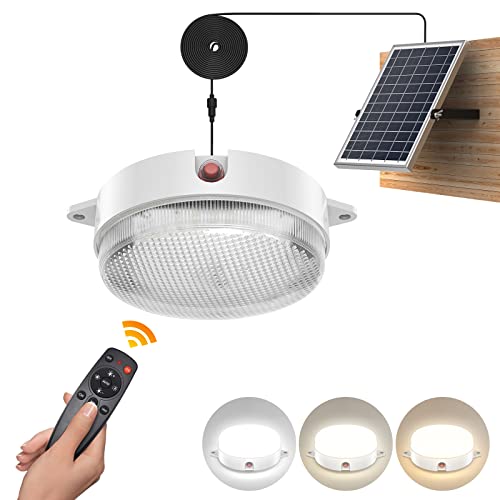
Unlike the remote-only controls on some alternatives, this ceiling light explicitly includes an on/off switch, with a remote as another control option. It offers dimming and three selectable color temperatures: 3,200K, 4,000K, and 6,000K. The maker describes daytime use as available, which can suit a shed or cabin that needs light even when the solar panel is not relying on darkness to trigger it. Its ceiling light format is the main limitation for buyers seeking a motion-activated wall floodlight or a streetlight-style fixture.
Bottom line: Choose this for a shed, cabin, or other space where a physical switch and selectable light color matter.
Malitupy Solar Street Light

This streetlight-style option is distinct for offering both warm and cool white color choices: 3,000–3,200K for a warmer tone and 6,000–6,500K for a cooler tone. It also includes an on/off switch and remote, with brightness and working hours adjustable by remote. The maker says its memory function retains settings between uses. Its larger outdoor fixture format suits a yard or carport better than an indoor ceiling lamp; buyers wanting a compact shed pendant should choose a different style.
Bottom line: Pick this for outdoor area lighting when adjustable color and remote settings are useful.
APILAB Solar Shed Light
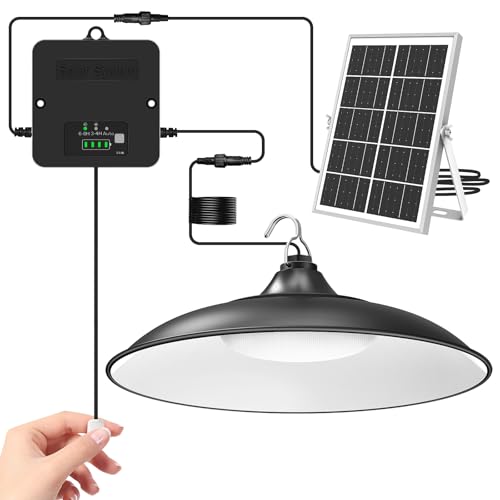
Instead of a wall switch or remote, this shed light uses a pull string to select among three lighting modes. The power box includes battery-level and mode indicators, and the maker says the light can be used during daytime. It produces 2,000 lumens at 6,500K, a cool-white tone. The pull-string setup can be convenient when a remote might be misplaced, but it is not the best match for someone who specifically needs a separate on/off switch on the fixture.
Bottom line: Choose this when pull-string mode control is more practical than a remote.
ONLYWIN Solar Outdoor Light

This outdoor floodlight differs from the explicit switch models by describing its built-in button and remote as controls for three working modes: Off-to-On, Always-On, and Dim-to-Bright. The maker specifies 1,000 lumens from 136 LEDs and a 160-degree coverage angle. A solar panel and rechargeable battery power the light, with no wiring or grid electricity required. The controls may suit a porch or garage where mode selection is the goal, but the specifications do not confirm a dedicated physical on/off switch, so verify that distinction if it is essential.
Bottom line: Consider this for outdoor lighting if mode control matters more than a confirmed dedicated switch.
Tuffenough Solar Security Lights

This two-pack is the motion-security option among these choices, with three adjustable heads and three lighting modes selected by remote. The maker gives an output of 2,500 lumens at 6,500K from 210 LEDs. Its wide-angle, multi-head design is intended for outdoor areas such as a courtyard or garage. The remote provides mode selection, but the specifications do not identify a separate on/off switch; choose a different option if an on/off control on the light itself is a requirement.
Bottom line: Choose this for multi-head outdoor motion lighting when remote mode control is sufficient.
How to choose a solar light control
A physical on/off switch, a remote, and a pull string are different control arrangements, so decide how the light will be reached before choosing a fixture. A switch mounted on a ceiling lamp is convenient only if the lamp is accessible; a remote can help with a high or awkward installation, while a pull string needs clear hanging space. Solar fixtures also have a separate charging and light-sensing process, so an off setting may prevent illumination even when the battery has charged. For an outdoor fixture mounted above reach, favor a remote control; for a reachable indoor ceiling lamp, a physical switch or pull string can be simpler. Verify that the control you need is explicitly included rather than assuming a mode button is a dedicated switch.
Solar panel placement and charging
Direct, unobstructed sun is the key placement condition for solar lights, and shade from eaves, trees, or walls reduces charging. As a practical starting point, place a panel where it can receive several hours of direct sun each day; shorter winter days and cloudy weather can reduce stored energy and runtime. Keep the panel oriented toward the open sky rather than under a porch roof, even when the lamp itself needs to illuminate a covered area. Dust and debris on the panel also block sunlight, so wipe it periodically with a soft cloth. If dependable light is critical, choose the brightest unobstructed panel location before mounting the lamp and check that its cable can reach.
Choose a fixture by the area and beam
Light output and beam shape should match the space: a multi-head security light can aim in several directions, while a ceiling lamp points into a room and a streetlight format serves a broader outdoor area. A 1,000-lumen fixture is a different output class from a 2,500-lumen fixture, but brightness alone does not establish useful coverage because beam angle and mounting height also matter. Use cooler color temperatures around 6,000K for a crisp white appearance; warmer light around 3,000K has a softer, amber appearance. For a narrow doorway, aim the heads at the approach rather than a neighbor’s windows. For a work area, favor a ceiling fixture or a light directed toward the task.
| Need | Control or form to favor |
|---|---|
| Reachable indoor lamp | Physical switch or pull string |
| High or awkward outdoor mount | Remote control |
| Several outdoor directions | Adjustable multi-head light |
| Wide open yard area | Streetlight-style fixture |
Mounting and routine care
Mount solar fixtures securely on a surface suited to their weight and keep the panel exposed to daylight rather than placing it beneath the lamp’s eave. A small alignment mistake can leave the light functional but the panel shaded, so inspect the panel at the time of day when the sun is strongest. Clean the panel when dust, pollen, or bird residue is visible; avoid abrasive pads that could scratch its surface. Outdoor-rated waterproofing does not remove the need for sensible placement: avoid locations where water pools or where a cable is pinched. For motion-oriented lights, aim the sensor toward the approach path and away from moving branches to limit unwanted triggering.
Frequently Asked Questions
How much sun do solar lights need to charge?
Solar lights charge best with several hours of direct, unobstructed sunlight each day. Shade, cloudy weather, and shorter winter days reduce the energy reaching the panel, so prioritize an open-sky position.
Can a solar light stay off during the day?
Many solar lights use a light sensor and operate differently in daylight, but a product’s control modes determine the behavior. Check whether its switch or mode selection overrides automatic dusk operation before relying on daytime use.
What does 3000K versus 6000K look like?
Around 3,000K appears warm and amber, while around 6,000K appears cooler and whiter. Choose warmer light for a softer appearance and cooler light when a crisp white tone is preferred.
Where should I aim an outdoor solar panel?
Aim the panel toward open sky with as little shade as possible for several hours of the day. A panel under an eave or behind foliage will receive less sunlight and may not recharge as effectively.
Can a solar floodlight illuminate a large yard?
A floodlight’s usefulness across a yard depends on lumens, beam angle, mounting height, and obstacles, not lumens alone. Aim adjustable heads toward the areas that need light and avoid directing them into windows.