
Grinders With a Vacuum System: 3 Options Compared

For concrete grinding, 7-Inch Concrete Grinder Set pairs a 7-inch grinder with a dust shroud designed to connect to a vacuum. Choose YUCHENGTECH 4-Head Concrete Grinder instead for four 4-inch grinding heads and a 0–3,500 RPM range; choose HERZO Angle-Grinder Dust Shroud only if you already have a compatible angle grinder and need a cutting guard.
We earn a commission if you buy through links on this page. As an Amazon Associate I earn from qualifying purchases. Products are compared on manufacturer specifications, not hands-on testing.
- Best overall: 7-Inch Concrete Grinder Set – Its 7-inch concrete grinder includes a dust shroud made to connect to a vacuum.
- Best for four-head grinding: YUCHENGTECH 4-Head Concrete Grinder – Four 4-inch diamond wheels and six speed settings suit a different concrete-grinding setup.
- Best for angle-grinder cutting: HERZO Angle-Grinder Dust Shroud – The shroud is an accessory for compatible 4½- or 5-inch angle grinders.
| Product | Best for | Type | Working size | Speed | Shop |
|---|---|---|---|---|---|
| 7-Inch Concrete Grinder Set | Concrete floor grinding | Concrete grinder | 7 in. | Up to 6,000 RPM | Check Price on Amazon |
| YUCHENGTECH 4-Head Concrete Grinder | Four-head concrete work | Concrete grinder | Four 4 in. wheels | 0–3,500 RPM | Check Price on Amazon |
| HERZO Angle-Grinder Dust Shroud | Angle-grinder cutting | Dust-shroud accessory | 4½- or 5-in. grinder | — | Check Price on Amazon |
Grinders With a Vacuum System
Match the grinder or shroud to the job, then confirm the dust-collection connection and fit before starting work.
7-Inch Concrete Grinder Set

For a larger concrete-grinding setup, this 7-inch grinder combines a 3,800W motor with six speed settings and a maximum speed of 6,000 RPM. Its detachable shroud is designed for flush-to-wall work and to connect to a vacuum, which makes the dust setup part of the tool rather than a separate accessory. The maker says the grinder handles concrete, cement, granite, and marble. It suits floor work where a 7-inch head and extendable rod fit the task.
Bottom line: Pick this for concrete floor work when a 7-inch head and vacuum-connected shroud fit your setup.
YUCHENGTECH 4-Head Concrete Grinder

Four 4-inch diamond wheels distinguish this concrete grinder from the single-head option, and the maker says its gear-driven system expands coverage for factory or warehouse floors. A 1,800W motor and six-speed control provide a 0–3,500 RPM range for grinding or polishing work. The dual-port dust hood is detachable, is designed to reach flush to walls, and is compatible with industrial vacuum cleaners. That makes it a fit for broad concrete or stone surfaces where the four-head layout is useful. The maker does not give a dust-flow or filtration rating, so check that the connected vacuum meets the requirements for the job.
Bottom line: Choose this when four 4-inch heads and a dual-port vacuum connection suit your floor work.
HERZO Angle-Grinder Dust Shroud
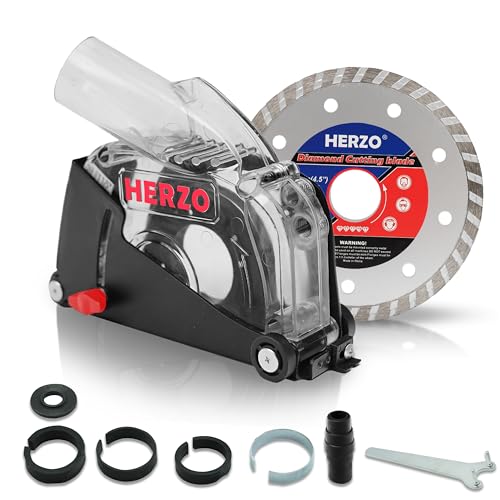
This is a dust-shroud accessory, not a grinder, and it is intended for cutting with a compatible 4½- or 5-inch angle grinder. The maker says it fits 80% of major-brand grinders in those sizes; that broad claim does not guarantee a fit with a particular tool. The PVC body, four clamp fittings, spanner, and cutting disc are included. Its role is narrower than the concrete grinders: it adds a guard around a cutting disc rather than supplying a motor or grinding head. Choose it only if your angle grinder matches and the shroud’s dust outlet can connect to an appropriate extractor; confirm both details before use.
Bottom line: Pick this only when you already own a compatible angle grinder and need a cutting shroud.
How to choose a grinder with dust collection
Start with the material and work area: a concrete floor grinder and an angle-grinder cutting shroud are different tool types, not interchangeable dust systems. The concrete sets pair a grinder with a shroud intended for vacuum connection, while the HERZO item is an add-on guard for a separate angle grinder. Match the head or disc size to the task, then check whether the shroud and vacuum connection are compatible. Concrete grinding can create respirable crystalline silica dust, which can cause serious lung disease. A shroud alone does not establish safe dust control; use a suitable dust-collection system and follow applicable workplace requirements. Avoid dry grinding concrete without effective dust controls, and wear eye and hearing protection appropriate to the work.
What the grinder sizes and speeds mean
Head diameter and speed describe different parts of the setup: a larger head covers a wider path, while RPM is rotational speed, not a guarantee of faster work. The concrete options use four 4-inch wheels or a 7-inch grinder, and their speed ranges top out at 3,500 or 6,000 RPM. Do not compare those maximum RPM figures as if they measure grinding output; wheel design, material, pressure, and speed setting also matter. Use the wheel or disc size intended for the tool and never install an accessory whose rated speed is below the grinder’s operating speed. This quick guide separates the tool roles.
| Need | Relevant option |
|---|---|
| Concrete floors with a 7-inch head | 7-Inch Concrete Grinder Set |
| Concrete work with four 4-inch wheels | YUCHENGTECH 4-Head Concrete Grinder |
| Cutting with an existing 4½- or 5-inch angle grinder | HERZO Angle-Grinder Dust Shroud |
Vacuum and shroud fit checks
A vacuum-connected shroud needs a compatible outlet, hose, and extractor; a dust hood that merely surrounds a wheel is not proof of adequate capture. For occupational concrete grinding, OSHA’s silica rules specify dust-control measures for covered tasks; requirements depend on the tool and operation. Check the shroud fit around the wheel and ensure the hose cannot interfere with the tool or work surface. For accessories, verify the grinder model, wheel size, clamp fit, and whether the guard is made for grinding or cutting.
Safe use and common dust-control mistakes
Silica dust from concrete is a serious inhalation hazard, so keep dust collection operating during grinding and avoid sweeping or blowing settled dust into the air. A vacuum system must capture dust at the shroud; an unconnected outlet or loose hose defeats that purpose. Inspect the wheel, guard, hose, and electrical cord before use, and keep the workpiece stable. Do not remove a grinder’s safety guard to make an accessory fit. If the shroud blocks visibility or cannot sit close to the surface, stop and correct the setup rather than continuing with poor capture. Worksite rules may require a written exposure-control plan, restricted access, or respiratory protection depending on the task and conditions.
Frequently Asked Questions
Can any shop vacuum connect to a grinder shroud?
No; hose diameter and dust-control performance both matter. Check the shroud outlet size and the extractor’s filtration and airflow before using it for concrete dust.
Does a dust shroud make concrete grinding safe?
A shroud can capture dust at the wheel, but it is only one part of silica exposure control. OSHA requirements vary by task, and effective extraction and suitable work practices are essential.
Can I use a 5-inch shroud on a 4-inch grinder?
A shroud’s grinder size is a fit range, not a general compatibility guarantee. Confirm the specific grinder body, guard attachment, and disc size match the shroud.
Why do concrete grinders have different RPM ranges?
RPM is rotational speed, and the right speed depends on the tool, wheel, and material. Never exceed the wheel’s marked maximum speed, even if the grinder offers a higher setting.