
Zinsser Bulls Eye 1-2-3 Primer: 3 Formats Compared

For most small interior projects, Zinsser Bulls Eye 1-2-3 PLUS Quart is the practical choice because its quart size is rated to cover about 87.5 to 100 square feet. Choose Zinsser Bulls Eye 1-2-3 PLUS Spray, 6-Pack for spot priming with an aerosol or Zinsser Bulls Eye 1-2-3 Water-Base, 5 Gallon for larger jobs; primer is a preparatory coating that helps paint adhere and can block stains.
We earn a commission if you buy through links on this page. As an Amazon Associate I earn from qualifying purchases. Products are compared on manufacturer specifications, not hands-on testing.
- Best overall: Zinsser Bulls Eye 1-2-3 PLUS Quart – The quart size suits smaller jobs, and the maker gives a coverage estimate of 350 to 400 square feet per gallon.
- Best for spot priming: Zinsser Bulls Eye 1-2-3 PLUS Spray, 6-Pack – The spray format covers up to 12 square feet per can and is sold in a six-pack.
- Best for large projects: Zinsser Bulls Eye 1-2-3 Water-Base, 5 Gallon – The five-gallon pail is the largest package of the three.
| Product | Best for | Formula | Package size (fl oz) | Shop |
|---|---|---|---|---|
| Zinsser Bulls Eye 1-2-3 PLUS Quart | Small indoor jobs | Water-based | 32 fl oz | Check Price on Amazon |
| Zinsser Bulls Eye 1-2-3 PLUS Spray, 6-Pack | Small spot areas | Oil-based spray | 6 × 13 oz | Check Price on Amazon |
| Zinsser Bulls Eye 1-2-3 Water-Base, 5 Gallon | Large projects | Water-based acrylic | 640 fl oz | Check Price on Amazon |
Zinsser Bulls Eye 1-2-3 Primer Formats
Match the application format and package size to the surface area and type of project.
Zinsser Bulls Eye 1-2-3 PLUS Quart
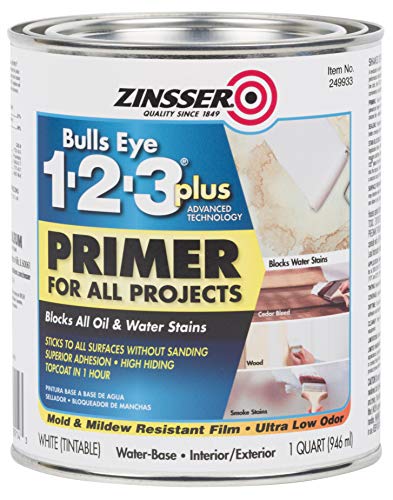
For a smaller project needing a water-based stain-blocking primer, Zinsser Bulls Eye 1-2-3 PLUS Quart comes in a quart rather than an aerosol or five-gallon pail. Zinsser says it blocks water stains, dries in one hour and covers about 350 to 400 square feet per gallon, depending on the surface; that converts to roughly 87.5 to 100 square feet per quart. The maker also says it sticks to any surface. The limitation is package size: a quart is less suited to a large room or multiple rooms than a five-gallon pail.
Bottom line: Choose this quart for smaller projects where a water-based stain blocker is a fit.
Zinsser Bulls Eye 1-2-3 PLUS Spray, 6-Pack

Unlike the brush-or-roller formats, Zinsser Bulls Eye 1-2-3 PLUS Spray, 6-Pack is an aerosol spray sold as six 13-ounce cans. Zinsser says each can covers up to 12 square feet, dries to the touch in 30 minutes and can be used on interior or exterior drywall, concrete, wood, masonry, metal and glossy surfaces. The maker also says its oil-based formula sticks without sanding and blocks stains. Each can covers a limited area, so this format is less practical for broad wall coverage than a pail.
Bottom line: Choose the spray for smaller areas where aerosol application is useful.
Zinsser Bulls Eye 1-2-3 Water-Base, 5 Gallon
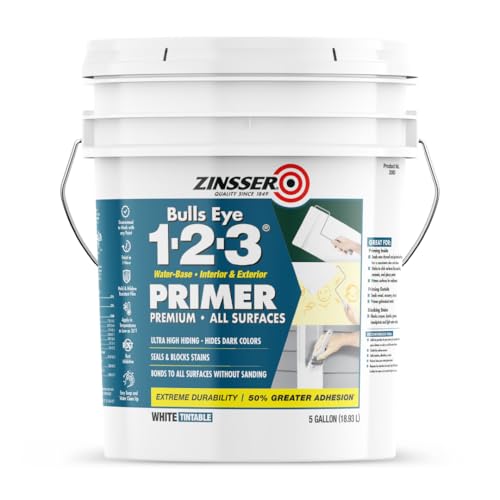
For a large project, Zinsser Bulls Eye 1-2-3 Water-Base, 5 Gallon has the biggest package here: a five-gallon pail of water-based primer-sealer. Zinsser says its acrylic formula is breathable and flexible, resists blistering and peeling, and sticks without sanding. The maker also says it seals stains, graffiti and tannin bleed, and inhibits rust on new metal. The pail is less convenient for a small repair than a quart or spray can, so consider the project area before choosing this package.
Bottom line: Choose the five-gallon pail when the project calls for a larger quantity of water-based primer.
How to choose a primer format
Choose by project area and application method: an aerosol suits small patches, a quart suits a modest project, and a five-gallon pail suits a larger job. Primer coverage is commonly estimated around 250 to 400 square feet per gallon, but rough or porous surfaces can use more; use the product’s coverage as the planning figure when available. For a surface area under about 100 square feet, a quart can be a more manageable starting quantity than a five-gallon pail. Primer is not a substitute for removing loose paint, dust or grease, which can interfere with adhesion.
Formula matters too: water-based acrylic primers clean up differently from oil-based formulas, and compatibility with the topcoat should be confirmed before work begins. The spray is oil-based; the quart and pail are water-based.
Primer coverage and project sizing
Estimate area before buying: a quart is one-fourth of a gallon, so a 350-to-400-square-foot-per-gallon rate converts to about 87.5 to 100 square feet per quart. That estimate changes with surface texture and porosity; unpainted drywall, masonry and rough wood can absorb more primer than a smooth previously painted surface. Measure each wall’s width times height, then subtract large doors and windows for a closer estimate.
The spray’s coverage is up to 12 square feet per can, so it is suited to localized work rather than broad coverage. Avoid estimating from container count alone: six spray cans do not make an equivalent choice to a pail unless the area and application needs align.
Primer application and surface preparation
Clean, dry surfaces give primer a better chance to bond; remove dust, loose paint and surface grime before coating. Glossy or difficult surfaces can require extra attention, even when a primer is designed to adhere without sanding. Follow the product’s cure and recoat directions, because touch-dry time does not necessarily mean a coating is ready for paint.
Apply an even coat rather than trying to stretch coverage beyond the rate. For stains or tannin bleed, make sure the selected formula is intended for that problem and inspect the primed area before topcoating. Keep aerosol spray away from flames and heat, and use it with strong ventilation; do not spray toward people or pets.
Primer types and project fit
Water-based acrylic primer is a common choice for general interior and exterior priming, while oil-based primers can be useful when the product is intended for a difficult surface or stain-blocking task. Formulas are not interchangeable for every substrate or topcoat, so confirm compatibility when the surface or finish is unusual. Primer selection should reflect both the surface and the problem being addressed, such as adhesion, staining or rust inhibition.
The comparison below gives a quick format-to-project rule. For broad coverage, choose a package with a suitable volume and application method; for a small patch, an aerosol can reduce setup, but it has limited area coverage.
| Project need | Format to consider | Reason |
|---|---|---|
| Small spot or patch | Aerosol spray | Up to 12 square feet per can |
| Modest project | Quart | About 87.5 to 100 square feet at stated rate |
| Large area | Five-gallon pail | Largest package size here |
Frequently Asked Questions
How much area does a quart of primer cover?
A quart covers about 87.5 to 100 square feet at a rate of 350 to 400 square feet per gallon. Rough or porous surfaces may require more.
Can primer go over glossy paint without sanding?
Some primers are designed to adhere to glossy surfaces without sanding, including the spray format compared here. Clean the surface first and confirm the primer is suited to the substrate.
How long should primer dry before painting?
The quart product’s maker says it dries in one hour, while the spray’s maker says it is touch-dry in 30 minutes. Touch-dry time is not necessarily the same as recoat readiness, so use the applicable product’s recoat direction.
Does water-based primer block water stains?
The maker says the quart product blocks water stains. Stain blocking can depend on the stain and surface, so check that the chosen formula is intended for the problem before applying a topcoat.
Is spray primer safe to use indoors?
Aerosol primer should be used only with strong ventilation and kept away from flames and heat. Do not spray toward people or pets, and use it outdoors when adequate indoor ventilation is not possible.