
4-Point Pulley Lift Systems Compared by Capacity and Fit

For most buyers, Pacikwest Roof Top Tent Hoist is the best fit because it combines a 250-pound capacity, four-point lift and stated 8:1 mechanical advantage for ceilings from 8 to 16 feet. Choose Pacikwest Self-Leveling Truck Cap Hoist instead for a truck cap and a self-leveling design; choose Cargo Box Ceiling Storage Hoist for a cargo box if its 180-pound rating is sufficient.
A four-point pulley lift raises an item from four attachment points to help keep it balanced overhead. Before mounting any system, verify that the ceiling structure and anchor locations can support the load.
We earn a commission if you buy through links on this page. As an Amazon Associate I earn from qualifying purchases. Products are compared on manufacturer specifications, not hands-on testing.
- Best overall: Pacikwest Roof Top Tent Hoist – Pairs a 250-pound capacity with an 8:1 pulley system and an 8–16-foot ceiling fit.
- Best for truck caps: Pacikwest Self-Leveling Truck Cap Hoist – Designed for truck caps and describes a self-leveling four-point lift.
- Best for cargo boxes: Cargo Box Ceiling Storage Hoist – Designed for roof cargo boxes and rated for loads up to 180 pounds.
| Product | Best for | Capacity | Ceiling height | Dimensions | Shop |
|---|---|---|---|---|---|
| Pacikwest Roof Top Tent Hoist | General gear storage | 250 lb | 8–16 ft | 15.35 × 4.7 × 11.42 in | Check Price on Amazon |
| Pacikwest Self-Leveling Truck Cap Hoist | Truck cap lifting | 250 lb | — | 41.3 × 6 × 7 in | Check Price on Amazon |
| Cargo Box Ceiling Storage Hoist | Roof cargo boxes | 180 lb | 8–16 ft | 10.1 × 2.8 × 8 in | Check Price on Amazon |
4-Point Pulley Lift Systems
Compare each system’s load capacity, ceiling fit and design to match the lift to the item and garage structure.
Pacikwest Roof Top Tent Hoist

Pacikwest Roof Top Tent Hoist combines a four-point lift with an 8:1 mechanical advantage and is sized for a 250-pound maximum load. The maker describes it for roof-top tents, cargo, kayaks, canoes and other bulky equipment; its adjustable straps are specified for ceilings from 8 to 16 feet. The dimensions are 15.35 × 4.7 × 11.42 inches. This is the broadest-use option among these four-point systems. Its 250-pound rating is a limit, not a target: weigh the item and any attached hardware, and confirm the ceiling anchors are suitable before lifting.
Bottom line: Choose this for varied bulky gear when the ceiling is 8–16 feet high and the load stays within 250 pounds.
Pacikwest Self-Leveling Truck Cap Hoist

Pacikwest Self-Leveling Truck Cap Hoist is the truck-cap-focused choice, with a four-point self-leveling design intended to keep the load level as it rises. The maker says its 8:1 pulley system allows one-person lifting, and gives a maximum capacity of 250 pounds. Its dimensions are 41.3 × 6 × 7 inches. The longer listed footprint distinguishes this model from the compact housings in this comparison. The intended use is narrower than a general cargo hoist, so buyers lifting a cargo box or mixed gear should check whether the mounting arrangement suits that item rather than assuming truck-cap compatibility covers every load.
Bottom line: Choose this for a truck cap when its four-point self-leveling design matches your setup.
Cargo Box Ceiling Storage Hoist
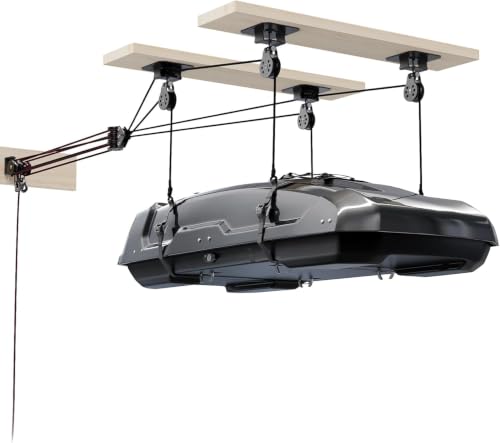
Cargo Box Ceiling Storage Hoist is specifically aimed at roof cargo box storage and has a 180-pound capacity, lower than the two 250-pound systems. Its ceiling range is 8 to 16 feet, and its dimensions are 10.1 × 2.8 × 8 inches. The four-point arrangement is intended to improve balance while storing a cargo box overhead. Match the actual combined weight of the box and anything attached to it against the 180-pound limit. Buyers with a heavier load, or a different bulky item such as a truck cap, should consider whether another system’s purpose and capacity are a closer match.
Bottom line: Choose this for a roof cargo box that stays within the 180-pound limit.
How to choose a four-point pulley lift
Choose by load, ceiling fit and anchor structure, in that order. Start with the weight of the item plus straps or other attached hardware; do not treat a rated maximum as a working target. A ceiling-mounted hoist transfers force into its fasteners and supporting framing, so anchors must connect to structural framing rather than drywall alone. A four-point lift suspends the item at four locations, but the load may not divide evenly if the item is off-center or its attachment points differ. Measure the item and the available ceiling space before selecting a system. For these options, the two 250-pound systems suit heavier loads than the 180-pound cargo box hoist, but capacity alone does not determine whether the mounting geometry fits.
Ceiling height and storage clearance
Ceiling height determines how much room the suspended item needs and whether straps can reach the load. The 8–16-foot fit specified for Pacikwest Roof Top Tent Hoist and Cargo Box Ceiling Storage Hoist gives a useful selection boundary: measure from floor to ceiling and confirm your ceiling falls in that range before choosing either. Measure the object’s height too, then leave enough clearance below it for vehicles, doors and walking paths. Compare the hoist’s dimensions with obstructions such as joists, lights and garage-door tracks; the housing dimensions do not tell you the full hanging clearance. A lift that fits the ceiling can still be unsuitable if the stored item blocks the door or hangs into a vehicle’s parking space.
Four-point lifts and pulley ratios
A four-point lift refers to the number of places where a load is supported, while a pulley ratio describes mechanical advantage; those terms do not mean the same thing. Pacikwest Roof Top Tent Hoist and Pacikwest Self-Leveling Truck Cap Hoist both specify an 8:1 or 8x pulley system, while Cargo Box Ceiling Storage Hoist describes a four-point lift without giving a ratio. In an ideal frictionless system, an 8:1 ratio trades longer rope travel for lower input force, but real pulleys have friction and lifting force also depends on load balance. A ratio does not increase a hoist’s rated capacity. Keep the item within its system’s capacity and avoid using the mechanism to raise a person or a load over people.
Mounting and overhead-load safety
Mount the ceiling lift only to structural framing that can support the suspended load, using attachment hardware suited to that structure. Drywall by itself is not a safe anchor for a loaded ceiling hoist. Check the manufacturer’s specified mounting method and capacity limits, then raise a new load only a short distance first to confirm it stays level and all attachment points remain secure. Keep people and pets clear beneath a suspended object, and do not climb under a hanging load. A four-point design can help distribute support, but it does not guarantee equal force at each point; uneven positioning or a shifting load can stress one side more heavily.
Frequently Asked Questions
How much weight can a four-point garage hoist lift?
The systems here have rated capacities of 180 or 250 pounds. Count the item and attached hardware together, and stay within the specific system’s limit.
Does an 8:1 pulley ratio mean eight times the capacity?
No; an 8:1 ratio describes mechanical advantage, not the hoist’s load rating. The 8:1 systems here are still rated for a maximum of 250 pounds.
Can I mount a ceiling hoist into drywall?
No; drywall alone is not structural support for a suspended load. The anchors must connect to ceiling framing capable of carrying the load.
How do I know if my garage ceiling is high enough?
Measure floor-to-ceiling height and compare it with the system’s range; two options here specify 8–16 feet. Also account for the hanging item’s height and any door tracks or lights.
Should people stand under a raised storage load?
No; keep people and pets clear of the area beneath any suspended load. Check that the load is balanced and secure before moving or working nearby.