
Plant Food A and B: 4 Two-Part Nutrients Compared

For plant food A and B, Hydroponics Nutrients A & B, 800 mL is the closest match for compact indoor hydroponic systems because it is explicitly compatible with AeroGarden-style setups and includes an 800 mL supply. Choose ENVY Hydroponic Plant Food A & B, Quart Set instead if you need one nutrient set across soil, coco, and hydroponics; VIVOSUN Liquid Nutrients Base A & B, 8 oz suits growers prioritizing a product described for vegetative and flowering stages.
We earn a commission if you buy through links on this page. As an Amazon Associate I earn from qualifying purchases. Products are compared on manufacturer specifications, not hands-on testing.
- Best overall: Hydroponics Nutrients A & B, 800 mL – Its 800 mL A-and-B supply is designed for indoor hydroponic systems including AeroGarden.
- Best for multiple media: ENVY Hydroponic Plant Food A & B, Quart Set – The quart set is described for soil, coco, hydroponics, and soilless systems.
- Best for growth stages: VIVOSUN Liquid Nutrients Base A & B, 8 oz – The product is described as a base nutrient for vegetative and flowering stages.
| Product | Best for | Total volume | Compatible media | Shop |
|---|---|---|---|---|
| Hydroponics Nutrients A & B, 800 mL | Indoor hydroponics | 800 mL | Hydroponics | Check Price on Amazon |
| ENVY Hydroponic Plant Food A & B, Quart Set | Multiple grow media | Quart set | Soil, coco, hydroponics | Check Price on Amazon |
| VIVOSUN Liquid Nutrients Base A & B, 8 oz | Stage support | 8 oz | Indoor and outdoor plants | Check Price on Amazon |
| All-Purpose Hydroponics Nutrients A & B, 1000 mL | Larger hydroponic supply | 1000 mL | Hydroponics | Check Price on Amazon |
Plant Food A and B Compared
Compare the intended growing media and package volume before choosing a two-part nutrient set.
Hydroponics Nutrients A & B, 800 mL

For compact indoor hydroponic systems, this set specifically names AeroGarden compatibility and includes 800 mL total. The package has two bottles plus six nutrient packs, and the directions specify mixing 5 mL each of A and B per 1 L of water. That makes it a direct fit for growers who want a two-part formula for vegetables or other plants in a recirculating indoor setup. The limitation is its hydroponic focus: choose another option if you need explicit soil or coco compatibility, or if your system requires a different feed concentration.
Bottom line: Choose this for an indoor hydroponic system that calls for 5 mL of each part per liter.
ENVY Hydroponic Plant Food A & B, Quart Set
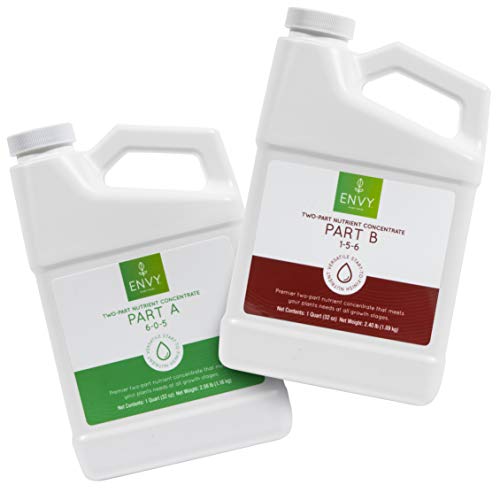
This quart set stands apart by covering hydroponics, soil, coco coir, and soilless media, including DWC, NFT, ebb-and-flow, and drip systems. Part A has an NPK ratio of 6-0-5 and Part B 1-5-6; together, the maker says they provide nutrients for all growth stages. Its broad media compatibility suits growers switching between containers and hydroponic setups without changing nutrient lines. The limitation is that the directions do not give a mixing rate, so confirm the dose for your reservoir or watering volume before use.
Bottom line: Pick this if you need one A-and-B set for several growing media.
VIVOSUN Liquid Nutrients Base A & B, 8 oz

Unlike the hydroponics-only-focused choices, this VIVOSUN bundle is positioned for indoor and outdoor plants and describes support from vegetative development through flowering. The 8-ounce set is a two-part base nutrient with nitrogen, phosphorus, potassium, calcium, and magnesium, and the maker says the formula is water-soluble and stabilizes nutrient-solution pH. It suits a grower who wants a stage-spanning base blend in a smaller package.
Bottom line: Choose this for a smaller two-part base blend aimed at vegetative and flowering growth.
All-Purpose Hydroponics Nutrients A & B, 1000 mL

With 1000 mL total, this is the largest hydroponic-focused supply among the products here, and it includes two bottles plus eight extra A-and-B packs. Its directions call for 5 mL of A and 5 mL of B per 1 L, with a dispensing cup for metering. The maker describes compatibility with a wide range of hydroponic grow systems, making it a reasonable choice for growers who want the dose and a larger supply.
Bottom line: Pick this if you want a larger stated supply for hydroponic feeding.
How to choose two-part plant food
Choose an A-and-B nutrient by matching the growing medium first, then the dose and nutrient analysis. Two-part formulas separate concentrated minerals that can react with each other; add each part to water separately rather than combining concentrates directly. For hydroponics, reservoir volume and the plant’s growth stage affect the feed strength, while soil and coco products may use different schedules. A dose such as 5 mL of each part per 1 L applies to that product, not to other brands. If the product gives no dose for your system, confirm the feeding rate before mixing rather than extrapolating from another formula.
How A and B nutrients are mixed
Mix each part into water one at a time, stirring between additions, because concentrated A and B can form insoluble deposits when combined undiluted. A typical hydroponic routine measures nutrient into the reservoir, then checks the final solution rather than relying on bottle volume alone. Many hydroponic crops grow in a solution around pH 5.5 to 6.5, though crop and water chemistry change the target. Use a calibrated pH meter or test kit, and do not pour nutrient concentrate into an occupied reservoir where roots or equipment can be exposed to a localized strong dose.
Match nutrient systems to growing media
Hydroponic nutrients are formulated for direct delivery in water, while soil and coco have different buffering and nutrient-retention behavior. Coco typically requires attention to calcium and magnesium because the medium can bind those ions; a formula intended for soil may not meet a hydroponic crop’s needs. The chart distinguishes product fit by medium, not by a universal quality ranking. Avoid assuming that a nutrient labeled for vegetables automatically suits every reservoir strength: leafy greens and fruiting crops can have different nutrient demands.
| Growing need | Suitable product fit | Decision point |
|---|---|---|
| Indoor hydroponic system | Hydroponics-focused A & B | Use only the dilution for that product |
| Soil, coco, and hydroponics | Media-flexible two-part set | Confirm feed rate for each medium |
| Vegetative through flowering | Stage-spanning base nutrient | Check the formulation’s mixing schedule |
Common mistakes with A and B plant food
The most common mixing error is pouring concentrated A and B together before dilution; always add each part to water separately. Overfeeding is another risk: excess dissolved salts can stress roots, and reservoir strength is commonly tracked with electrical conductivity (EC) rather than guessed by color or smell. Change nutrient solution regularly in recirculating systems and watch pH and EC as plants take up water and minerals at different rates. Keep concentrates away from children and pets, and avoid contact with eyes or skin; use clean measuring tools so residue from one part does not contaminate the other bottle.
Frequently Asked Questions
Can A and B plant nutrients be mixed together first?
No; dilute each part separately in water before combining the solutions. Concentrated parts can react and form deposits when poured together directly.
What pH range is typical for hydroponic nutrients?
Many hydroponic crops use a nutrient-solution pH around 5.5 to 6.5. Crop choice and source-water chemistry can shift the target, so measure the mixed solution.
How much A and B should I add per liter?
The dose depends on the specific formula; one product here calls for 5 mL of A and 5 mL of B per 1 L of water. Do not transfer that rate to a different nutrient set.
Do hydroponic A and B nutrients work in soil?
Some two-part formulas specify soil compatibility, while hydroponics-focused products may not. Choose one that names your medium and verify its feeding rate for that use.
Why does pH change in a hydroponic reservoir?
Plant uptake, water source, and nutrient composition can all shift reservoir pH over time. Measure it regularly and adjust gradually rather than making a large correction at once.