
Live Scope Transducer Pole Options Compared by Mount Type

For most buyers seeking a live scope transducer pole, Stratum Outdoors Telescoping Pole, 30–60 in is the direct manual-pole choice because it telescopes from 30 to 60 inches and supports forward, down, and Perspective modes. Choose Garmin Spy Pole, 42 in instead if you want motorized control and remote operation; confirm that its mounting setup suits your boat before ordering.
We earn a commission if you buy through links on this page. As an Amazon Associate I earn from qualifying purchases. Products are compared on manufacturer specifications, not hands-on testing.
- Best overall: Stratum Outdoors Telescoping Pole, 30–60 in – The 30–60-inch telescoping pole supports three scanning orientations.
- Best for motorized control: Garmin Spy Pole, 42 in – It offers wireless and foot control, plus SpyLock and SpyScan functions.
- Best for broad compatibility: Brocraft Telescopic Transducer Pole – Its telescoping pole and deck base are designed for many live sonar transducers.
| Product | Best for | Pole length | Mount included | Control | Shop |
|---|---|---|---|---|---|
| Stratum Outdoors Telescoping Pole, 30–60 in | Manual mode changes | 30–60 in | No | Manual; quick release | Check Price on Amazon |
| Garmin Spy Pole, 42 in | Remote sonar control | 42 in | Trolling-motor mount | Motorized; wireless or foot control | Check Price on Amazon |
| Brocraft Telescopic Transducer Pole | Deck-base mounting | Adjustable; range unspecified | Deck base included | Manual; adjustable | Check Price on Amazon |
Live Scope Transducer Poles
Compare pole length, mounting hardware, and adjustment methods before choosing a setup.
Stratum Outdoors Telescoping Pole, 30–60 in

Unlike a fixed-length mount, this pole adjusts from 30 to 60 inches and supports forward, down, and Perspective/Landscape/Scout positioning. Its rotation collar uses ThruBolt technology and has a bike-stand repair mount adapter. The pole is designed for Garmin LiveScope LVS32/LVS34, MEGA Live 1 and 2, and Active Target 1 and 2 transducers. The brand says a pin mechanism secures the modes and a quick release helps change them. The deck stand is sold separately, so this pole suits boaters who already have a compatible stand or plan to source one separately.
Bottom line: Choose this if you want a manually adjusted pole with a 30–60-inch range and supported mode changes.
Garmin Spy Pole, 42 in
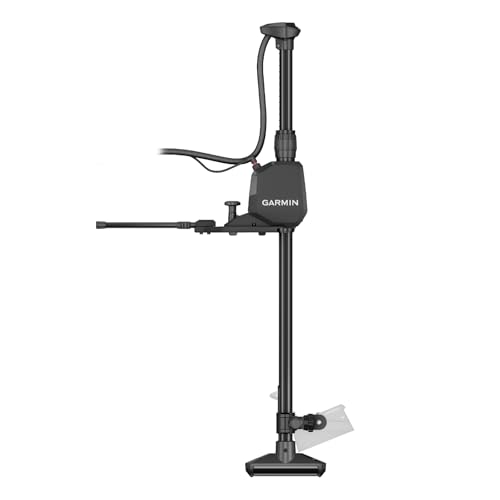
Unlike the manually positioned poles, this 42-inch model motorizes sonar control and includes a wireless foot control and a rod-mountable gesture remote; compatible Garmin chartplotters can also control it. Garmin says SpyLock can hold a point and SpyScan can sweep back and forth, while SpyLink synchronizes with a compatible Force Pro trolling motor. Its shaft routes cables internally, and the pole is designed to hold LiveScope alongside a GT360UHD transducer. This suits anglers seeking remote or automated positioning. It mounts to a trolling motor, so it is not the right choice if the boat needs a standalone deck-mounted pole.
Bottom line: Choose this for motorized positioning and remote control from a trolling-motor setup.
Brocraft Telescopic Transducer Pole

It includes a deck mounting base and is designed for many popular live sonar and fish-finder transducers. The brand says its adjustable design helps position a transducer at a desired depth and angle, and describes the design as patent-pending. This is a reasonable fit for a buyer prioritizing an included deck base and broad stated compatibility. Because the actual extension range is not provided, confirm the needed reach before ordering if the boat’s gunnel or deck position requires a particular pole length.
Bottom line: Choose this if an included deck base matters more than an extension range.
How to choose a live scope transducer pole
Choose by control style first: manual poles let you reposition the transducer at the pole, while motorized systems can move it through a remote or chartplotter. A telescoping range of 30 to 60 inches gives more reach flexibility than a single stated 42-inch length, but those figures do not tell you the installed height above the water. Match the mounting method to the boat: a deck base needs a suitable flat mounting area, while a trolling-motor mount requires a compatible motor setup. Forward, down, and Perspective orientations change the direction of the sonar view; verify that the mount can hold the orientation you intend to use. For a narrow or crowded mounting area, measure available clearance before selecting a pole and mount combination.
Mounting and transducer positioning
Place the transducer where it can be lowered into the water without striking the hull, motor, or another fitting during normal positioning. The boat’s geometry determines useful reach: measure from the proposed mount point to the waterline, then allow room for the transducer to clear the hull. Tighten deck hardware against a sound, supported surface; a loose base can shift under repeated repositioning. Keep cable routing clear of moving joints and pinch points, especially on adjustable or motorized poles. A pole with internal cable routing can protect cables along the shaft, but routing at the mounting point still needs to remain clear. Before using the boat, check that the pole and transducer move through the intended range without contacting other equipment.
Live sonar modes and pole control
Forward mode points the sonar view ahead of the boat, down mode points beneath it, and Perspective mode changes the viewing orientation for a broader forward-looking view. A manual pole can reposition the transducer physically, while a motorized pole adds powered control; neither changes what the transducer itself can support. Match mode support across the transducer, pole, and sonar system rather than assuming a pole adds a mode. A dedicated remote can reduce the need to reach the pole during scanning, while a fixed or manually adjusted system keeps operation simpler. The practical decision rule is straightforward: choose a pole with explicit mode support if you switch among modes, and verify chartplotter compatibility before relying on chartplotter-based control.
| Need | Suitable setup type | Check before choosing |
|---|---|---|
| Manual mode repositioning | Telescoping manual pole | Supported modes and reach |
| Remote powered movement | Motorized pole | Mount and control compatibility |
| Deck installation | Deck-base pole | Base fit and clear mounting area |
Safe setup and common fit mistakes
A transducer pole is exposed to impact, so stow or raise it when the boat is moving through shallow water, near obstructions, or when it is not being used. Before each outing, check that fasteners are secure and that the pole cannot swing into the hull or propeller. Do not assume that a pole’s length equals its usable underwater reach: mounting height and transducer position determine the actual placement. Another common mistake is buying a pole without the separate stand or mount it requires. Compare what is included with the installation plan, and confirm the mount style and reach for the intended boat location before ordering. Keep cables away from rotation points to reduce snagging or pinching.
Frequently Asked Questions
How long should a live sonar transducer pole be?
Choose a pole long enough to put the transducer in the water from its intended mounting point while clearing the hull. A 30–60-inch adjustable range offers more flexibility than a fixed stated length, but measure the boat because mount height affects usable reach.
Can one pole support forward and down modes?
Some poles are designed for both orientations; the pole must also work with the transducer and sonar system. Check for explicit mode support, since physically rotating a transducer does not guarantee that the system supports every view.
Where should a transducer pole mount on a boat?
Mount it where the transducer can enter the water and move without hitting the hull, motor, or fittings. Measure from the proposed base to the waterline and check clearance through the full intended movement before installation.
Should I choose a manual or motorized sonar pole?
Choose manual adjustment if repositioning at the pole is acceptable; choose motorized control if you need remote movement or automated scanning. Motorized poles also require a compatible mounting and control setup.
How do I keep a transducer pole safe underway?
Raise or stow the pole when running through shallow water or near obstructions, and check that its fasteners are secure before use. Route cables clear of moving joints so they cannot snag or pinch during repositioning.