
Best Water Temperature Gauge for Fishing: 4 Compared

Fishpond Riverkeeper Digital Thermometer suits most anglers because its digital display, clip and IPX7 submersible rating make it a practical streamside gauge. Choose Aventik Dual-Scale Fly Fishing Thermometer if you prefer a dual Fahrenheit/Celsius scale, or a probe style if you need a cable-mounted sensor.
We earn a commission if you buy through links on this page. As an Amazon Associate I earn from qualifying purchases. Products are compared on manufacturer specifications, not hands-on testing.
- Best overall: Fishpond Riverkeeper Digital Thermometer – Its IPX7 rating and carabiner-style clip suit submerged readings and attachment to webbing.
- Best for dual scales: Aventik Dual-Scale Fly Fishing Thermometer – The rotating handle switches between Fahrenheit and Celsius, with a 20–120°F range.
- Best for quick visual zones: Cling Fishing Temperature Tape – The adhesive tape uses color-coded zones and is made for clean, flat gear surfaces.
| Product | Best for | Temperature range | Construction or display | Attachment | Shop |
|---|---|---|---|---|---|
| Fishpond Riverkeeper Digital Thermometer | Streamside readings | — | Digital; polycarbonate and silicone | Carabiner clip; IPX7 | Check Price on Amazon |
| Aventik Dual-Scale Fly Fishing Thermometer | Dual-scale reading | 20–120°F | Aluminum case; rotating F/C scale | Hook clip | Check Price on Amazon |
| Cling Fishing Temperature Tape | Visual trout zones | — | Color-coded Fahrenheit tape | Adhesive; flat surfaces | Check Price on Amazon |
| Digital Probe Thermometer with 30 m Cable | Cable probe setup | −58–140°F | Digital instrument; probe | 30 m cable | Check Price on Amazon |
Water Temperature Gauges for Fishing
Choose a gauge by how you want to read the water and attach or position the sensor.
Fishpond Riverkeeper Digital Thermometer

For a digital readout in a compact body, Fishpond Riverkeeper Digital Thermometer combines a polycarbonate main body with a soft silicone outer case. The display has a UV filter, and the unit is rated IPX7 for submersion. Its carabiner-style clip fits webbing up to 1 inch wide, so anglers can attach it to compatible gear rather than carry it loose. Fishpond says the body uses recycled polycarbonate and is ultrasonically welded. The replaceable CR2025 battery is included.
Bottom line: Pick this for a compact digital gauge that clips to compatible fishing gear.
Aventik Dual-Scale Fly Fishing Thermometer
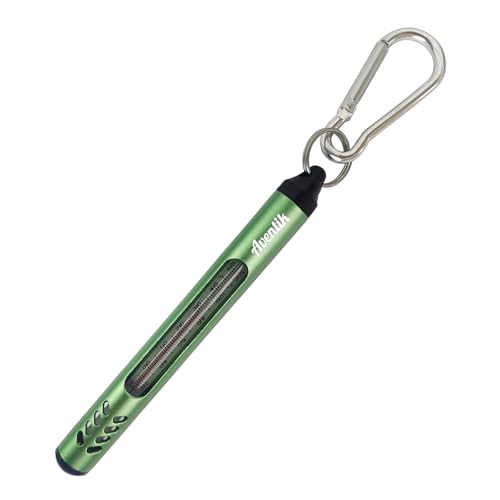
Unlike the digital option, Aventik Dual-Scale Fly Fishing Thermometer uses a rotating handle to select a Fahrenheit or Celsius display. The Fahrenheit range is 20–120°F, and its aluminum case and cap measure 6.2 inches long. The maker positions it for stream, brook and river fly fishing; the hook clip gives it a simple way to attach to gear. This suits anglers who want both temperature scales without a digital display. Its longer body may be less convenient in a tight pocket, and anglers seeking a submersion rating should verify that feature before choosing it.
Bottom line: Choose this if switching between Fahrenheit and Celsius matters more than a compact digital body.
Cling Fishing Temperature Tape

Rather than a separate thermometer, Cling Fishing Temperature Tape is a stick-on tape designed for clean, flat surfaces such as nets or smooth gear. Its Fahrenheit display uses green, yellow and red zones that the maker describes as safe, caution and high-risk ranges for trout. The manufacturer says readings are accurate within 1–2 degrees. This format may suit anglers who want a glanceable indicator attached to suitable equipment. It is not a probe or a stand-alone submerged instrument, so it is a partial fit for anyone who needs to measure water directly; confirm it adheres to the surface you plan to use.
Bottom line: Pick this only if a surface-mounted, color-coded indicator fits your setup.
Digital Probe Thermometer with 30 m Cable
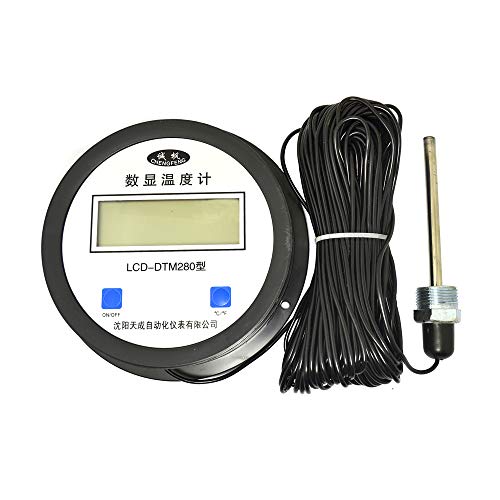
Digital Probe Thermometer with 30 m Cable differs from fishing-specific gauges by using a digital instrument with a probe and a 30 m cable. Its measuring range of −50 to +60°C converts to −58–140°F. That broad span may be useful when a remote probe setup matters more than a compact clip-on design. The working environment for the dial is 0–40°C (32–104°F), a separate condition from the temperature range. The product is not described specifically as fishing gear, so anglers should confirm that the probe and cable arrangement suits their water-measuring method before relying on it outdoors.
Bottom line: Consider this for a cable-and-probe setup, after confirming it suits outdoor fishing use.
How to choose a fishing water temperature gauge
Choose by readout, range and how you will position the sensor. A digital unit is easy to scan, while a dual-scale analog design lets you read Fahrenheit or Celsius without converting. For most US fishing decisions, Fahrenheit is convenient; Celsius is useful when comparing with guidance published in metric units. Check whether the product is a submersible thermometer, an attached surface indicator or a remote probe, since those formats do not measure water in the same way. A practical rule: if you need an actual water reading, choose a probe or thermometer intended to enter the water, not an adhesive indicator made for flat gear. Also consider whether the clip, cable or adhesive suits your vest, net or other setup.
How to take a useful water temperature reading
Take the reading in shade and away from sun-warmed rocks, shallow margins or water sitting in a net. Surface temperature can differ from the water where fish hold, especially in sunny shallows; use a consistent location and depth when comparing readings between spots. Give a thermometer time to settle before recording it—about 30 seconds is a reasonable starting point for a small handheld instrument, but allow longer if the display is still changing. Keep the sensor immersed while reading, and avoid touching it with warm hands. A single reading is a snapshot, so take another downstream or in deeper water when the stream has obvious warm and cool zones.
Water temperature and trout fishing safety
Water at or above about 68°F (20°C) can put trout under significant thermal stress, so consider stopping catch-and-release fishing for trout as temperatures approach or exceed that level. The risk depends on species, acclimation, oxygen, and duration of exposure; a threshold is a caution point, not a guarantee of safety below it. Warm water holds less dissolved oxygen than cold water, and handling or fighting fish adds stress. Measure where trout are likely to hold rather than relying on a sunlit bank reading. If the temperature is near the threshold, avoid targeting trout and let cooler conditions return; a colorful indicator should not substitute for an actual water measurement.
Fishing thermometer formats compared
Choose the format that matches the measurement you need; these devices serve different roles.
| Format | Useful when | Main limitation |
|---|---|---|
| Digital submersible gauge | You want a quick numeric reading and gear attachment | Check its measurement range |
| Dual-scale thermometer | You want Fahrenheit and Celsius | Longer body than compact digital units |
| Adhesive temperature tape | You want a color indicator on flat gear | Not a submerged probe |
| Cabled probe | You need sensor separation from the display | More cable to manage |
Frequently Asked Questions
How long should a fishing thermometer stay underwater?
Allow about 30 seconds as a starting point for a small handheld thermometer, then wait longer if the reading is still changing. Keep the sensor immersed and out of direct sun while it settles.
What water temperature is too warm for trout fishing?
Around 68°F (20°C) is a common caution threshold for trout, particularly for catch-and-release fishing. Species, dissolved oxygen and handling stress also affect risk, so stop targeting trout as water approaches that level.
Does a fishing thermometer need to be waterproof?
A thermometer used directly in water needs a probe or body designed for immersion. An IPX7 rating, as on Fishpond Riverkeeper Digital Thermometer, means the maker rates that product for submersion; do not assume every clip-on gauge has the same rating.
Can an adhesive temperature strip measure stream water?
An adhesive strip is intended to attach to a suitable flat surface, not function as a submerged probe. For a direct stream reading, use a thermometer or probe intended to contact water.
Why can stream temperatures differ from one spot to another?
Sun exposure, depth, shade and inflows can create local temperature differences within the same stream. Compare readings at a consistent depth and check another spot when conditions change sharply.