
Best Transfer Pole Floor to Ceiling: 4 Models Compared

The HEALTHCRAFT uPole with Pivot Bar suits most people seeking a floor-to-ceiling transfer pole because its rotating bar is designed for transfers beside a toilet, bed or chair and it supports up to 300 pounds. Choose a different design if you need a ceiling-height range or prefer handles that do not rotate.
A transfer pole is a tension-mounted support between floor and ceiling that provides a handhold for sitting, standing and moving between nearby surfaces.
We earn a commission if you buy through links on this page. As an Amazon Associate I earn from qualifying purchases. Products are compared on manufacturer specifications, not hands-on testing.
- Best overall: HEALTHCRAFT uPole with Pivot Bar – Its PivotBar rotates for toilet, bed and chair transfers, and the pole supports up to 300 pounds.
- Best for taller ceilings: Marudina Adjustable Transfer Pole – Its adjustable range covers ceiling heights from 6.9 to 10 feet.
- Best for non-rotating handles: Stander Double Handle Non-Rotating Pole – Its double handles can be positioned at different heights or angles.
- Best for curved grab support: Stander Wonder Pole – Its pivoting curve grab bar offers multiple handrails.
| Product | Best for | Ceiling fit | Handle design | Capacity | Shop |
|---|---|---|---|---|---|
| HEALTHCRAFT uPole with Pivot Bar | Rotating transfer support | 7–10 ft | Rotating PivotBar | 300 lb | Check Price on Amazon |
| Marudina Adjustable Transfer Pole | Wide ceiling range | 6.9–10 ft | Adjustable non-slip handle | 300 lb | Check Price on Amazon |
| Stander Double Handle Non-Rotating Pole | Fixed handle layout | — | Double, non-rotating; adjustable height/angle | — | Check Price on Amazon |
| Stander Wonder Pole | Curved grab support | 7–9 ft 6 in | Pivoting curve bar; multiple handrails | — | Check Price on Amazon |
Floor-to-ceiling transfer poles
Compare ceiling fit and handle style first, then match the pole to the transfer points where support is needed.
HEALTHCRAFT uPole with Pivot Bar
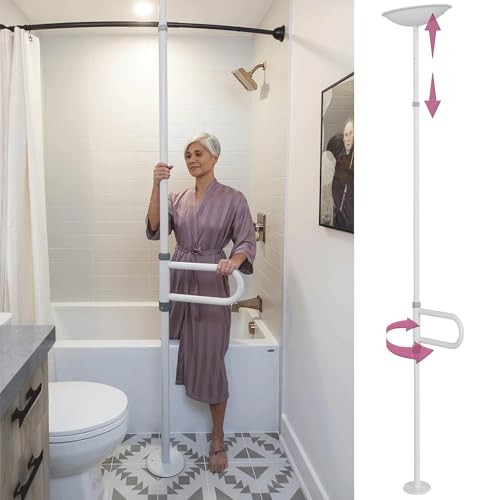
The rotating PivotBar distinguishes this pole for transfers beside a toilet, bed or chair. The HEALTHCRAFT uPole is a floor-to-ceiling, no-drill grab bar pole that supports up to 300 pounds, making its capacity useful when a buyer needs a clear load limit. The 7–10-foot fit gives a concrete ceiling range to compare against the room. Choose this model when the rotating bar suits the direction of movement; buyers who want multiple adjustable handles or a non-rotating configuration should compare the other handle layouts.
Bottom line: Choose this when a rotating bar and a 7–10-foot ceiling fit suit the transfer area.
Marudina Adjustable Transfer Pole

The 6.9–10-foot adjustment range reaches slightly lower ceilings than the 7-foot minimum of the HEALTHCRAFT option. Marudina uses an adjustable non-slip handle, dual anti-slip rubber bases and stainless steel and aluminum construction. Its capacity is 300 pounds, and the pole is intended for transfers around the bath, bed and living areas. The range is the key selection point: measure the ceiling where the bases will sit and confirm it is flat before choosing this tension-mounted design. Buyers wanting a rotating bar should consider another handle style.
Bottom line: Choose this if your measured ceiling is between 6.9 and 10 feet and you want an adjustable handle.
Stander Double Handle Non-Rotating Pole

The non-rotating double-handle arrangement separates this Stander pole from the options with a pivoting bar. Its handles can be positioned at different heights or angles, allowing a buyer to set support for a bedside, chair or bathroom transfer without choosing a rotating design. The tension-mounted pole is intended for use around the home without permanent changes. Because ceiling fit and capacity are not established here, verify both before ordering, particularly if the ceiling is unusually low or high or the user’s weight approaches a support limit.
Bottom line: Choose this if you want two non-rotating handles positioned for a particular transfer.
Stander Wonder Pole

The Wonder Pole pairs a pivoting curve grab bar with multiple handrails, rather than the double non-rotating handles on the other Stander model. Its ceiling range is 7 feet to 9 feet 6 inches, and it is a tension-mounted pole intended for standing and sitting support around the home. That range is narrower at the top than the poles reaching 10 feet, so measure the installation spot before deciding. The curve and pivoting handrails may suit transfers that benefit from more than one grasping position; verify capacity before use.
Bottom line: Choose this if your ceiling is within its range and you prefer a pivoting curved bar with multiple handrails.
How to choose a floor-to-ceiling transfer pole
Start with the ceiling measurement and the direction of the transfer, because those determine whether the pole fits and where the handhold needs to be. Measure floor to ceiling at the exact installation point; a sloped or uneven surface can prevent a tension-mounted pole from seating correctly. The models here span minimum ceiling heights of 6.9 or 7 feet and maximum heights of 9 feet 6 inches or 10 feet. Choose a pole only when the measured height falls inside its range, and confirm capacity against the user’s weight before relying on it for support.
Handle movement is the next decision: pivoting bars can change orientation, while a fixed arrangement holds a chosen angle. Think through the actual movement from bed, chair or toilet rather than selecting by appearance alone.
Transfer pole handle styles and ceiling fit
Rotating and fixed handles serve different transfer paths; neither style is automatically better for every room. A pivoting bar can change position around the pole, while adjustable-height or angle handles let a buyer configure the grasp point. A double non-rotating arrangement keeps the handles from rotating after positioning. The following comparison ties handle style to the available ceiling ranges.
| Need | Useful fit or feature |
|---|---|
| Ceiling below 7 feet | 6.9–10 ft range |
| Ceiling from 7 to 9 ft 6 in | All four stated ranges overlap this span |
| Ceiling above 9 ft 6 in through 10 ft | 7–10 ft or 6.9–10 ft range |
| Non-rotating grasp points | Double handles adjustable in height or angle |
Measure at the mounting spot rather than relying on a room’s advertised ceiling height; even a small change in surface height affects tension fit.
Safe placement and use of a transfer pole
A transfer pole is a handhold, not a substitute for a fixed wall grab bar or a mobility aid designed to carry the user’s full weight. Tension mounting depends on secure contact with the floor and ceiling, so use a flat ceiling and follow the pole maker’s installation procedure. Keep the pole near the transfer surface without placing it where a foot, wheelchair or walker path is obstructed. A 300-pound capacity applies to two of these options, but capacity is a limit, not a target; stay within the manufacturer’s load rating and do not pull against a loose or shifting pole.
After installation, check that the pole remains firm before each transfer. Stop using it if it moves, tilts or loses contact with either surface, and reassess the mounting location.
Measuring and avoiding common fit mistakes
A correct ceiling-height measurement is essential: measure vertically from the finished floor to the flat ceiling where both pole ends will rest. Do not assume a pole fitting one room will fit another, since flooring, ceiling finish and slope can alter the available span. Compare that measurement with the full stated range, not just its maximum. Also map the route from sitting to standing and confirm the selected handle can be reached from the user’s normal seated position.
For homes with a sloped ceiling, textured or fragile surfaces, or uncertain load needs, confirm compatibility with the manufacturer or an occupational therapist before installation. Never improvise a spacer or use a pole outside its height or weight limit.
Frequently Asked Questions
How do I measure for a floor-to-ceiling transfer pole?
Measure straight from the finished floor to the flat ceiling at the planned pole location. The measurement must fall within the pole’s full adjustment range; for example, a 6.9–10-foot pole cannot fit a 10-foot-1-inch ceiling.
Can a transfer pole fit a sloped ceiling?
A tension pole requires suitable contact at both ends, and the Marudina model specifies a flat ceiling. Do not assume a sloped ceiling is compatible; confirm with the maker before installing.
Are transfer poles safe for full body weight?
Use a pole only within its capacity and as a handhold for transfers, not as a device for lifting or suspending the body. Two options here specify a 300-pound capacity, and a secure installation is still essential.
How often should I check a tension-mounted pole?
Check that the pole remains firmly seated before each transfer, and stop using it if it shifts or tilts. Recheck it after moving the pole or changing the floor or ceiling contact surface.
Where should a transfer pole go beside a bed?
Place the pole close enough for the user to grasp from the normal seated position, while leaving the bed exit and mobility-aid path clear. Test the transfer route without relying on the pole if the handle cannot be reached comfortably.