
Best 12 Inch Midrange Speakers: 4 Models Compared

The PRV Audio 12MR2000 is the strongest fit for most high-output systems here, with a 4-inch voice coil and 2,000-watt power rating. Choose another model if sealed-enclosure use or a specified frequency range matters more, since the five options differ in role and published specifications.
We earn a commission if you buy through links on this page. As an Amazon Associate I earn from qualifying purchases. Products are compared on manufacturer specifications, not hands-on testing.
- Best overall: PRV Audio 12MR2000 – A 4-inch voice coil and 2,000-watt rating suit high-power two- or three-way systems.
- Best for sealed boxes: Timpano TPT-MD12 – Designed for sealed enclosures and rated at 97 dB sensitivity.
- Best for lighter builds: PRV Audio 12MR2000-NDY – The neodymium version pairs the 2,000-watt rating with a neodymium magnet.
| Product | Best for | Voice coil | Shop |
|---|---|---|---|
| PRV Audio 12MR2000 | High-power systems | 4 in | Check Price on Amazon |
| Timpano TPT-MD12 | Sealed enclosures | — | Check Price on Amazon |
| PRV Audio 12MR2000-NDY | Neodymium builds | 4 in | Check Price on Amazon |
| PRV Audio 12W800A | Extended midbass | 2.5 in | Check Price on Amazon |
12 Inch Midrange Speakers Compared
Match the speaker’s role and power handling to the system rather than choosing by wattage alone.
PRV Audio 12MR2000

For high-power two- or three-way systems, this driver stands out with its 4-inch CCAW voice coil and 2,000-watt rating. PRV says its stiff, lightweight cone maintains a linear response through 5,000 Hz, and the speaker is intended to provide vocal support in stage monitors as well as midbass output. The reinforced surround and resin-treated spider are designed for demanding use. At 23.04 pounds, it is the heaviest model here with a weight, so installers prioritizing low mass should compare the neodymium option instead.
Bottom line: Choose it for a high-output build that can accommodate its 23.04-pound weight.
Timpano TPT-MD12

The TPT-MD12 is the clearest choice for a sealed enclosure: it is designed for that box type and can also be used where high efficiency or output is the goal. Timpano gives it a 97 dB sensitivity rating and describes a natural tone with low distortion at high levels. Its 800-watt maximum musical rating is lower than the 2,000-watt PRV drivers, so it suits buyers matching a more moderate power target.
Bottom line: Pick it when sealed-box compatibility and 97 dB sensitivity are priorities.
PRV Audio 12MR2000-NDY
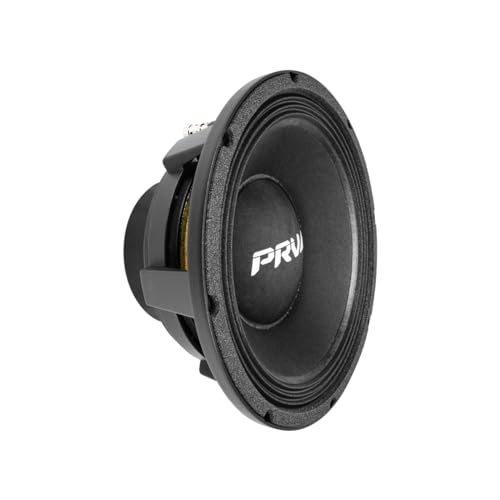
This PRV model keeps the 12MR2000’s high-power focus but uses a neodymium design, making it the distinct option for a build that calls for that magnet type. The shared 4-inch CCAW coil, reinforced surround and intended vocal support make it relevant to demanding two- or three-way systems. PRV says the cone response remains linear through 5,000 Hz. The weight is absent, so buyers working to a strict weight limit should verify the finished driver’s weight before committing; the standard 12MR2000 is specified at 23.04 pounds.
Bottom line: Choose it when a neodymium driver is the specific build requirement.
PRV Audio 12W800A

The 12W800A is the strongest match for buyers who want stated low-frequency extension alongside midbass output: its specified response runs from 60 to 5,500 Hz. PRV gives it 97 dB sensitivity, 800 watts RMS and a 2.5-inch voice coil, plus 5.72 mm Xmax for displacement. That makes it a different proposition from the 2,000-watt 12MR2000 drivers, which are framed around higher-power vocal support. Its response begins at 60 Hz, so a system needing deeper bass will require a separate low-frequency solution.
Bottom line: Pick it for an 800-watt midbass role with a specified 60 Hz lower response.
How to choose a 12 inch midrange speaker
Start with the driver’s intended band and the amplifier power, not the largest wattage number. RMS, program and maximum musical ratings describe different power-handling conventions, so compare like with like; the 12W800A’s 800-watt RMS rating is not directly equivalent to the TPT-MD12’s 800-watt maximum musical rating. Sensitivity also affects output: a 3 dB increase is roughly equivalent to doubling amplifier power for the same sound-pressure level under comparable conditions. For vocal emphasis and high-power two- or three-way designs, the 2,000-watt PRV models are the match; for sealed-box use, the Timpano is specifically designed for it. Confirm amplifier impedance and crossover compatibility before choosing.
Midrange versus midbass roles
Midrange drivers focus on the speech and instrument band, while midbass drivers extend lower to add punch and body. The exact crossover point depends on the other drivers and enclosure, but a conventional three-way system often crosses a midrange to a tweeter around 2,000 to 4,000 Hz and to a woofer around 200 to 500 Hz. The PRV 12W800A gives a 60 to 5,500 Hz response, while PRV describes the 12MR2000 cone as linear through 5,000 Hz; those figures do not replace a system crossover design. Use the following distinction when narrowing the field:
| Need | Relevant trait | Choice |
|---|---|---|
| High-power vocal support | 2,000 W and 4 in coil | PRV Audio 12MR2000 or PRV Audio 12MR2000-NDY |
| Sealed cabinet | Designed for sealed enclosure | Timpano TPT-MD12 |
| Specified extended midbass | 60–5,500 Hz response | PRV Audio 12W800A |
Impedance, power and amplifier matching
An 8-ohm speaker draws less current than a 4-ohm speaker at the same amplifier voltage, but the amplifier’s rated output usually changes with load. All four options with impedance information here are 8 ohms, so check whether the amplifier is stable at the combined impedance created by wiring multiple drivers. Two identical 8-ohm drivers wired in parallel present a nominal 4-ohm load; wired in series, they present 16 ohms. Keep continuous amplifier output within the speaker’s applicable power rating and avoid clipping, which can overheat a voice coil even when the nominal wattage seems suitable. Do not treat maximum musical and RMS ratings as interchangeable.
Enclosure and installation checks
A 12-inch nominal size does not guarantee that a driver fits a particular cutout: basket diameter, mounting depth, bolt pattern and cabinet volume determine fit. Measure the existing opening and available depth before ordering, especially for heavy high-output drivers. A sealed enclosure is a defined match for Timpano TPT-MD12, while other enclosure needs require a design suited to the driver’s parameters rather than a generic 12-inch box. Use a crossover that protects the driver below its safe operating range; midrange and midbass drivers are not substitutes for a subwoofer when deep bass is required. Secure the driver to a rigid baffle and check that wiring polarity is consistent across the system.
Frequently Asked Questions
What crossover frequency suits a 12 inch midrange speaker?
A common three-way system may cross the midrange to a tweeter around 2,000 to 4,000 Hz and to a woofer around 200 to 500 Hz. The correct points depend on the connected drivers and their usable response.
Can an 8 ohm speaker work with a 4 ohm amplifier?
Yes, an 8-ohm speaker is generally a higher load than 4 ohms, but the amplifier may deliver less power into it. Check the amplifier’s rated output at 8 ohms and avoid parallel wiring that drops the total load below its stable minimum.
How many watts should a midrange speaker handle?
Match the amplifier’s clean output to the speaker’s applicable RMS rating rather than a maximum musical figure. For example, the 12W800A is rated at 800 watts RMS, while the TPT-MD12 is rated at 800 watts maximum musical power.
Does a 12 inch speaker need a sealed enclosure?
No; enclosure type depends on the driver’s design and intended system. The TPT-MD12 is specifically designed for sealed enclosures, while other models need an enclosure chosen for their parameters and installation.
What should I measure before replacing a 12 inch speaker?
Measure the mounting cutout, basket depth and bolt pattern; nominal 12-inch size alone does not ensure a physical fit. Also verify the enclosure space and amplifier’s stable impedance before installation.