
Magnifying Glasses for Hobbies: 3 Headsets Compared

For hobby work that needs several levels of detail, YOCTOSUN 5-Lens Head Magnifier is a versatile choice because its five lenses range from 1X to 3.5X and its frame can be worn with an optional head strap. Choose JARLINK 5-Lens Headset Magnifier instead if you want a 4X lens, or YOCTOSUN 4-LED Headband Magnifier if four LEDs are a priority.
Headband magnifiers hold a lens in front of the eyes so both hands stay free for tasks such as stitching, model building and small repairs.
We earn a commission if you buy through links on this page. As an Amazon Associate I earn from qualifying purchases. Products are compared on manufacturer specifications, not hands-on testing.
- Best overall: YOCTOSUN 5-Lens Head Magnifier – Five interchangeable lenses cover 1X to 3.5X, and the frame can be worn with a head strap.
- Best for higher magnification: JARLINK 5-Lens Headset Magnifier – Its five lenses span 0.75X to 4X, including the highest power in this group.
- Best for four LEDs: YOCTOSUN 4-LED Headband Magnifier – Four LEDs provide task lighting, with two brightness levels.
| Product | Best for | Magnification range | LED lights | Shop |
|---|---|---|---|---|
| YOCTOSUN 5-Lens Head Magnifier | Versatile hobby work | 1X–3.5X | 2 | Check Price on Amazon |
| JARLINK 5-Lens Headset Magnifier | Fine-detail tasks | 0.75X–4X | 3 | Check Price on Amazon |
| YOCTOSUN 4-LED Headband Magnifier | Brighter task lighting | 1X–3.5X | 4 | Check Price on Amazon |
Magnifying Glasses for Hobbies Compared
Compare the lens ranges, lighting and wearing options to match a headset magnifier to your hobby work.
YOCTOSUN 5-Lens Head Magnifier
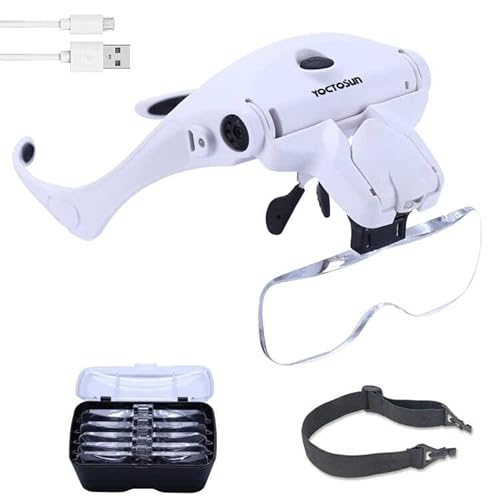
YOCTOSUN 5-Lens Head Magnifier stands apart for its option to wear the magnifier as glasses or secure it with the included head strap. The five interchangeable acrylic lenses provide 1X, 1.5X, 2X, 2.5X and 3.5X powers, while the two LEDs have two brightness levels. The flexible rubber nose pad can be shaped for fit. This range suits hobbyists who switch between broader viewing and finer detail without changing headsets. The tradeoff is that its top lens is 3.5X, below the 4X maximum offered by JARLINK 5-Lens Headset Magnifier, which matters for work requiring the strongest magnification here.
Bottom line: Choose this if you want adjustable wearing options and five magnification steps up to 3.5X.
JARLINK 5-Lens Headset Magnifier

JARLINK 5-Lens Headset Magnifier reaches 4X, the highest magnification among these three hobby headsets, and also includes a 0.75X lens at the low end. Its five acrylic resin lenses come in a portable case; the maker says the lenses have 5H hardness. Three LEDs offer two brightness levels, controlled with a side button. This wider power span can suit hobbyists who want both a lower-power view and a stronger close-detail option. The limitation is that its features do not describe an alternate glasses-style fit, so buyers who specifically want that option should consider YOCTOSUN 5-Lens Head Magnifier.
Bottom line: Pick this for the widest magnification span and a 4X lens.
YOCTOSUN 4-LED Headband Magnifier

YOCTOSUN 4-LED Headband Magnifier distinguishes itself with four LEDs, more than the two on YOCTOSUN 5-Lens Head Magnifier and three on JARLINK 5-Lens Headset Magnifier. Its five detachable lenses provide 1X, 1.5X, 2X, 2.5X and 3.5X magnification, and the maker says its rechargeable battery charges by USB Type-C. The two brightness levels let the wearer switch illumination settings at the headset. This is a fit for crafts or hobby work where built-in lighting is a deciding feature. Its maximum power is 3.5X, so choose JARLINK 5-Lens Headset Magnifier if you need the strongest lens in this comparison.
Bottom line: Choose this when four built-in LEDs matter more than reaching 4X magnification.
How to Choose Hobby Magnifying Glasses
Start with the smallest detail you need to see, then compare the available lens powers and lighting. A lower-power lens generally gives a wider view and more room to position your hands; a higher-power lens shows a smaller area and usually requires closer positioning. Swap lenses as the task changes rather than assuming the strongest lens is best for every step. For work under dim room lighting, choose a headset with built-in LEDs and brightness settings. If you move frequently while working, prioritize a secure head strap or adjustable fit. For fine work requiring more than 3.5X magnification, JARLINK 5-Lens Headset Magnifier reaches 4X; for other hobby tasks, the 1X–3.5X options offer multiple intermediate steps.
Magnification and Working Distance
Higher magnification usually means a shorter working distance, so test the comfortable space between the lens, your eyes and the object before settling into a long project. Keep the lens aligned with the area being worked on; tilting your head to compensate can make prolonged close work less comfortable. A useful starting rule is to select the lowest power that lets you see the detail clearly, then move up only when needed. The exact working distance depends on the lens design and the user’s vision, so confirm the comfortable distance before ordering if your project needs a fixed hand position. The five-step sets here progress in 0.5X increments from 1X through 3.5X, while JARLINK 5-Lens Headset Magnifier adds 0.75X, 1.25X, 3X and 4X options.
Lens and Lighting Differences
LED count and lens range are separate buying considerations: more LEDs do not mean greater magnification, and stronger magnification does not guarantee better lighting. Use this comparison to prioritize the feature that matters to your workspace.
| Need | Choose | Why |
|---|---|---|
| Glasses-style or strap wear | YOCTOSUN 5-Lens Head Magnifier | Offers both wearing options |
| Highest magnification in this group | JARLINK 5-Lens Headset Magnifier | Includes a 4X lens |
| Most built-in LEDs | YOCTOSUN 4-LED Headband Magnifier | Has four LEDs |
Built-in LEDs illuminate the work area, but they do not replace room lighting; keep the workspace evenly lit to reduce harsh contrast and shadows. Avoid staring directly into the LEDs, and take a viewing break if close work makes your eyes feel tired.
Fit and Care for Headset Magnifiers
A headset magnifier works best when it sits steadily without pressing hard on the nose or temples. Adjust the nose pad and strap so the selected lens stays centered while you look down at the project. Keep interchangeable lenses in their case when they are not in use; loose lenses can be scratched or misplaced. Clean acrylic or resin lenses with a soft, clean cloth rather than an abrasive material that could mark the surface. Remove dust before wiping so particles do not drag across the lens. Rechargeable models need their charging connection, and a charged battery is useful before a long session. If you change between lenses, store unused lenses in a consistent order so the desired power is easy to find.
Frequently Asked Questions
Which magnification should I use for cross-stitch?
Start with the lowest lens power that lets you distinguish the stitch and fabric clearly, then move up if the detail remains difficult. Higher magnification narrows the visible area and usually brings the work closer to the lens.
Do hobby magnifying glasses need built-in lights?
Built-in LEDs help when room lighting leaves the work in shadow, but they are not a substitute for even ambient light. For broader illumination among these options, YOCTOSUN 4-LED Headband Magnifier has four LEDs and two brightness levels.
How do I keep a headset magnifier comfortable?
Center the lens in your line of sight and adjust the nose pad or strap until the headset stays put without concentrated pressure. Take a break if extended close viewing causes eye fatigue.
How should I clean interchangeable magnifier lenses?
Use a soft, clean cloth after removing loose dust from the lens surface. Avoid abrasive cloths or dry rubbing over grit, which can scratch plastic or acrylic lenses.
Is a 4X lens better for every hobby?
No; a 4X lens can reveal finer details, but its narrower view and shorter working distance can make larger tasks harder to manage. Use the lowest power that gives a clear view of the detail.