
Traild Can Am X3 Brake Pads Compared by Riding Type

Choose Traild Brass X3 Pads instead for mud and water riding if you accept more noise and weaker stopping; riders replacing rotors should consider the pad-and-rotor kit, while fitment should be checked against the exact X3 year and trim.
We earn a commission if you buy through links on this page. As an Amazon Associate I earn from qualifying purchases. Products are compared on manufacturer specifications, not hands-on testing.
- Best overall: Traild Ceramic X3 Pads – Ceramic compound and pads for all four calipers, with resistance to fade under repeated use.
- Best for mud and water: Traild Brass X3 Pads – Solid brass compound is specifically aimed at muddy and wet riding.
- Best for rotor replacement: Traild Ceramic Pad and Rotor Kit – Includes four-wheel ceramic pads and Ridge Rider rotors in a bolt-on kit.
| Product | Best for | Compound / kit | Coverage | Fitment range | Shop |
|---|---|---|---|---|---|
| Traild Ceramic X3 Pads | General trail riding | Ceramic pads | Front and rear | X3 2017–2026 | Check Price on Amazon |
| Traild Brass X3 Pads | Wet muddy trails | Solid brass pads | Front and rear | X3 2017–2026 | Check Price on Amazon |
| Traild Ceramic Pad and Rotor Kit | Pads and rotors | Ceramic pads plus rotors | Full vehicle, four wheels | X3 2017–2024 | Check Price on Amazon |
Traild Can Am X3 Brake Pads
The main choice is between ceramic pads for stronger braking and brass pads intended for wet, muddy conditions.
Traild Ceramic X3 Pads

The ceramic set stands apart for riders who prioritize initial bite and repeated braking over muddy-terrain durability. It includes pads for two front and two rear calipers, and fits Maverick X3 and X3 MAX models from 2017 through 2026, plus Maverick Trail and Sport models from 2018 through 2026. Traild says the automotive-grade compound is designed for quieter operation and less fade under high temperatures. This is the broadest year range among the pad-only options. Riders seeking a pad specifically intended for mud and water should compare the brass compound instead.
Bottom line: Choose this set for broad X3 year coverage and ceramic braking characteristics.
Traild Brass X3 Pads

The solid brass construction is the distinct choice for mud, water, and wet sand, rather than high-speed or heavy braking. The CNC-machined, single-piece pads are described as direct fit with no modification, and cover X3 and X3 MAX models through 2026, alongside 2018–2026 Maverick Trail and Sport models. Their limitation matters: Traild cautions that these pads stop less effectively than its ceramic option and make more noise. Choose them for the wet-terrain priority only when that tradeoff suits your riding.
Bottom line: Pick these for wet, muddy conditions when noise and reduced stopping are acceptable.
Traild Ceramic Pad and Rotor Kit
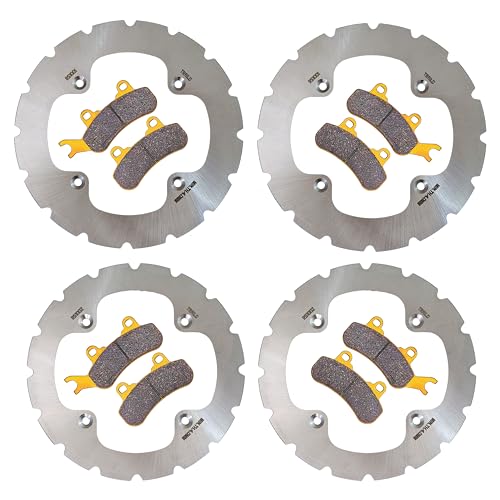
This kit is the only option here that pairs pads with rotors, making it relevant when both components are being replaced. It is a four-wheel set for all X3 models from 2017 through 2024, including named trims such as XRC, XMR, XDS, Turbo R, MAX, DS, Turbo RR, and RS. Traild says the Ridge Rider rotors use a solid surface and ridge cutouts to help debris and hot gases escape during braking. The 2024 upper year limit is narrower than the pad-only ceramic set, so owners of later models should confirm fitment before choosing it.
Bottom line: Pick this kit when the job calls for both ceramic pads and rotors on a 2017–2024 X3.
How to choose Can-Am X3 brake pad compound
Choose the compound around the riding conditions and braking demand: ceramic is the better fit here for stronger initial bite, while the brass option is aimed at mud and water. Brake pads convert the rotor’s rotation into heat through friction, so repeated hard stops raise temperature and can reduce braking consistency. A compound’s intended terrain matters because water, grit, and mud can alter the friction surface and increase wear. Avoid treating a mud-oriented pad as a high-speed choice: the brass pads specifically carry a caution against high-speed stopping and heavy braking. If your use includes those demands, the ceramic set is the more appropriate of these choices.
Use this quick comparison to match the compound to the priority.
| Riding need | Choice | Tradeoff |
|---|---|---|
| General or repeated trail braking | Ceramic pads | Not the mud-specialized compound |
| Mud, water, wet sand | Brass pads | Noisier and weaker stopping than ceramic |
| Replacing pads and rotors | Ceramic pad-and-rotor kit | Listed X3 coverage ends at 2024 |
Confirm X3 model year and trim fit
Match the year and trim before buying, because the options do not share identical coverage. The Traild ceramic pads list X3 and X3 MAX through 2026 and Maverick Trail and Sport from 2018 through 2026; the brass set lists X3 through 2026 but X3 MAX beginning in 2019. The rotor kit is limited to X3 models through 2024, while the multi-vehicle generic set lists X3 coverage through 2025. If the vehicle is a 2025 or 2026 X3, favor an option whose range reaches that year and confirm the exact trim.
When to replace pads and rotors
Inspect brake pad friction material regularly; replace pads before the material is worn to roughly 1/8 inch, or sooner if braking changes or damage is visible. Off-road use can accelerate wear because abrasive grit and mud collect around the brake assembly, and frequent hard stops add heat. Check rotor thickness against the vehicle service limit rather than relying on appearance alone; scoring, cracks, or severe uneven wear call for closer inspection. Replacing pads on a damaged or below-limit rotor can compromise the new friction surface. A pad-and-rotor kit is useful when both parts are due, but fitment year and condition should guide the decision rather than assuming every brake job needs new rotors.
Brake pad installation and safe bedding
Brake work requires secure support of the vehicle and correct reassembly of each caliper; never rely on a jack alone while working underneath. Keep grease and oil off pad friction faces and rotor surfaces, and inspect the caliper hardware and fluid condition during service. New pads generally need bedding: make several controlled moderate stops in a safe area, allowing cooling between them, and avoid prolonged hard braking immediately afterward. Exact procedures vary by pad material and vehicle, so use the vehicle service procedure and pad maker’s process where provided. After installation, verify firm pedal feel and check for leaks before riding; a soft pedal or uneven braking means the vehicle should not be ridden until corrected.
Frequently Asked Questions
How often should Can-Am X3 brake pads be inspected?
Inspect the pads at regular service intervals and after muddy or dusty rides, since grit can accelerate wear. Replace friction material before it reaches about 1/8 inch, or earlier if braking becomes uneven or the pads are damaged.
Do brass brake pads work for high-speed X3 riding?
The brass pads are not recommended for high-speed stopping or heavy braking. They are intended for mud, water, and wet sand, and are noisier with weaker stopping than the ceramic option.
When should X3 brake rotors be replaced with pads?
Replace rotors when they are cracked, badly scored, or below the vehicle’s minimum thickness. Check thickness against the service limit; new pads should not be paired casually with a damaged rotor.
How should new off-road brake pads be bedded in?
Use several controlled moderate stops in a safe area, with cooling time between stops. Avoid repeated hard stops during initial bedding, and confirm firm pedal feel before returning to the trail.
Can I use the same pads on every Maverick X3 year?
No, the year ranges differ: the ceramic pad set reaches 2026, while the ceramic pad-and-rotor kit reaches 2024. Check the exact trim and year, especially for MAX, Trail, and Sport variants.