
Adjustable Glasses for Distance: Focus Options Compared

For adjustable glasses for distance, Vi Shift Adjustable Glasses is the closest match because each lens adjusts from -6.00D to +3.00D for near and distance viewing. Choose a different option if you want magnification mainly for TV viewing or a reader-style focus dial rather than a negative-to-positive range.
We earn a commission if you buy through links on this page. As an Amazon Associate I earn from qualifying purchases. Products are compared on manufacturer specifications, not hands-on testing.
- Best overall: Vi Shift Adjustable Glasses – Each lens has a manual -6.00D to +3.00D adjustment range.
- Best for positive focus: PUDOEN Flex Focal Adjustable Glasses – The focus range is 0D to +3.5D.
- Best for TV viewing: Jojomis 2.1X Max TV Headband Glasses – The glasses offer 2.1X screen magnification and a recommended 3-meter viewing distance.
| Product | Best for | Focus range | Intended viewing | Lens or magnification | Shop |
|---|---|---|---|---|---|
| Vi Shift Adjustable Glasses | Near and distance | -6.00D to +3.00D | Near and distance | PC lenses | Check Price on Amazon |
| PUDOEN Flex Focal Adjustable Glasses | Positive focus range | 0D to +3.5D | Near, far and reading | Adjustable magnification | Check Price on Amazon |
| Jojomis 2.1X Max TV Headband Glasses | TV screen magnification | Refraction 0 to -3 | TV viewing | 2.1X magnification | Check Price on Amazon |
| ASMZEN Dial Vision Adjustable Glasses | Adjustable reading | 0D to +3.5D | Reading and screens | Adjustable lenses | Check Price on Amazon |
Adjustable glasses for distance compared
Compare each option’s focus range and intended viewing before choosing.
Vi Shift Adjustable Glasses

The broadest range here is -6.00D to +3.00D, with separate side dials for each eye. The glasses use PC lenses and weigh 91.3 grams, and the maker positions them for books, documents, computer work and distance viewing. This design may suit someone who wants to tune each side rather than use one fixed power. The range alone does not confirm a prescription or guarantee a clear distance fit, so people who need correction for driving or other safety-critical tasks should get an eye-care professional’s guidance.
Bottom line: Choose these if you need adjustable negative-to-positive focus for near and distance tasks.
PUDOEN Flex Focal Adjustable Glasses
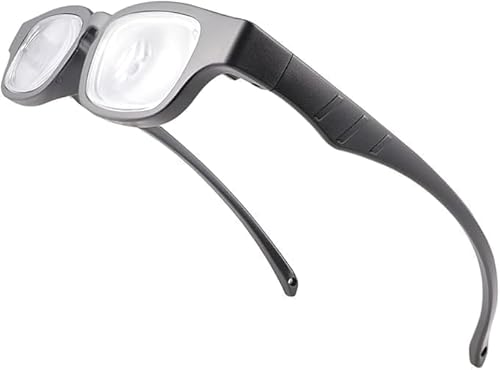
The PUDOEN option stays in positive focus, with a magnification range of 0D to +3.5D rather than the negative-to-positive span of Vi Shift Adjustable Glasses. It has a dial on each side for adjusting the lenses, and the maker describes it for near, far and reading use. That makes it a possible match for readers seeking adjustable magnification, but it is not the right substitute for distance correction involving a negative prescription. Confirm the actual lens adjustment range and suitability with an eye-care professional before relying on it for distance vision.
Bottom line: Pick this if you want a positive-only adjustable reader range.
Jojomis 2.1X Max TV Headband Glasses

The Jojomis model is intended to enlarge a television screen, not to provide broad adjustable prescription correction: its defining figure is 2.1X screen magnification. It includes a focusing wheel, gives a recommended observation distance of 3 meters and identifies a refraction range from 0 to -3. The maker describes it for people with myopia and TV viewing. Its specialized use is a limitation for anyone seeking everyday adjustable glasses for road or general distance vision; screen magnification and a focus wheel do not establish a safe driving correction.
Bottom line: Choose these for magnified TV viewing at the recommended distance, not everyday correction.
ASMZEN Dial Vision Adjustable Glasses

The ASMZEN glasses are framed as adjustable reading glasses for activities such as gaming, television and computer use, with each lens adjusted individually by a knob. Unlike Vi Shift Adjustable Glasses, their features focus on positive magnification and do not give a negative-to-positive range. The maker also claims blue-light blocking, but no technical specification accompanies that claim here. These may suit someone looking for adjustable near-task eyewear; the limitation is that the available focus information does not establish suitability for distance correction, especially for driving or other safety-sensitive viewing.
Bottom line: Pick these for adjustable reading and screen tasks rather than distance correction.
How adjustable distance glasses work
Dial-adjustable glasses change lens power mechanically, so turning a control shifts focus without swapping lenses. The Vi Shift provides a stated -6.00D to +3.00D range per lens, while positive-only reading models cover magnification rather than the same negative range. Diopters measure optical power: negative powers are used for myopia correction and positive powers for magnification or farsighted correction. Adjustable eyewear is not automatically a substitute for a prescription, because astigmatism correction and exact pupillary alignment also affect clarity. For driving, choose professionally prescribed lenses that meet your vision needs; do not rely on a general-purpose adjustable pair as a safety correction.
Choosing a focus range for distance
Start by identifying whether your distance correction requires negative lens power; a pair whose range begins at 0D cannot provide negative correction. A useful decision rule is to rule out positive-only models if your prescription has a minus sphere value. Range endpoints also do not tell you whether the frame centers the lenses correctly or corrects astigmatism, so an eye exam remains important when distance vision is persistently blurred. Adjustable glasses can be convenient for changing tasks, but a broad range is not proof that every setting will match a particular person’s prescription. For driving and other tasks where clear distance vision is essential, use eyewear selected with an eye-care professional.
TV magnification versus distance correction
TV glasses enlarge the screen, while refractive correction aims to focus an image clearly on the retina; those jobs are not interchangeable. The Jojomis specifies 2.1X magnification and a 3-meter recommended viewing distance, making its use more specialized than adjustable reading glasses. Screen enlargement can make a distant image appear larger without correcting the underlying refractive error. A practical choice is to use TV magnifiers only for the named viewing setup and select prescription correction separately for walking, driving or seeing signs. If a viewing distance changes substantially from 3 meters, the magnified image size and comfort can change as well.
Safe use and fit checks
Distance eyewear must provide clear, stable vision across the field of view; a sharp center with blur at the edges can make movement and depth judgments harder. Never use improvised adjustable glasses for driving if signs, lane markings or other vehicles are not consistently clear. Dial mechanisms change power but do not necessarily correct astigmatism, prism needs or uneven prescriptions. For persistent headaches, double vision or sudden changes in sight, stop relying on the glasses and arrange an eye exam; sudden vision loss warrants urgent care. Keep the lenses clean and check that both sides remain aligned after adjusting the dials, since a shifted frame can change where the optical centers sit relative to the eyes.
Frequently Asked Questions
Can adjustable glasses correct distance vision?
Some adjustable glasses offer negative diopters that can address myopia, but not every model does. A range that starts at 0D cannot supply minus-power correction, and adjustable lenses may not correct astigmatism.
What does a negative diopter mean?
A negative diopter is a diverging lens power commonly used to correct myopia. The amount needed depends on an eye prescription, so a broad adjustment range is not a substitute for an exam.
Are adjustable glasses safe for driving?
Only use eyewear that gives you clear, stable vision and meets your prescribed correction for driving. Magnifying TV glasses and general-purpose dial glasses are not proof of safe road vision.
Do adjustable glasses correct astigmatism?
A simple dial-adjusted spherical lens does not necessarily correct astigmatism, which needs a specific cylinder power and axis. Check your prescription and have an eye-care professional confirm whether a product can meet it.
How far away are TV glasses designed to work?
The Jojomis model gives a recommended observation distance of 3 meters. TV magnification changes apparent screen size, so it should not be treated as general distance correction.