
Alien Tape Draft Seal: 3 Sizes Compared for Fit

For most households, Alien Draft Seal 49-Foot Set is the practical starting point because its three rolls provide 49 feet of 1.4-inch-wide strip for multiple gaps. Choose Alien Draft Seal 16-Foot Set for a smaller project or Alien Draft Seal 98-Foot Set when you need the most total coverage.
Alien draft seal is a peel-and-stick flexible flap intended to cover gaps around doors and windows; confirm the gap and door clearance before applying it.
We earn a commission if you buy through links on this page. As an Amazon Associate I earn from qualifying purchases. Products are compared on manufacturer specifications, not hands-on testing.
- Best overall: Alien Draft Seal 49-Foot Set – Three rolls provide 49 feet of 1.4-inch-wide strip.
- Best for small projects: Alien Draft Seal 16-Foot Set – Its three rolls total 16 feet, less material for limited coverage.
- Best for large projects: Alien Draft Seal 98-Foot Set – Six rolls provide 98 feet of 1.4-inch-wide strip.
| Product | Best for | Total length | Strip width | Rolls | Shop |
|---|---|---|---|---|---|
| Alien Draft Seal 49-Foot Set | Multiple gaps | 49 ft | 1.4 in | 3 | Check Price on Amazon |
| Alien Draft Seal 16-Foot Set | Small projects | 16 ft | 1.3 in | 3 | Check Price on Amazon |
| Alien Draft Seal 98-Foot Set | Large projects | 98 ft | 1.4 in | 6 | Check Price on Amazon |
Alien Tape Draft Seal Options
Compare each set by total strip length and width before estimating how much of your home it can cover.
Alien Draft Seal 49-Foot Set
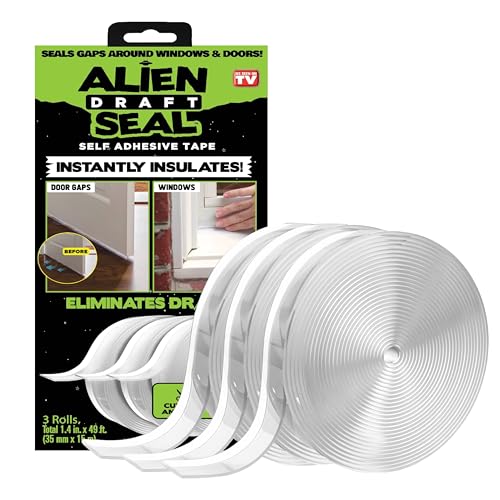
For a project that spans several openings, Alien Draft Seal 49-Foot Set provides 49 feet across three rolls, with each roll measuring 1.4 inches wide and 16.34 feet long. The transparent silicone strip has an adhesive backing and a flexible flap intended to seal door and window gaps. Measure each opening and plan cuts before peeling the backing so you can allocate the total length where needed. This set is a sensible fit for multiple gaps, but the specifications do not establish a maximum gap size; buyers with unusually wide or uneven gaps should confirm fit before applying it.
Bottom line: Choose this set when you need 49 feet of strip for multiple door or window gaps.
Alien Draft Seal 16-Foot Set

For a short run or a limited number of openings, Alien Draft Seal 16-Foot Set supplies three rolls totaling 16 feet, with a narrower 1.3-inch strip than the other sets. The transparent silicone flap is intended for doors, window bottoms and other gap areas, and its peel-and-stick backing is cut to length during installation. Its shorter combined run may help reduce leftover material on a small project. The tradeoff is coverage: a long door-and-window project may require more material, so measure the planned runs before choosing this set.
Bottom line: Pick this set for a smaller job where 16 feet is enough coverage.
Alien Draft Seal 98-Foot Set

For the most coverage in this group, Alien Draft Seal 98-Foot Set combines six rolls into 98 feet of 1.4-inch-wide transparent silicone strip. The set is packaged as two boxes and is intended for cutting to length around doors, windows and showers. Its total length is double the 49-foot set, making it the option to consider when several long runs need sealing. It also means more material to plan and apply; buyers sealing only one short gap may find a smaller set easier to allocate.
Bottom line: Choose this set when measured runs add up to a large total length.
How to choose Alien draft seal length
Choose by the total length of the gaps you plan to cover, not by the number of openings alone. Measure each straight run in inches, add the measurements, then divide by 12 to estimate feet; add a little allowance for corners and trimming. A typical exterior door is about 36 inches wide, so one bottom run uses about 3 feet, but the side and top edges add substantially more. Window dimensions vary, so measure every frame rather than assuming they match. The 16-, 49- and 98-foot sets suit progressively larger measured totals. Leave enough material for clean end cuts, and avoid stretching adhesive weatherstripping as you apply it because tension can pull the strip away from the surface.
Check door and window fit before sticking
Check that the flap can contact the surface without preventing a door or window from closing and latching. A door sweep is designed for the bottom edge, while flexible adhesive weatherstripping can address narrow gaps at the sides or top; these are different placements and should not be treated as interchangeable. The strip width of 1.3 or 1.4 inches is not a gap-capacity measurement, so confirm the gap and clearance before ordering. For a very uneven gap, a compressible foam weatherstrip may conform better than a thin flap. Clean, dry surfaces generally give pressure-sensitive adhesives a better chance to bond; dust, oil and moisture can interfere with adhesion.
Compare adhesive flaps with other draft seals
Use the gap location and shape to choose a weatherstripping type; no single format suits every opening. This table gives a practical distinction among common options, not a claim about the maximum gap any one product can cover. Adhesive flap strips are flexible and can be trimmed for a continuous run. Foam tape compresses to fill irregular spaces, while a door sweep or under-door stopper is intended for the floor-level gap. Measure the opening and check that the chosen material does not interfere with movement or latching. For exterior doors, also consider whether the seal must withstand frequent contact and exposure; an adhesive strip’s suitability for those conditions should be verified for its intended placement.
| Seal type | Typical placement | Useful distinction |
|---|---|---|
| Adhesive flap strip | Door or window frame edges | Flexible, cut-to-length run |
| Foam weatherstrip | Frame contact surfaces | Compresses into uneven gaps |
| Door sweep | Bottom edge of door | Designed to address floor-level gaps |
Prepare surfaces for adhesive weatherstripping
Clean and dry the application surface before pressing on adhesive weatherstripping; residue, dust and moisture can weaken contact. Measure and cut each section first, then apply it in a straight run with steady pressure instead of pulling it tight. At corners, make neat cuts and align the flap so it meets the opposing surface without bunching. A seal that rubs hard can peel or interfere with opening, while a seal that misses the frame may leave a draft path. Test the door or window’s movement after application and check that it closes and latches normally. For surfaces exposed to water, verify that the chosen placement and adhesive are appropriate before installing it.
Frequently Asked Questions
How many feet of draft seal does one door need?
A 36-inch-wide door bottom needs about 3 feet for that edge alone. Sealing the sides and top adds their measured lengths, so measure the entire intended run before selecting a set.
Can adhesive draft seal go on a window?
Flexible adhesive weatherstripping is commonly used on window frame contact areas, but it must not block sliding or latching. Test a short placement and confirm the window still moves freely before covering a full side.
Does a wider strip seal a wider gap?
Strip width does not by itself establish the gap size a flap can seal. Check the gap and the flap’s contact and clearance, especially where a door must still close and latch.
Should I install weatherstripping on a wet surface?
No; adhesive weatherstripping generally bonds more reliably to a clean, dry surface. Moisture, dust and oily residue can interfere with adhesion, so dry and clean the area before applying it.
Can I use draft seal under a door?
A door bottom is a different placement from the side or top frame, and a door sweep is specifically designed to address the floor-level gap. Choose a seal that clears the floor and does not prevent the door from swinging or latching.