
Auto Focus Glasses: 4 Models Compared by Features

For readers comparing auto focus glasses, Auto Focus Glasses, Silver 2-Pack is the closest match for near-to-far viewing because its maker claims the lenses adjust between distances. These products are marketed as alternatives to switching glasses, but the features do not establish how the lenses adjust or whether they suit a particular prescription.
Choose conventional prescription progressives instead if you need vision correction fitted to your eyes; confirm the lens design and optical measurements before relying on an adjustable-lens claim.
We earn a commission if you buy through links on this page. As an Amazon Associate I earn from qualifying purchases. Products are compared on manufacturer specifications, not hands-on testing.
- Best overall: Auto Focus Glasses, Silver 2-Pack – Its maker claims the lenses adjust focal length for near-to-far viewing, and the package is described as two pairs.
- Best for included case: PKRFCJ Smart Zoom Reading Glasses, 2-Pack – The product name includes a case and glasses cloth, and its maker claims smart zoom for reading and other activities.
- Best for claimed range: Auto Focus Glasses, 3-Piece Set – Its maker claims an adaptive range of 100°–700°.
- Best for lightweight frame: PRGIJ Blue Lume Auto Focus Glasses – Its maker describes a resin and PC frame as featherweight, with soft nose pads.
| Product | Best for | Pack count | Lens claim | Frame or accessories | Shop |
|---|---|---|---|---|---|
| Auto Focus Glasses, Silver 2-Pack | Near-to-far claim | 2 pairs | Auto-adjusting focal length | — | Check Price on Amazon |
| PKRFCJ Smart Zoom Reading Glasses, 2-Pack | Case and cloth | 2 pairs | Smart zoom; anti-blue protection | Case and glasses cloth | Check Price on Amazon |
| Auto Focus Glasses, 3-Piece Set | Claimed lens range | 3 pieces | 100°–700° adaptive claim | — | Check Price on Amazon |
| PRGIJ Blue Lume Auto Focus Glasses | Lightweight frame | — | 100°–700° auto-focus claim | Resin and PC | Check Price on Amazon |
Auto focus glasses compared
Compare the lens claims and package features, then verify optical suitability before choosing.
Auto Focus Glasses, Silver 2-Pack

For shoppers focused on near-to-far viewing, this two-pair set is the clearest match: its maker says the lenses adjust focal length for transitions between reading, screens and distance viewing. The maker also claims the lenses block up to 95% of blue light. Silver is the color. This may suit someone seeking a pair for multiple viewing distances, but the features do not explain the lens mechanism or establish prescription compatibility. Verify those points before relying on the glasses for vision correction.
Bottom line: Choose this if its claimed distance adjustment is your priority and the optical fit checks out.
PKRFCJ Smart Zoom Reading Glasses, 2-Pack

The distinguishing package feature is a case and glasses cloth, alongside two pairs of black smart zoom reading glasses. The maker claims the lenses support reading, computer use and outdoor activities without frequent glasses changes. Soft silicone nose pads and elastic temples are also described as comfort and fit features. This could suit someone who wants accessories included with a claimed multi-distance reading option. However, the features do not give a lens power range or explain how zoom works, so buyers needing a defined prescription should verify the lens specifications first.
Bottom line: Pick this if the included case and cloth matter more than a specified lens range.
Auto Focus Glasses, 3-Piece Set
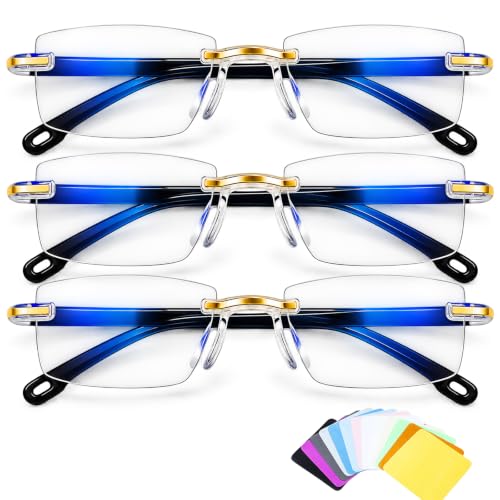
The main differentiator is a claimed 100°–700° adaptive lens range, along with a three-piece package. Its maker says blue-coated lenses adjust focal length from near to far and claims blue-light blocking for screens. The product is presented for reading, screen work and distance viewing. It may appeal to buyers prioritizing a range and multiple pieces, but the specifications do not define the meaning of the degree figures or explain whether each piece is a complete pair. Verify both the optical range and package contents before choosing.
Bottom line: Choose this if the claimed range is useful only after confirming what its figures and three-piece count mean.
PRGIJ Blue Lume Auto Focus Glasses

Frame materials distinguish this pair: the maker identifies resin and PC and describes the frame as lightweight, with soft nose pads. The maker also claims that its blue-coated lenses automatically adjust focal length across a 100°–700° range. The black pair may suit someone who values the frame materials and adjustable-lens concept. The features do not define the range or provide a weight measurement, so the comfort claim cannot be compared quantitatively. Confirm the lens specifications if you need a particular correction or working distance.
Bottom line: Pick this if resin and PC construction is a priority and the lens range is verified.
How to compare auto focus glasses
Start by separating a measurable optical specification from a broad focus claim. Standard reading glasses use a fixed lens power, while prescription progressives combine distance, intermediate and near zones in a lens made for an individual prescription. An auto focus claim should explain what changes in the lens and identify its usable range; a number without a definition is not enough to compare models. Look for the intended working distances, prescription compatibility and whether the pair is meant for both eyes. If you need correction for astigmatism or different prescriptions in each eye, choose lenses made to those measurements rather than assuming a generic adjustable lens will work.
What lens range and fit mean
Lens power is measured in diopters, written D, while pupillary distance (PD) is measured in millimeters; these are different measurements, not interchangeable range labels. A useful specification identifies lens power or adjustment limits in diopters and explains how the glasses accommodate PD and lens placement. Progressive lenses also need appropriate fitting height so the viewing zones align with the wearer’s eyes. If a claimed range is expressed only as degrees, confirm what that unit means before comparing it with a prescription. With a written prescription, compare its values and fitting needs against the lens maker’s compatibility; do not infer suitability from a broad near-to-far promise.
Auto-adjusting lenses versus progressives
Conventional progressives provide multiple fixed focal zones in a gradual lens design; they do not automatically change power as the wearer shifts focus. Reading glasses usually provide one fixed near power, so a wearer may remove them to see far away. Products marketed as auto focus glasses claim a different approach, but the term alone does not establish how the lens works or whether it produces prescription-level correction. Use this table as a screening guide, not a substitute for an optical prescription.
| Lens type | What changes | Useful verification |
|---|---|---|
| Reading glasses | Fixed near power | Diopter strength |
| Progressives | Viewing zone by gaze direction | Prescription and fitting measurements |
| Auto focus marketed | Maker claims adjustment | Mechanism, range and prescription compatibility |
Vision safety and when to get an eye exam
Glasses that do not match a person’s prescription can leave vision blurred or uncomfortable, so do not rely on a generic pair for driving or other tasks that require clear distance vision. A comprehensive eye exam can identify refractive errors and eye conditions that adjustable-lens marketing does not assess. If vision changes suddenly, or one eye sees differently from the other, arrange professional evaluation rather than trying stronger or different readers. Screen use also does not establish a need for blue-light lenses; the key buying question is whether the glasses provide the correction and fit you need. Keep prescription glasses available until any alternative has been confirmed as suitable.
Frequently Asked Questions
Are auto focus glasses the same as progressive lenses?
No. Progressives have fixed distance, intermediate and near zones, while auto focus glasses are marketed as changing focus; verify the mechanism and optical range for a specific pair.
What does 100°–700° mean on auto focus glasses?
The degree figures need a definition before they can be compared with lens power. Diopters (D), not angular degrees, are the standard unit used to express spectacle lens power.
Can auto focus glasses replace prescription glasses?
Only if the lenses provide the correction and fit prescribed for your eyes. Verify prescription compatibility and fitting measurements, especially if your eyes have different prescriptions or astigmatism.
Are auto focus glasses suitable for driving?
Do not use them for driving unless they provide clear distance vision and meet your prescription needs. A reading-focused lens can blur distant objects, so confirm suitability with an eye-care professional.
Do blue-light lenses improve vision for screens?
Blue-light filtering does not determine whether a lens corrects your vision. Choose screen glasses based on the needed prescription and working distance, and treat filtering percentages as a maker claim.