
Baja Gold Salt: Fine or Granular for Your Cooking

Choose fine Baja Gold salt for baking and even everyday seasoning, or natural grain crystals for finishing, pickling and salt crusts. Baja Gold Fine Grind, 5 lb is the named fine grind option in a 5 lb bag; choose a different grind if you want visible crystals or a slower-melting finish.
Fine salt is milled to a flour-like texture, while natural grain is coarser. Both are sea salts; the practical difference is how each disperses and feels in food.
We earn a commission if you buy through links on this page. As an Amazon Associate I earn from qualifying purchases. Products are compared on manufacturer specifications, not hands-on testing.
- Best overall: Baja Gold Fine Grind, 5 lb – Fine grind is the clearest all-purpose choice for baking, sautéing and everyday seasoning.
- Best for smaller quantities: Baja Gold Fine Grind, 1 lb – Fine grind comes in a 1 lb bag for kitchens that do not need a larger supply.
- Best for finishing: Baja Gold Natural Grain, 5 lb – Natural grain crystals suit finishing, pickling and salt-crust preparations.
| Product | Best for | Grind | Package size | Notable use | Shop |
|---|---|---|---|---|---|
| Baja Gold Fine Grind, 5 lb | Everyday fine seasoning | Fine | 80 oz | Cooking and baking | Check Price on Amazon |
| Baja Gold Fine Grind, 1 lb | Smaller fine salt supply | Fine | 16 oz | Cooking and baking | Check Price on Amazon |
| Baja Gold Fine Salt Shaker, 9 oz | Countertop seasoning | Fine | 9 oz | Table use | Check Price on Amazon |
| Baja Gold Natural Grain, 5 lb | Coarse-grain finishing | Natural grain | 80 oz | Finishing and pickling | Check Price on Amazon |
Baja Gold Salt Fine or Granular Options
Choose the grain size and package format that match how you season, bake or finish food.
Baja Gold Fine Grind, 5 lb
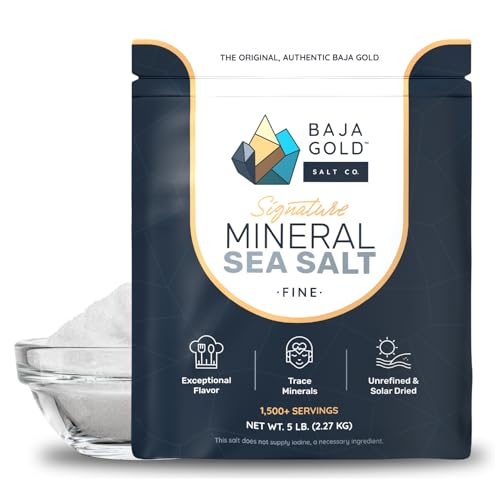
Baja Gold Fine Grind, 5 lb pairs the fine grind with the largest fine salt bag among these options: 5 lb. Its flour-like texture is intended for cooking and baking, where even distribution matters more than a crunchy finish. Baja Gold says the unrefined salt retains naturally occurring trace minerals, including magnesium and potassium. The larger bag suits frequent cooks who use fine salt across multiple dishes. The limitation is the package size: cooks who want to sample the grind or use fine salt only occasionally may prefer the 1 lb bag.
Bottom line: Choose this if you regularly use fine salt for cooking and baking.
Baja Gold Fine Grind, 1 lb

Baja Gold Fine Grind, 1 lb offers the same fine grind style in a 1 lb bag, rather than the 5 lb format. The flour-like texture works for baking and everyday seasoning, and Baja Gold says this unrefined salt contains trace minerals such as magnesium and potassium. Its smaller package is a practical match for a compact pantry or a cook who uses fine salt selectively. The tradeoff is less quantity on hand than the larger bag, so frequent fine salt users may need to replenish sooner.
Bottom line: Pick this when you want fine grind without keeping a 5 lb bag.
Baja Gold Fine Salt Shaker, 9 oz

Baja Gold Fine Salt Shaker, 9 oz puts fine Baja Gold salt in a countertop shaker rather than a bulk bag. The maker says the salt is lightly air-dried to support smooth flow and prevent clumping; the fine grain is intended to disperse across food for table use, sautéing, baking, soups and sauces. At 9 oz, this format suits cooks who want a ready-to-season container beside the stove or table. Its limitation is capacity: it is a smaller supply than either bag, so it is not the best fit for stocking a pantry.
Bottom line: Choose this for ready-to-use countertop seasoning in a shaker.
Baja Gold Natural Grain, 5 lb

Baja Gold Natural Grain, 5 lb is the natural grain choice, with larger crystals instead of the fine grind. Baja Gold positions this texture for finishing, pickling and salt crusts, where visible crystals and a more substantial texture can be useful. The 5 lb bag suits cooks who use coarse salt regularly for those jobs. The limitation is its grain: it is less suited than fine salt when a recipe calls for flour-like particles or an evenly dispersed fine seasoning. For baking, choose one of the fine grind options instead.
Bottom line: Pick this for coarse crystals used in finishing, pickling or salt crusts.
How to choose between fine and granular salt
Fine salt suits recipes where rapid, even distribution matters; natural grain crystals suit finishing and preparations that benefit from a coarse texture. Fine particles dissolve and blend faster than larger crystals, while larger crystals remain more noticeable on a finished dish. A useful decision rule is to choose fine grind when the recipe mixes salt throughout batter, dough or a sauce, and natural grain when you want crystals to remain distinct on a surface. Salt volume measurements are not interchangeable across grain sizes: a teaspoon of fine salt packs differently from a teaspoon of coarse crystals. When replacing one grind with another in a measured recipe, weigh the salt if the recipe gives a weight; otherwise, avoid assuming equal spoonfuls deliver equal amounts.
Which Baja Gold grind fits common kitchen tasks
Fine grind fits baking and everyday seasoning, while natural grain is suited to finishing, pickling and salt crusts. For precise baking, even distribution matters because salt is mixed through the dough or batter; coarse crystals may not spread uniformly when stirred in briefly. On vegetables, meat or other finished dishes, larger crystals can provide a more noticeable texture. This guide maps the intended use to the grain choice without treating the grinds as direct volume-for-volume substitutes.
| Kitchen task | Grind to consider |
|---|---|
| Baking and mixed-in seasoning | Fine |
| Finishing dishes | Natural grain |
| Pickling and salt crusts | Natural grain |
| Tabletop seasoning | Fine shaker |
How to store sea salt and keep its texture
Dry storage helps salt stay free-flowing: keep the container closed and away from steam, splashes and damp utensils. Salt readily takes up moisture from humid air, and fine grains can form clumps when exposed to moisture. Store a countertop shaker away from the stove’s steam path, and return bags to a sealed, dry container after opening. Avoid shaking salt directly over a steaming pot if moisture can enter the container. A clean, dry spoon also helps prevent damp clumps in a pantry supply. The shaker option is described as lightly air-dried to support smooth flow, but dry handling still matters for any salt stored near cooking moisture.
Frequently Asked Questions
Can I substitute fine salt for natural grain salt?
You can substitute by taste in many savory dishes, but the textures and volume measures differ. Fine salt dissolves and disperses more quickly, while larger crystals can remain distinct; weigh the salt when a baking recipe provides a weight.
Which Baja Gold grind works better for baking?
Fine grind is the better match for baking because its flour-like texture mixes through batter and dough more evenly than larger crystals. If a recipe specifies salt by weight, measure by weight rather than assuming a spoonful of another grind is equivalent.
Does natural grain salt dissolve as quickly as fine salt?
No, larger crystals generally dissolve more slowly than fine particles. For a sauce or dough where salt needs to blend quickly, fine grind is the more convenient choice.
How should I keep sea salt from clumping?
Store salt sealed in a dry place away from steam and splashes. Use a dry utensil, and keep a countertop shaker out of the stove’s steam path because moisture encourages clumping.
Is natural grain salt suitable for pickling?
Natural grain is positioned for pickling, but the recipe’s required salt amount and measurement method still matter. Use a weight measurement when available, since crystal size changes how much salt fits in a spoon.