
Baking Soda Aluminum Free: 4 Options Compared

Quay Naturals Pure Baking Soda is the clearest match for baking soda aluminum free because it is a 1-pound, food grade sodium bicarbonate product marked aluminum-free.
Baking soda is sodium bicarbonate, a single-ingredient leavener that needs an acidic ingredient in the recipe to release carbon dioxide.
We earn a commission if you buy through links on this page. As an Amazon Associate I earn from qualifying purchases. Products are compared on manufacturer specifications, not hands-on testing.
- Best overall: Quay Naturals Pure Baking Soda – A 1-pound food grade baking soda package specifically marked aluminum-free.
- Best for larger quantity: Food Grade Baking Soda, 2 lb – The 2-pound food grade package is twice the amount of the 1-pound options.
| Product | Best for | Amount | Intended use | Shop |
|---|---|---|---|---|
| Quay Naturals Pure Baking Soda | Everyday baking | 16 oz | Food and household use | Check Price on Amazon |
| Food Grade Baking Soda, 2 lb | Larger supply | 32 oz | Food and household use | Check Price on Amazon |
| BioWisdom Baking Soda Powder | Organic-use positioning | 16 oz | Health and wellness positioning | Check Price on Amazon |
| Nature’s Sodium Bicarbonate | Wellness positioning | 16 oz | Health and wellness positioning | Check Price on Amazon |
Aluminum-Free Baking Soda Options
Compare the products by ingredient type, package amount, and the purpose each is presented for.
Quay Naturals Pure Baking Soda

Quay Naturals Pure Baking Soda stands out for directly pairing an aluminum-free claim with food grade baking soda and a 1-pound package. The maker says it meets USP standards and positions it for baking as well as cleaning and deodorizing; it is also described as vegan, gluten-free, fragrance-free, and dye-free. That makes it a practical fit when you want one product for kitchen and household tasks. The package is smaller than Food Grade Baking Soda, 2 lb, so it is less suited to buyers seeking a 2-pound supply. For baking, remember that baking soda needs an acidic ingredient to leaven a recipe.
Bottom line: Choose this if you want a 1-pound, food grade option for baking and general household use.
Food Grade Baking Soda, 2 lb

Food Grade Baking Soda, 2 lb is the largest baking soda package here at 2 pounds, twice the amount in the 1-pound packages. Its product name identifies it as food grade and aluminum free, and the maker describes it as pure sodium bicarbonate for baked goods, cleaning, and deodorizing. Pick this size if you regularly use baking soda for both cooking and home tasks and prefer fewer package replacements. The tradeoff is that a larger amount may be unnecessary if you bake only occasionally. Baking soda is not a direct substitute for baking powder because it needs recipe acidity to produce lift.
Bottom line: Pick this for frequent use when a 2-pound package suits your storage space.
BioWisdom Baking Soda Powder
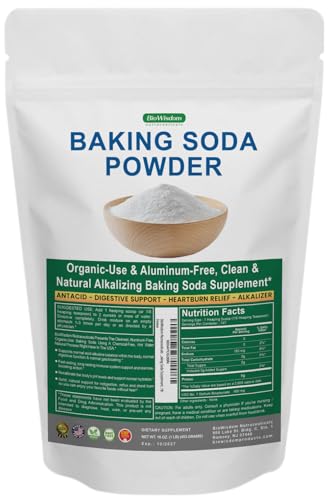
BioWisdom Baking Soda Powder differs from the straightforward food-and-household choices by emphasizing organic use and health-and-wellness positioning. The maker describes a water-only process and calls the powder aluminum-free; its package contains 1 pound. Those claims distinguish it for shoppers focused on the product’s processing and intended positioning, rather than simply seeking a kitchen staple. However, the product name and features also promote supplement and digestive uses, so it is not as clearly focused on ordinary baking as Quay Naturals Pure Baking Soda or Food Grade Baking Soda, 2 lb. Baking soda is sodium bicarbonate, but a product’s food grade status should be clear before using it in recipes.
Bottom line: Consider this if the organic-use positioning matters more than a baking-first focus.
Nature’s Sodium Bicarbonate

Nature’s Sodium Bicarbonate is presented as organic-use aluminum-free baking soda for health and wellness, rather than with the baking and cleaning use cases emphasized by Quay Naturals Pure Baking Soda and Food Grade Baking Soda, 2 lb. The product name identifies sodium bicarbonate and a 1-pound package, but offers little indication of how it is intended to perform in recipes or household tasks. That makes it a more limited match for someone specifically shopping for a baking staple. Choose a product that clearly identifies food grade use when cooking is the main purpose; baking soda and baking powder are different ingredients and cannot be swapped one-for-one.
Bottom line: Choose this only when its wellness-oriented positioning matches your intended use.
How to Choose Aluminum-Free Baking Soda
Choose a product clearly intended for food use when baking is the priority, and match the package amount to how often you cook. Baking soda is sodium bicarbonate; aluminum is not part of the chemical formula, so the useful distinction is whether the package identifies the contents as baking soda rather than baking powder and makes an explicit aluminum-free claim. For recipes, baking soda needs an acidic ingredient such as buttermilk, yogurt, lemon juice, or vinegar to make carbon dioxide. A package that emphasizes other uses may not be as clear a kitchen choice. If you bake only occasionally, a 1-pound amount is more manageable than 2 pounds; frequent kitchen and household use can justify the larger package.
Baking Soda and Baking Powder Are Not Interchangeable
Baking soda is a single leavener, while baking powder combines sodium bicarbonate with acid salts and usually a starch. A recipe that calls for baking soda relies on acidity in its other ingredients; baking powder carries its own acid and can work in recipes without a separate acidic ingredient. Use the ingredient named in the recipe rather than swapping equal amounts. Baking soda also has household uses such as deodorizing, but a cleaning use does not make a product suitable for food; confirm food grade labeling before cooking.
Package Size and Storage
Package size changes how much product you keep on hand, not the leavening chemistry. The options here range from 16 ounces to 32 ounces, and a 32-ounce package contains twice as much as a 16-ounce one. Keep baking soda in a cool, dry place and close the container between uses; moisture can cause clumping and reduce its usefulness as a dry ingredient. For recipes that depend on a strong rise, freshness matters: replace a package that has absorbed moisture or odors. Use a dry measuring spoon and avoid returning a spoon that has touched wet ingredients to the container. Store household-use powder separately from ingredients when there is any chance of cross-contamination.
Frequently Asked Questions
Does baking soda contain aluminum naturally?
Baking soda is sodium bicarbonate, whose chemical formula is NaHCO₃ and contains no aluminum. Check that a package is actually baking soda rather than baking powder, which is a blended leavener.
Can I replace baking powder with baking soda?
Not in equal amounts, because baking soda needs acid in the recipe while baking powder includes an acid component. Use the leavener named by the recipe unless you are adjusting the full formula.
How much baking soda should I use in a recipe?
Use the amount specified by the recipe because too much can leave a soapy or bitter taste. Baking soda also needs acidic ingredients, such as buttermilk or lemon juice, to produce leavening gas.
How should I store baking soda for baking?
Keep baking soda sealed in a cool, dry place to limit moisture and odor absorption. Use a dry spoon, and replace powder that has become damp or strongly scented.
How can I tell baking soda from baking powder?
Baking soda packages identify sodium bicarbonate as the ingredient, while baking powder is a mixture of bicarbonate, acid salts, and usually starch. Read the product name and ingredient label before using it in a recipe.