
Best Auto-Darkening Welding Hood: 4 Models Compared

The YESWELDER LYG-M800H suits most welders who want a broad view and four arc sensors, with a 3.93-by-3.66-inch viewing area. An auto-darkening hood uses a lens that switches to a darker shade when it detects an arc.
Choose ARCCAPTAIN Helmet with Light instead if an attached work light matters, or YESWELDER LYG-L600A if ANSI Z87.1 certification is a deciding requirement.
We earn a commission if you buy through links on this page. As an Amazon Associate I earn from qualifying purchases. Products are compared on manufacturer specifications, not hands-on testing.
- Best overall: YESWELDER LYG-M800H – Its 3.93-by-3.66-inch viewing area and four arc sensors suit varied shop tasks.
- Best for low-light work: ARCCAPTAIN Helmet with Light – It includes a USB-powered LED light with two brightness settings.
- Best for certification: YESWELDER LYG-L600A – Its product name identifies ANSI Z87.1 certification.
| Product | Best for | Viewing area | Arc sensors | Response time | Shop |
|---|---|---|---|---|---|
| YESWELDER LYG-M800H | Wide-view versatility | 3.93 × 3.66 in | 4 | 1/30,000 sec | Check Price on Amazon |
| YESWELDER LYG-L600A | Certification priority | 3.64 × 1.67 in | 2 | 1/30,000 sec | Check Price on Amazon |
| ARCCAPTAIN Helmet with Light | Dim work areas | 3.94 × 3.66 in | 4 | 1/25,000 sec | Check Price on Amazon |
| Auto-Darkening Helmet with Vent System | Ventilation feature | — | — | 0.1 ms | Check Price on Amazon |
Best Auto-Darkening Welding Hoods
Compare lens coverage, sensor count, and shade range against the welding processes and workspace you use.
YESWELDER LYG-M800H
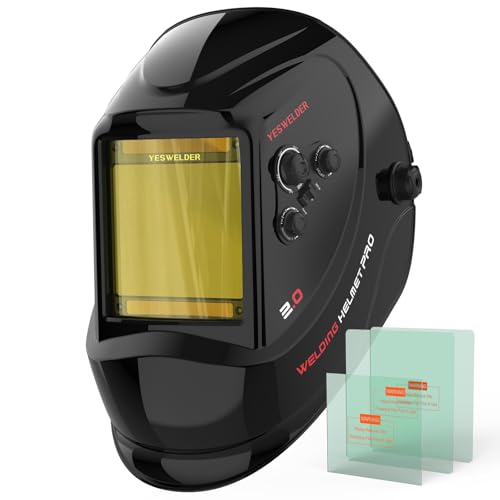
The YESWELDER LYG-M800H combines the widest viewing area here with four arc sensors. Its 1/1/1/1 optical clarity rating and true-color lens provide a natural-color view, while the shade range covers 3/5-9/9-13. The maker says the lens switches in 1/30,000 second and supports TIG, MIG, Stick, cutting, and grinding. This hood suits welders moving among several common processes. Its larger viewing area may matter less to someone prioritizing an integrated work light or a certification.
Bottom line: Choose this for a wide view and multiple welding processes.
YESWELDER LYG-L600A

The YESWELDER LYG-L600A is the only option here whose product name identifies ANSI Z87.1 certification. Its 3.64-by-1.67-inch viewing area is narrower than the other specified windows, and its lens has 1/1/1/1 optical clarity. The maker says two arc sensors switch in 1/30,000 second; adjustable sensitivity and delay help tailor switching to arc and lighting conditions. Shade 3/7-13 covers TIG, MIG, and arc welding, with a grind mode. Pick it when the certification callout matters more than a large viewing window.
Bottom line: Choose this when the ANSI Z87.1 certification is a priority.
ARCCAPTAIN Helmet with Light

The ARCCAPTAIN stands apart with a USB-powered LED work light, supplied uninstalled, with two brightness levels. Its 3.94-by-3.66-inch window is the largest specified here, and the lens offers shade 4/5-8/9-13. The maker says four sensors switch in 1/25,000 second; the lens is solar-powered and has a replaceable battery. TIG, MIG, Stick, grinding, and cutting are named applications. This is a fit for dim work areas, though buyers wanting a work light ready to use immediately should account for attaching it first.
Bottom line: Choose this if an integrated work light is useful in a dim workspace.
Auto-Darkening Helmet with Vent System

The Auto-Darkening Helmet with Vent System is the only model here that calls out a breathable vent system and adjustable headband. Its product name also identifies UV/IR protection, and its features claim a 0.1-millisecond transition and true-color optics. TIG, MIG, arc welding, and grinding are named uses. This may suit buyers who prioritize the headband and vent features. The specifications do not give a viewing-window measurement, sensor count, or shade range, so compare those specifications with your welding process before choosing.
Bottom line: Choose this if its vent system and adjustable headband are your priorities.
How to choose an auto-darkening welding hood
Start with shade range and process, then compare viewing area and sensor count. Welding shades are numbered by darkness: higher numbers transmit less visible light, and the correct setting depends on process and welding current. A range that includes 9-13 gives more high-shade adjustment than a lens capped at 13 but starting at 7; make sure the range also covers any lower-shade work you do. A larger window helps keep the joint and surrounding work in view, while multiple sensors can help detect an arc from more angles. For example, select a hood with at least four sensors if your work regularly puts your face or hands in positions that can obstruct a sensor.
Check fit and adjust the headgear so the hood stays in place when raised or lowered. A loose fit can shift the viewing area away from your line of sight.
Understanding shade range and welding safety
Choose the shade for the welding process and current, not simply the darkest setting available. Arc welding produces intense visible light and ultraviolet and infrared radiation; use a welding helmet with an appropriate filter shade, and protect exposed skin with suitable clothing. OSHA’s welding guidance gives shade recommendations by operation and current, so consult its table or your workplace safety procedure when selecting the setting. A hood alone does not protect hands, arms, or neck. Keep a properly rated lens in place and inspect the lens and cover plates for cracks, pitting, or spatter before work; replace damaged parts before striking an arc.
Grinding is a separate mode on some helmets, not permission to use a welding shade for every task. Follow the tool’s eye-protection requirements when grinding.
Comparing window size, sensors, and extra features
Viewing area and sensor count are different buying factors: a wide window improves the field of view, while sensors detect the arc to trigger darkening. The table below separates those measurable traits from a useful work-area feature.
| Need | Compare | Decision rule |
|---|---|---|
| More peripheral view | Viewing-area dimensions | Choose a larger window if you need to see the joint edges without shifting your head. |
| Arc detection angles | Sensor count | Favor more sensors when positioning can obstruct a sensor. |
| Dark workspace | Work light | Choose a light-equipped model if added local illumination is useful. |
A work light illuminates the work area but does not replace the lens filter or proper task lighting. A 1/1/1/1 optical clarity rating is a useful comparison point for lens clarity, but it does not determine the correct shade or substitute for safe setup.
Fitting and maintaining a welding hood
Set headgear tension and the viewing angle before welding so the hood remains stable through repeated flips. Adjust the headband to avoid pressure points and confirm the lens aligns with your eyes in the working position. Keep the outer and inner cover plates clean; spatter and scratches can obscure the puddle and make it harder to see the joint. Inspect cover plates and the helmet shell before each session, and replace damaged covers rather than welding through a cloudy or cracked surface. Keep spare cover plates compatible with the helmet on hand. Store the hood away from direct heat, moisture, and abrasive equipment that could damage the lens or headgear.
Frequently Asked Questions
How many sensors should a welding hood have?
Two sensors can suit straightforward positions with an unobstructed view of the arc, while four can help when your hands or workpiece may block one sensor. Keep the hood positioned so its sensors can see the arc.
What shade should I use for MIG welding?
The appropriate shade depends on welding current and the applicable safety guidance, so there is no single shade for every MIG setup. Use the process-and-current shade recommendations from OSHA or your workplace procedure, and select a lens range that includes that setting.
Does true-color optics change the required shade?
No, true-color optics affect the view through the lens, not the protection level required for the arc. Choose shade by welding process and current even when the view appears more natural.
Can I grind with an auto-darkening welding hood?
Use a dedicated grind mode only when the hood provides one, and check that it leaves a suitable view for grinding. Grinding also requires eye protection appropriate to the tool and task; a welding shade is not automatically the right protection.
How often should welding helmet cover plates be replaced?
Replace a cover plate when spatter, cracks, or scratches interfere with a clear view, and inspect it before each welding session. Work with heavy spatter can require more frequent replacement than occasional light welding.