
Best Bathroom Door Locks: 3 Picks by Use and Fit

For most homes, Kwikset Casey Privacy Lever is the best bathroom door lock because its keyless privacy turn button can be released from outside with the included tool. Choose OAKMOORE Vacant/Occupied Restroom Lock instead for a public restroom that needs a vacant/occupied indicator; BESTTEN Keyed Entry Knob and Lanwandeng Keyed Entry Knob are keyed-entry locks, not privacy locks suited to a typical bathroom interior.
We earn a commission if you buy through links on this page. As an Amazon Associate I earn from qualifying purchases. Products are compared on manufacturer specifications, not hands-on testing.
- Best overall: Kwikset Casey Privacy Lever – Keyless inside turn button and outside release tool suit bedroom and bathroom privacy.
- Best for public restrooms: OAKMOORE Vacant/Occupied Restroom Lock – A visible vacant/occupied indicator is designed for commercial bathroom doors.
| Product | Best for | Lock function | Door thickness | Backset | Shop |
|---|---|---|---|---|---|
| Kwikset Casey Privacy Lever | Home bathroom privacy | Keyless privacy | 1 3/8–1 3/4 in | 2 3/8 or 2 3/4 in | Check Price on Amazon |
| OAKMOORE Vacant/Occupied Restroom Lock | Commercial restroom use | Vacant/occupied indicator | 1 3/8–2 in | Adjustable | Check Price on Amazon |
| BESTTEN Keyed Entry Knob | Keyed entry use | Keyed entry | 1 3/8–1 3/4 in | 2 3/8 or 2 3/4 in | Check Price on Amazon |
| Lanwandeng Keyed Entry Knob | Keyed entry use | Keyed entry | — | 2 3/8 or 2 3/4 in | Check Price on Amazon |
Bathroom Door Locks for Home and Commercial Use
Choose by privacy function first, then confirm that the lock fits the door thickness and backset.
Kwikset Casey Privacy Lever

Unlike keyed-entry knobs, this privacy lever locks with an inside turn button and can be released from outside with its included tool. It is intended for bedrooms and bathrooms, and its reversible lever accommodates either door handing. The latch adjusts to either 2 3/8- or 2 3/4-inch backsets, while the lever fits doors 1 3/8 to 1 3/4 inches thick. The maker identifies its security, durability, and finish as Grade 3 BHMA certified. This is a privacy lock, not a keyed security lock; buyers who need a visible occupied indicator should choose a commercial restroom lock instead.
Bottom line: Pick this for a standard home bathroom door that needs keyless privacy.
OAKMOORE Vacant/Occupied Restroom Lock
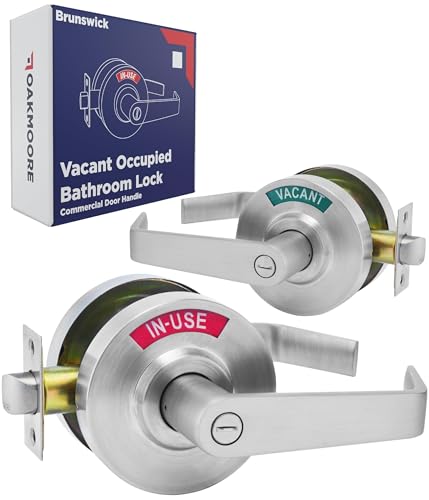
The visible vacant/occupied indicator distinguishes this commercial restroom lock from home privacy levers that only show an inside lock state. Its stainless-steel construction is intended for frequent use and exposure to grime, moisture, and grease, and the maker includes a 2-year warranty. It fits doors 1 3/8 to 2 inches thick and has an adjustable backset; installation is described as drop-in. Choose it for a public or industrial restroom where visitors need an occupancy signal. Its commercial indicator function is more than a typical home bathroom needs, so a simpler privacy lock is a better match for most residences.
Bottom line: Choose this when a commercial restroom needs a visible occupancy signal.
BESTTEN Keyed Entry Knob

Unlike the keyless privacy lever, this knob uses a key and locks on both sides, making it an entry-style lock rather than a conventional bathroom privacy set. The package includes three keys and uses a KW1 keyway; the maker says it is not rekeyable. Stainless steel handles and a brass mechanism form its construction, and the maker reports testing to 250,000 cycles. It fits doors 1 3/8 to 1 3/4 inches thick with either a 2 3/8- or 2 3/4-inch backset. A bathroom door that occupants must open without a key is a poor use for this keyed function.
Bottom line: Use this only if a keyed lock is genuinely needed on the door.
Lanwandeng Keyed Entry Knob

This keyed knob differs from the bathroom privacy options by requiring a key rather than an inside turn button or restroom indicator. The package includes three brass keys, and the maker says the keys are alike across the locks. Its stainless-steel knobs, copper lock, and matte black finish are identified in the product features; the maker also reports ANSI Grade 3 and more than 200,000 cycles. The adjustable latch fits 2 3/8- or 2 3/4-inch backsets. Door-thickness compatibility is a key fit check before purchase because this product’s specified dimensions do not establish a thickness range.
Bottom line: Pick this only when shared keyed entry matters more than bathroom privacy.
How to Choose a Bathroom Door Lock
For a typical home bathroom, choose a privacy lock with an inside turn button and an outside emergency release. Privacy locks are intended to prevent casual entry, not to provide keyed security; avoid a two-sided keyed entry function where a person inside may need to exit without a key. For shared public restrooms, an occupancy indicator adds a clear vacant/in-use signal. A measurable fit rule is to match both door thickness and backset: a lock that accepts a 2 3/8-inch backset will not automatically fit a 2 3/4-inch preparation unless its latch adjusts. Check the existing door measurements before selecting the lock function.
Bathroom Door Thickness and Backset Fit
Most common residential interior doors are 1 3/8 inches thick, while many entry doors are 1 3/4 inches thick; bathroom locks should match the actual door, not just the room name. Backset is the distance from the door edge to the center of the knob or lever bore, commonly 2 3/8 or 2 3/4 inches. Measure from the edge to the center of the existing handle hole, then verify the lock supports that measurement and the door thickness. Adjustable latches cover both common backsets, but they do not solve a mismatch in door thickness. Commercial doors may be thicker, so verify the range before ordering.
Privacy Locks and Commercial Indicator Locks
Home privacy locks and commercial restroom locks solve different problems: the former restricts entry from outside, while the latter may also show whether a stall or restroom is occupied. A release tool or emergency pin allows an outside release on many residential privacy sets; keep the tool accessible and ensure household members know where it is. Commercial indicator locks are useful where users need a visible status signal, but their installation and door preparation can differ from ordinary residential knobs. The following table separates the main functions so the intended use—not the finish—drives the choice.
| Need | Lock type | Useful fit check |
|---|---|---|
| Home bathroom privacy | Turn-button privacy lock | Door thickness and backset |
| Public restroom occupancy | Vacant/occupied indicator lock | Commercial door preparation |
| Key-controlled access | Keyed entry lock | Key access on both sides |
Bathroom Lock Safety and Common Fit Mistakes
A bathroom privacy lock should allow emergency access from outside, because a locked door can become a safety issue if someone inside cannot respond. Keep any release tool or pin in a known, reachable place rather than relying on a key that may be elsewhere. Common installation mistakes include measuring backset from the wrong point, overlooking the door thickness, and assuming a keyed entry knob works like a privacy latch. Before fitting a new lock, compare the latch orientation and hole locations with the existing door preparation. For high-use commercial doors, select a lock specifically intended for that setting rather than assuming a residential privacy set will provide an occupancy indicator.
Frequently Asked Questions
How do I measure a bathroom door backset?
Measure from the door edge to the center of the knob or lever bore. The common residential backsets are 2 3/8 and 2 3/4 inches, so verify which one the latch must match.
Can a bathroom privacy lock open from outside?
Many residential privacy locks include an outside emergency release, often operated with a pin or release tool. Keep the tool accessible and confirm the lock’s release method before installation.
What is the difference between a privacy lock and a keyed lock?
A privacy lock usually locks from inside with a turn button and allows emergency release from outside. A keyed entry lock requires a key and may lock from both sides, so it is not the usual choice for an interior bathroom.
What door thickness fits a bathroom lever lock?
Many residential interior doors are 1 3/8 inches thick, and common entry doors are 1 3/4 inches thick. Check the lock’s thickness range against the door before installation.
Do commercial bathroom locks show occupancy?
Some commercial restroom locks include a vacant/occupied indicator, while ordinary residential privacy locks generally provide no visible status outside. Choose an indicator lock when visitors need to see whether the restroom is in use.