
Best Boot for High Arches: 4 Options Compared

For most people seeking the best boot for high arches, OrthoComfoot Women’s Ankle Hiking Boot is the closest match because it is a women’s waterproof ankle hiking boot with built-in orthotic support and a wide size 7 fit. Choose an insole instead if you already have boots that fit well and want to add firmer arch support.
We earn a commission if you buy through links on this page. As an Amazon Associate I earn from qualifying purchases. Products are compared on manufacturer specifications, not hands-on testing.
- Best overall: OrthoComfoot Women’s Ankle Hiking Boot – A waterproof ankle hiking boot with built-in orthotic support, offered in a wide size 7.
- Best for larger sizes: VALSOLE Heavy Duty High Arch Insoles – A heavy-duty high arch insert sized for men’s 12–12.5 and women’s 14–14.5.
- Best for firm arch structure: Carbon-Fiber Composite Arch Insoles – Its carbon-fiber composite arch support is paired with PORON heel cushioning.
| Product | Best for | Type | Support design | Fit or size | Shop |
|---|---|---|---|---|---|
| OrthoComfoot Women’s Ankle Hiking Boot | Wide hiking fit | Ankle hiking boot | Built-in orthotic insole | Women’s 7 Wide | Check Price on Amazon |
| VALSOLE Heavy Duty High Arch Insoles | Larger shoe sizes | Replacement insole | Rigid high-arch support | Men’s 12–12.5; women’s 14–14.5 | Check Price on Amazon |
| Carbon-Fiber Composite Arch Insoles | Structured arch support | Replacement insole | Carbon-fiber composite arch | Men’s 8.5–9.5; women’s 10.5–11.5 | Check Price on Amazon |
| High Arch Support Insoles, Medium | Medium size range | Replacement insole | Rigid high-arch support | Men’s 9–10.5; women’s 10–11.5 | Check Price on Amazon |
Boots and Insoles for High Arches
Start with whether you need a boot with built-in support or an insert for footwear you already own.
OrthoComfoot Women’s Ankle Hiking Boot

Unlike the other options here, this is a complete boot, with built-in orthotic insoles rather than a separate insert. It is a women’s waterproof ankle hiking boot in size 7 Wide, intended for walking, hiking, trekking, and outdoor work. Its wide fit may suit someone who needs more forefoot room as well as arch support. The maker says the waterproof materials repel light rain and splashes; that is not a guarantee for prolonged exposure or deep water. Confirm that the boot’s shape and width fit your foot before choosing it.
Bottom line: Choose this if you want an ankle hiking boot with built-in support in a wide size.
VALSOLE Heavy Duty High Arch Insoles
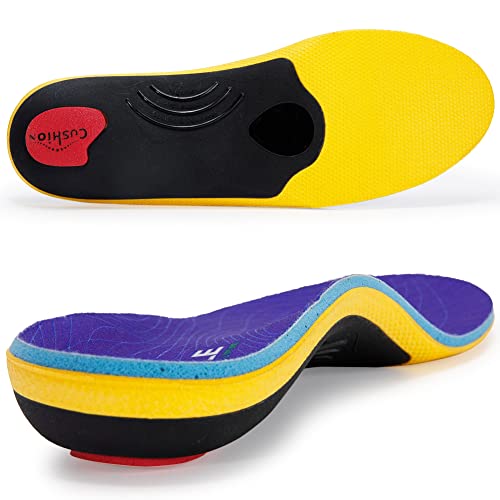
This insert stands apart by targeting larger shoe sizes and people seeking a heavy-duty support design. The men’s 12–12.5 and women’s 14–14.5 size is listed as 302 mm; the product also describes a Poron heel pad. The maker says the rigid high arch support and shock-guard design are intended for work and prolonged standing. As an insole rather than a boot, it only makes sense if your existing footwear has a removable insert and enough interior volume; a thick insert can make a close-fitting boot feel cramped.
Bottom line: Choose this for a compatible boot in the larger size range.
Carbon-Fiber Composite Arch Insoles

The carbon-fiber composite arch structure distinguishes this insert from the other choices, while PORON heel and forefoot cushioning and EVA foam add cushioning around that firmer support. It is sized for men’s 8.5–9.5 or women’s 10.5–11.5, with a length of 9.4 inches and width of 3.9 inches. The maker says the support is designed for daily walking, standing, and work shifts. This is an insert, not footwear, so it will not solve a boot’s poor width or heel fit; check that the insert can sit flat in the boot.
Bottom line: Choose this if you want a composite arch structure and your shoe size matches.
High Arch Support Insoles, Medium

This medium-size insert covers a different shoe range from the other inserts: men’s 9–10.5 or women’s 10–11.5. It is described as a rigid high arch support insert with shock-protection technology and moderate cushioning for work or standing. The maker says its design aims to reduce impact with each step. Because the size ranges overlap but do not match the other options exactly, measure the removable insole from a boot that fits well and compare it with the size guidance before buying; an insert that is too long or wide may bunch or shift.
Bottom line: Choose this when its medium size range matches your existing footwear.
How to Choose a Boot for High Arches
Choose a boot that holds the heel securely, leaves room for toes, and cushions the areas that bear pressure; a prominent arch alone does not determine the right fit. Many hiking shoes and boots have removable footbeds, so an insert can be swapped if the boot has enough interior space. Try footwear with the socks you expect to wear, and check fit late in the day when feet may be slightly larger. A useful rule is to leave roughly half an inch between the longest toe and the boot’s front when standing, while keeping the heel from lifting excessively. A wider boot can help with forefoot room, but width does not automatically mean more arch support.
Boot Fit and Toe Room for Long Walks
For hiking, toe room matters most on descents, when feet slide forward inside the boot. About half an inch of space at the front is a common fitting target, but the heel should still feel held in place and the midfoot should not slide. Lace tension can secure the heel without crushing the top of the foot; loosen the lower laces if pressure builds across the instep. Break in new boots with short walks before a long hike, and stop if rubbing develops into a hot spot. OrthoComfoot Women’s Ankle Hiking Boot is a wide women’s size 7, so check both the length and width rather than assuming the size number alone will determine fit.
Built-In Support Versus High Arch Insoles
Built-in orthotic insoles come as part of a boot, while replacement insoles are intended for compatible footwear with enough space. The practical difference is flexibility: a removable footbed can be exchanged, but adding a thicker insert can crowd toes or raise the heel too far in a boot. Use this quick guide to decide which type fits your need.
| Need | Type to consider |
|---|---|
| Complete hiking footwear | Boot with built-in support |
| Keep boots you already own | Replacement insole |
| More room across the forefoot | Boot offered in a wide fit |
Match insole length and width to the boot’s removable footbed, not just the size printed on the shoe. A boot that fits poorly in the heel or toe may remain uncomfortable even with an added arch insert.
Waterproof Boots and Outdoor Use
Waterproof footwear can help keep feet dry in wet conditions, but the term does not mean a boot is suited to submersion or every storm. OrthoComfoot Women’s Ankle Hiking Boot is described as using waterproof materials that repel light rain and splashes, so it is best considered for damp ground and ordinary wet-weather exposure. For hikes, pair boots with hiking socks that do not bunch, and check for rubbing after a short outing before increasing distance. Wet socks and friction can contribute to blisters; carry dry socks on longer outings and address hot spots early. If a route includes streams or standing water, verify the boot’s intended water protection rather than assuming a light-rain claim covers immersion.
Frequently Asked Questions
How much toe room should hiking boots have?
A common fitting target is about half an inch between the longest toe and the boot’s front while standing. Keep the heel secure as well, because excess movement can cause rubbing on descents.
Can high arch insoles go in any hiking boot?
No; the boot needs a removable footbed or enough interior volume to accept an insert. Compare the insert’s length and width with the boot’s existing footbed, since a thicker insert can crowd the toes or raise the heel.
Are waterproof boots suitable for stream crossings?
A light-rain waterproof claim does not establish suitability for submersion. For crossings, check the boot’s intended water protection and avoid assuming splash resistance will keep feet dry in deeper water.
Should hiking boots feel tight across the instep?
They should feel secure without painful pressure across the top of the foot. Adjust lace tension, especially over the lower foot, and reassess fit with the socks you plan to wear.
How should I break in new hiking boots?
Start with short walks in the socks you expect to hike in, then increase time and distance gradually if no rubbing develops. Address hot spots early, since continued friction can lead to blisters.