
Best Brush for Epoxy: 5 Options by Project Type

For broad epoxy spreading, Stone Coat 2-Inch Chop Brush is the best fit because its 2-inch angled head is designed for epoxy and countertop work. Choose a different option for tiny areas or craft details, where a narrower brush or flexible silicone head gives more control.
Epoxy brushes apply or move mixed resin; the right head depends on the area and desired finish, not just the word “epoxy” on the package.
We earn a commission if you buy through links on this page. As an Amazon Associate I earn from qualifying purchases. Products are compared on manufacturer specifications, not hands-on testing.
- Best overall: Stone Coat 2-Inch Chop Brush – Its 2-inch angled nylon brush is designed for epoxy spreading and countertop edges.
- Best for broad coating: Pro Grade 2-Inch Chip Brushes, 36-Pack – The 2-inch natural-bristle brushes come in a 36-pack for coating projects.
- Best for tiny areas: Pro Grade 3/8-Inch Acid Brushes, 36-Pack – Each 3/8-inch brush has a chiseled boar-hair edge for applying material in small spaces.
| Product | Best for | Width | Head material | Pack / count | Shop |
|---|---|---|---|---|---|
| Stone Coat 2-Inch Chop Brush | Countertop spreading | 2 in | Nylon | 1 brush kit | Check Price on Amazon |
| Pro Grade 2-Inch Chip Brushes, 36-Pack | Disposable coating | 2 in | Natural bristle | 36 brushes | Check Price on Amazon |
| Pro Grade 3/8-Inch Acid Brushes, 36-Pack | Small-area application | 3/8 in | Boar hair | 36 brushes | Check Price on Amazon |
| 7-Piece TPR Silicone Applicator Kit | Resin craft details | — | TPR silicone | 7 brushes | Check Price on Amazon |
| Nezyo Silicone Brushes, 1/2/3-Inch Set | Reusable craft spreading | 1, 2, 3 in | Silicone | 3 brushes | Check Price on Amazon |
Brushes for Epoxy
Match the brush head and width to the area you need to coat or shape.
Stone Coat 2-Inch Chop Brush
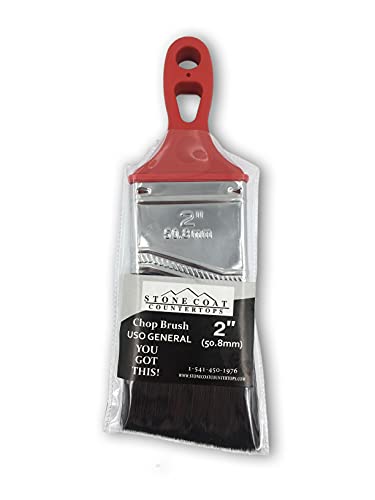
For a broad epoxy application with edge control, this 2-inch angled chop brush is the most purpose-specific choice here. Its nylon bristles and flexible handle are designed for spreading epoxy around countertops and hard-to-reach areas. The maker says the bristles are reusable and the handle is ergonomic; the brush weighs 3 ounces. A broad brush is less suited to fine detail than the narrow applicators in this group, and the feature set recommends pairing it with a 1/8-inch square-notch trowel to help address bubbles and inconsistencies.
Bottom line: Choose this for countertop epoxy work that needs a broad, maneuverable brush.
Pro Grade 2-Inch Chip Brushes, 36-Pack

For repeated coating jobs where a fresh brush per task is useful, this pack provides 36 two-inch chip brushes with natural bristles and poplar handles. The maker describes them for paint, stain, glue and epoxy, and says the adhesive construction reduces bristle shedding. The broad head suits covering more area than a detail brush, while the disposable format avoids relying on a reusable head. It is less specialized for maneuvering around countertop edges than the angled chop brush, so choose another style when precise edge work is central.
Bottom line: Pick this pack for broad epoxy coating tasks where disposable brushes suit the workflow.
Pro Grade 3/8-Inch Acid Brushes, 36-Pack

For small spots rather than broad surfaces, this 36-pack of 3/8-inch acid brushes offers the narrowest head in the group. Each brush has a chiseled boar-hair edge, a metal ferrule and a 6-inch handle; the maker includes epoxy, resin and adhesives among its uses. That narrow width makes it more suited to touch-ups and confined applications than coating a countertop. These are general-purpose acid brushes, not wide spreading tools, so they are a poor match when the job calls for covering a large surface evenly.
Bottom line: Choose these for applying epoxy or adhesive in small areas, not for broad coats.
7-Piece TPR Silicone Applicator Kit

For craft work where a flexible, fluid-resistant head matters more than bristles, this seven-piece kit uses TPR brush heads with PS handles and aluminum tubes. The maker positions the set for epoxy art crafting as well as beauty applications, and says the heads are easy to clean. Its compact kit is better aligned with small creative applications than coating a wide countertop; no brush width is given, so buyers needing a particular coverage width should verify the dimensions before ordering. Silicone heads also give a different feel from conventional bristles when moving resin.
Bottom line: Pick this set for small resin crafts that benefit from flexible silicone applicators.
Nezyo Silicone Brushes, 1/2/3-Inch Set

For craft projects that need different spreading widths, this set pairs three silicone brush sizes: 1, 2 and 3 inches. The maker says the flexible heads are suitable for applying epoxy smoothly, and the set is also described for acrylic and water-based tools. The width choices make it more versatile for craft-scale spreading than the narrower acid brush. Silicone is a distinct alternative to the nylon and natural-bristle heads here, but the maker frames the set for crafts rather than dedicated countertop work, where the angled chop brush is more targeted.
Bottom line: Choose this set for craft applications where multiple silicone spreading widths help.
How to Choose an Epoxy Brush
Choose by coverage area first: a 2- to 3-inch head covers broad surfaces more efficiently, while a 3/8-inch brush is better for narrow spots. Bristle brushes can help move and spread resin; flexible silicone heads are useful when you want to push material around a craft surface. A brush does not replace the mixing step: most two-part epoxies require resin and hardener to be combined in the specified ratio before application. Pot life—the workable time after mixing—varies by formula and temperature, so plan the area and tools before combining a batch. For a wide countertop coat, favor a broad head; for seams or small touch-ups, use a narrow one.
Brush Types for Epoxy Work
Natural-bristle chip brushes, synthetic bristle brushes and silicone applicators serve different jobs. Chip brushes are commonly used for broad coating and can be disposable; synthetic bristles offer a conventional paintbrush feel, while silicone heads flex and push resin rather than holding it like bristles. Acid brushes are narrow applicators for small areas, not general-purpose surface coaters. Use this guide to match the type to the task.
| Need | Brush type | Typical use |
|---|---|---|
| Cover a broad area | 2- to 3-inch brush | Surface coating |
| Reach small spots | 3/8-inch acid brush | Touch-ups and confined areas |
| Push resin on a craft surface | Silicone applicator | Craft spreading and shaping |
Choose a brush width smaller than the narrowest area you need to reach; a 3/8-inch head is more controllable than a 3-inch head in tight corners.
Epoxy Application and Safety
Apply epoxy within its working time: many formulas become harder to spread as they warm and begin to cure, and a thick batch can generate heat. Mix only the amount you can apply during the product’s pot life, and do not leave a large mixed mass in a container. Wear chemical-resistant gloves and eye protection, and work with ventilation because uncured epoxy components can irritate skin and eyes. Avoid using a brush once resin becomes stringy or begins to gel; trying to spread it then can leave ridges. Keep tools and resin away from children and pets, and follow the resin maker’s safety directions for that formula.
Cleaning and Reuse
Whether an epoxy brush can be reused depends on the brush material and the resin’s cure stage. Uncured epoxy is generally easier to remove than cured resin, but cleanup solvents are formulation-dependent and can damage brush materials or create additional hazards. Do not assume water will clean a conventional epoxy; check the resin maker’s specified cleanup method and solvent compatibility before using one. Silicone heads are often easier to wipe clean than bristles, while disposable chip brushes avoid the need to recover a bristle head. Set aside reusable tools before mixing so cleanup can begin while resin is still workable.
Frequently Asked Questions
Can I use a regular paintbrush for epoxy resin?
A paintbrush can spread epoxy if its bristles and handle tolerate the resin and its cleanup method. A 2-inch brush suits broader areas, while a 3/8-inch brush is easier to control in small spots.
Are silicone brushes good for epoxy crafts?
Silicone applicators can push and spread resin on craft surfaces without a conventional bristle head. Choose a 1-, 2- or 3-inch width to match the work area, and clean the head before resin cures if it is intended for reuse.
Why do epoxy brushes leave streaks?
Streaks can form when resin is too thick to level, the application is uneven, or the epoxy is beginning to gel. Apply within the formula’s working time and use a wider brush for broad areas rather than making repeated passes as the mixture thickens.
Should I use a disposable brush for epoxy?
A disposable brush is practical when cleanup would be difficult or the task is a one-time coat. A 36-pack of 2-inch chip brushes is suited to broad coating, while narrow 3/8-inch acid brushes fit small applications.
How do I clean epoxy from a brush?
Clean uncured resin promptly using only the method recommended for that epoxy formula. Cured epoxy is difficult to remove from bristles, so do not assume water or an arbitrary solvent will work safely.