
Best Deer Processing Knife Sets: 5 Kits Compared

For most deer processors, KNINE OUTDOORS 12-Piece Hunting Set is the strongest fit because its 12-piece kit combines several specialized knives with a bone saw, cutting board, sharpener, and gloves.
Choose a smaller kit if you want fewer tools to carry, or a butcher-focused set if most work happens at a prep station rather than in the field.
We earn a commission if you buy through links on this page. As an Amazon Associate I earn from qualifying purchases. Products are compared on manufacturer specifications, not hands-on testing.
- Best overall: KNINE OUTDOORS 12-Piece Hunting Set – Its 12 pieces include specialized knives, a bone saw, cutting board, sharpener, and gloves.
- Best for a broad tool mix: OUTDOOR EDGE Game-Pro 11-Piece Set – The 11-piece set is described as including caping and boning knives, a saw, shears, sharpener, and rib spreader.
- Best for meat prep: Huusk 5-Piece Butcher Knife Set – The five-piece assortment focuses on boning, butcher, skinning, and caping knives, with a sharpening stone and roll bag.
| Product | Best for | Piece count | Included tools | Carry format | Shop |
|---|---|---|---|---|---|
| KNINE OUTDOORS 12-Piece Hunting Set | Full field kit | 12 pieces | Knives, saw, spreader, shears, board | Portable set | Check Price on Amazon |
| OUTDOOR EDGE Game-Pro 11-Piece Set | Saw and shears | 11 pieces | Caping and boning knives, skinning knife, saw | Hard-side case | Check Price on Amazon |
| Mossy Oak 8-Piece Field Dressing Kit | Named blade sizes | 8 pieces | Saw, spreader, caping knife, gut-hook skinner | Plastic case | Check Price on Amazon |
| OUTDOOR EDGE ErgoMax 6-Piece Set | Grip comfort | 6 pieces | Caping and boning knives, skinning knife | Blow-molded case | Check Price on Amazon |
| Huusk 5-Piece Butcher Knife Set | Prep-station work | 5 pieces | Curved and straight boning, butcher, skinning | Roll bag | Check Price on Amazon |
Deer Processing Knife Sets Compared
Match the kit’s tools and carry format to where you process game and which tasks you handle yourself.
KNINE OUTDOORS 12-Piece Hunting Set
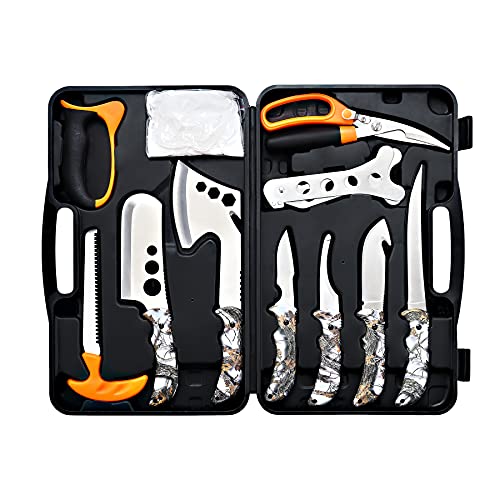
The 12-piece assortment stands out for pairing multiple blade shapes with field accessories, including a hawkbill knife, skinning cleaver, gut-hook butcher axe, bone saw, ribcage spreader, game shear, portable cutting board, sharpener, and cleaning gloves. Its blades are 7Cr17MoV steel, and the handles use black-and-blue camo colors with ergonomic, non-slip materials. The breadth suits someone who wants separate tools for several stages of processing. Its larger tool count means more pieces to organize and clean than a compact knife-only kit.
Bottom line: Choose this if you want the broadest range of field-processing tools in one set.
OUTDOOR EDGE Game-Pro 11-Piece Set

The hard-side case is the key distinction here, paired with a set described as covering caping, boning, skinning, sawing, and rib spreading. The 11-piece kit is identified as including caping and boning knives, a deer skinning knife, bone saw, game shears, sharpener, and rib spreader. Its dimensions are 14 by 11 by 3 inches, useful for estimating storage space. The specifications do not enumerate every piece, so buyers who need a particular specialty tool should confirm its inclusion before ordering.
Bottom line: Pick this if you prefer a hard-side case and want both a saw and game shears.
Mossy Oak 8-Piece Field Dressing Kit
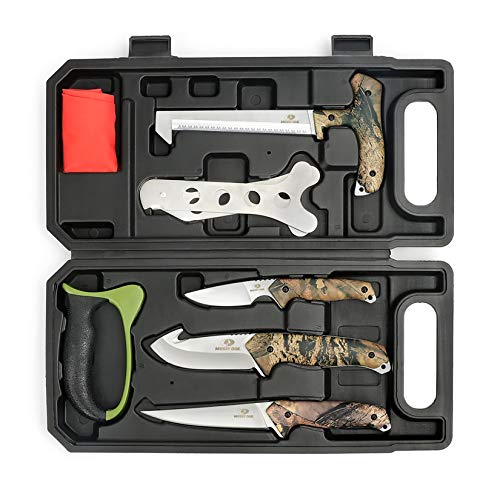
The Mossy Oak kit gives specific blade and tool measurements, which helps buyers compare the working sizes before choosing. Its tools include an 8.7-inch wood-and-bone saw, steel stick/brisket spreader, 7.5-inch caping knife, 9.5-inch gut-hook skinner, 10-inch boning knife, tungsten carbide V-sharpener, and red game-cleaning gloves. The blades are stainless steel with full-tang construction and camouflage handles. This eight-piece set suits buyers who value those named knife sizes; it includes fewer total pieces than the broader 11- and 12-piece assortments.
Bottom line: Choose this when the knife lengths and core field-dressing tools match your needs.
OUTDOOR EDGE ErgoMax 6-Piece Set

The ErgoMax emphasizes grip design rather than a long tool list: its rubberized, triple-shot TPR handles are described as offering traction in slippery conditions and reducing hand fatigue. The six-piece professional game set includes caping and boning knives, a skinning knife, and a butcher knife, with a lightweight blow-molded case. The maker positions it for extended use, but the specifications do not give blade lengths or enumerate all six pieces. It is a more focused option than kits that specifically name a saw, gloves, or a cutting board.
Bottom line: Pick this if handle traction and a compact case matter more than a large accessory assortment.
Huusk 5-Piece Butcher Knife Set

The Huusk set is oriented toward meat preparation, with curved and straight boning knives, a granton butcher knife, skinning knife, caping knife, sharpening stone, and roll bag. Its blades are described as German stainless steel, hand-sharpened, titanium-coated, and tempered to 58+ HRC; the textured handles are high-visibility orange and non-slip. That combination suits a processor who wants several cutting profiles organized in a roll.
Bottom line: Choose this for a focused knife assortment and roll-bag storage for meat prep.
How to choose a deer processing knife set
Start with the tasks you need to cover, not the highest piece count. Field dressing and breakdown commonly call for a skinning or caping knife, a boning knife, and a bone saw; shears, a spreader, gloves, or a cutting board add task-specific utility. A kit with several specialty blades can reduce tool swapping, while a smaller assortment takes less space and has fewer pieces to clean. Match the carrying format to your processing location: a rigid case helps contain a mixed kit, while a roll bag keeps a knife-focused set organized. If you already own a saw or sharpening tool, prioritize the blades you lack rather than duplicating accessories.
Blade lengths and knife roles for deer
Knife role matters more than a single ideal length: shorter blades give control around hide and joints, while longer boning blades cover more distance along a cut. The Mossy Oak set names a 7.5-inch caping knife, 9.5-inch gut-hook skinner, and 10-inch boning knife; those lengths are useful comparisons, not universal requirements. Gut-hook blades are intended for opening the hide without using a plain edge for that task, but controlled shallow cuts remain important. Use the bone saw for bone rather than forcing a knife through it. A blunt hooked saw tip can help reduce accidental puncture risk when working near organs.
Field kit or butcher knife set
A field kit combines cutting tools with accessories for processing away from a prep counter, while a butcher-oriented set centers on knife profiles and storage. Use this quick comparison to decide which format fits your workflow.
| Need | Useful tools | Tradeoff |
|---|---|---|
| Field dressing and breakdown | Skinning or caping knife, boning knife, saw | More accessories to carry and clean |
| Meat trimming at a station | Boning and butcher knives, sharpener | May omit saw, gloves, or spreader |
| Mixed tasks in one kit | Specialty knives plus saw or shears | Piece count alone does not show blade quality |
Choose a set with a saw if your workflow includes cutting bone; if you only need trimming and boning, a knife-focused kit can avoid carrying tools you will not use.
Cleaning and safe handling after processing
Clean and dry hunting knives and saws promptly after contact with meat, then store them dry to limit corrosion and contamination. Wash hands and sanitize food-contact tools between raw meat and ready-to-eat foods; raw meat juices should not reach clean surfaces. Keep blade edges pointed away from the supporting hand, and cut on a stable surface rather than holding meat in the air. Sharpening helps restore a controlled edge, but a sharp knife still needs deliberate handling. Keep knives secured in their case or roll rather than loose with other gear, and inspect handles and blade attachment points before the next use.
Frequently Asked Questions
What knives are most useful for processing a deer?
A skinning or caping knife and a boning knife cover much of the cutting work, while a bone saw handles bone. Add a gut-hook blade or shears only if those tools match your workflow.
Do I need a bone saw in a deer processing kit?
A bone saw is useful when your processing plan includes cutting through bone; a knife is intended for cutting meat and connective tissue, not forcing through bone. Use controlled strokes and keep the saw away from the supporting hand.
What does a gut-hook knife do?
A gut-hook blade is designed to open hide with its hooked edge rather than a straight cutting edge. Keep the cut shallow and controlled, especially near organs.
How should I clean deer processing knives?
Wash and dry knives and saws promptly after meat contact, then sanitize food-contact tools before they touch other food. Keep raw-meat juices away from clean surfaces and store the kit dry.
How often should hunting knives be sharpened?
Sharpen when the edge no longer cuts cleanly with controlled pressure; frequency depends on use and the material being cut. Use a stable sharpening surface and keep fingers clear of the edge.