
Kentucky 31 Grass Seed: 3 Options Compared by Size

For most buyers seeking Kentucky 31 grass seed, Pennington Kentucky 31 Tall Fescue, 40 lb is the practical choice because its 40-pound bag suits larger lawns while retaining the drought and traffic traits. Choose Pennington Kentucky 31 Tall Fescue, 7 lb for a smaller bag; The Dirty Gardener Kentucky 31, 50 lb is the better fit if you want the Dirty Gardener’s 50-pound package.
Kentucky 31 is a tall fescue lawn grass, a cool-season type suited to fall establishment in many parts of the United States.
We earn a commission if you buy through links on this page. As an Amazon Associate I earn from qualifying purchases. Products are compared on manufacturer specifications, not hands-on testing.
- Best overall: Pennington Kentucky 31 Tall Fescue, 40 lb – The 40-pound bag is a useful middle ground for larger lawn projects and the traits include drought and traffic tolerance.
- Best for smaller projects: Pennington Kentucky 31 Tall Fescue, 7 lb – The 7-pound package is the smallest option and gives a germination window of 8 to 21 days.
- Best for bulk seeding: The Dirty Gardener Kentucky 31, 50 lb – The 50-pound package is the largest and is described as suited to full sun through medium shade.
| Product | Best for | Bag size | Sun exposure | Shop |
|---|---|---|---|---|
| Pennington Kentucky 31 Tall Fescue, 40 lb | Larger lawns | 40 lb | — | Check Price on Amazon |
| Pennington Kentucky 31 Tall Fescue, 7 lb | Small lawn areas | 7 lb | Full sun to medium shade | Check Price on Amazon |
| The Dirty Gardener Kentucky 31, 50 lb | Bulk supply | 50 lb | Full sun to medium shade | Check Price on Amazon |
Kentucky 31 grass seed options
Compare package size and stated growing traits before choosing seed for your lawn area.
Pennington Kentucky 31 Tall Fescue, 40 lb

Pennington Kentucky 31 Tall Fescue, 40 lb is the largest Pennington package here, at 40 pounds, and suits buyers seeding a larger area or keeping extra seed on hand. The maker describes Kentucky 31 as a lighter-green, drought-resistant turf that tolerates foot traffic and hot summers; its germination window is 8 to 21 days. Tall fescue is generally established in early fall, when cooler air and warm soil favor root growth. The trade-off is package scale: a 40-pound bag can be more seed than a small patch needs, so estimate area before opening it.
Bottom line: Choose it for a larger lawn project and the 40-pound package size.
Pennington Kentucky 31 Tall Fescue, 7 lb
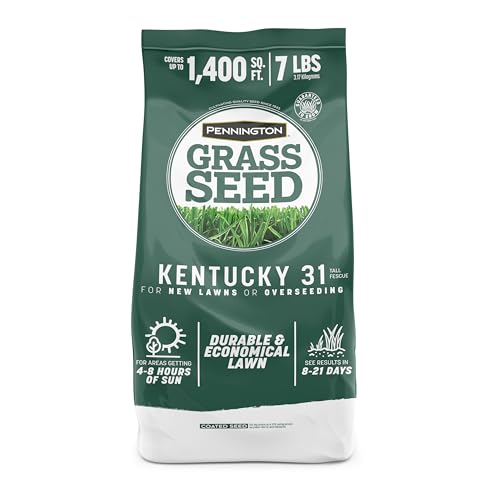
Pennington Kentucky 31 Tall Fescue, 7 lb is the smallest package, making it the sensible option when a full 40- or 50-pound bag would exceed the project. The maker says it is for full sun to medium shade, stands up to hot summers and heavy rains, tolerates foot traffic, and may show results in 8 to 21 days. The product name gives a coverage figure up to 1,400 square feet, while one feature separately says up to 4,000 square feet; confirm the intended coverage before calculating how much seed to use. Tall fescue’s coarse blades create a different look from fine-bladed lawn grasses.
Bottom line: Choose it for a small project, after confirming the coverage figure.
The Dirty Gardener Kentucky 31, 50 lb
The Dirty Gardener Kentucky 31, 50 lb has the largest package in this comparison: 50 pounds of Kentucky 31 tall fescue. The maker describes its turf as light green with a coarse texture, and says it tolerates heat, drought and foot traffic while requiring little maintenance. The exposure range is full sun to medium shade, so heavily shaded yards are a poor match for this description. Tall fescue develops a coarser appearance than fine fescues, a meaningful trade-off for buyers prioritizing a uniform, fine-textured lawn over a durable turf type.
Bottom line: Choose it when you want the 50-pound bag and a coarse-textured tall fescue.
How to choose Kentucky 31 grass seed
Choose Kentucky 31 by lawn area, sun exposure and the texture you want, then match package size to the seeding rate. Tall fescue is a cool-season grass with broader, coarser blades than fine fescues; that look is part of the trade-off for a tough lawn. For new lawns, a common seeding rate is 6 to 8 pounds per 1,000 square feet, while overseeding an existing lawn often uses about 3 to 5 pounds per 1,000 square feet. Rates vary with seed mix and site preparation, so use the bag directions for the specific application. Pick a different grass type if the lawn is deeply shaded or a fine-bladed appearance is essential.
When to seed tall fescue
Early fall is usually the best time to sow tall fescue, when soil remains warm enough for germination but air temperatures begin to moderate. In much of the transition zone, late summer into early fall gives seedlings time to establish before winter; spring seeding is possible but young grass faces summer heat sooner. Seed needs consistent moisture during germination, and newly seeded areas should not dry out. Kentucky 31 is a cool-season grass, so avoid expecting strong establishment during hot weather. The products describe different germination windows or none, but actual emergence also depends on soil temperature, moisture and seed-to-soil contact.
Seed rate and lawn coverage
Measure the lawn before opening a bag: area equals length times width, and irregular spaces can be split into rectangles. A typical tall fescue rate is 6 to 8 pounds per 1,000 square feet for a new lawn, so a 2,000-square-foot area takes roughly 12 to 16 pounds at that range. Existing lawns generally need less for overseeding, commonly 3 to 5 pounds per 1,000 square feet. Use the lower rate for a well-prepared seedbed and the higher end where establishment conditions are less favorable, while following the seed package rate. Too much seed creates crowding and weak seedlings; too little leaves bare patches.
| Use | Typical tall fescue rate | Example for 1,000 sq ft |
|---|---|---|
| New lawn | 6–8 lb per 1,000 sq ft | 6–8 lb |
| Overseeding | 3–5 lb per 1,000 sq ft | 3–5 lb |
Establishing and maintaining Kentucky 31
Prepare a firm, level seedbed and spread seed evenly in two crossing passes to reduce missed strips and clumps. Lightly rake or roll seed into contact with soil rather than burying it deeply; tall fescue seed is small and needs reliable surface moisture to germinate. Keep the top layer of soil consistently moist through emergence, then transition to deeper, less frequent watering as roots develop. Once established, mow tall fescue around 3 to 4 inches high, removing no more than one-third of the blade at a time. A sharp mower blade gives the coarse grass a cleaner cut, and avoiding scalping helps protect the lawn during heat.
Frequently Asked Questions
How much Kentucky 31 seed covers 1,000 square feet?
A typical new tall fescue lawn uses about 6 to 8 pounds per 1,000 square feet; overseeding usually takes about 3 to 5 pounds. Check the specific package rate because seed coverage claims can differ by application.
How long does Kentucky 31 take to germinate?
Tall fescue commonly germinates in roughly 5 to 12 days under favorable soil moisture and temperature. The Pennington options here give a maker-stated window of 8 to 21 days, and cool or dry soil can slow emergence.
What is the best month to plant Kentucky 31?
Late summer through early fall is generally the best seeding period for tall fescue, with the exact window depending on local climate. Seed at least several weeks before the first expected hard frost so seedlings can establish.
How short should I mow Kentucky 31 grass?
Keep established tall fescue around 3 to 4 inches high for a typical lawn. Remove no more than one-third of the blade in a mowing to avoid scalping and stress.
Can Kentucky 31 grow in heavy shade?
Kentucky 31 is better suited to sun or moderate shade than dense shade. If an area gets fewer than about 4 hours of direct sun daily, look for a more shade-tolerant grass type rather than relying on this tall fescue.