
Best Dog Trolley System: 4 Setups Compared by Run Length

The 100-foot runner with two tie-out lead lengths suits most buyers who need flexibility across yard and camping setups. Choose a shorter system for a compact run, or a single-lead setup if you prefer fewer parts.
A dog trolley system suspends a lead from a cable so a dog can move along a fixed path; it is not a substitute for supervision or a fenced, secure area.
We earn a commission if you buy through links on this page. As an Amazon Associate I earn from qualifying purchases. Products are compared on manufacturer specifications, not hands-on testing.
- Best overall: Upgraded 100-ft Dog Trolley System – A 100-foot runner and both 10-foot and 15-foot tie-out leads support different setups.
- Best for long runs: Snagle Paw 100-ft Trolley System – The 100-foot run cable pairs with a 10-foot pulley runner lead.
- Best for shock cushioning: 50-ft Double-Shock Dog Trolley System – The 10-foot lead is paired with an additional elastic lead for added give.
| Product | Best for | Runner length | Tie-out lead | Cable material | Shop |
|---|---|---|---|---|---|
| Upgraded 100-ft Dog Trolley System | Flexible setups | 100 ft | 10 ft and 15 ft | 5 mm stainless steel | Check Price on Amazon |
| Snagle Paw 100-ft Trolley System | Long yard runs | 100 ft | 10 ft | Vinyl-coated cable | Check Price on Amazon |
| 50-ft Double-Shock Dog Trolley System | Extra lead give | 50 ft | 10 ft plus elastic lead | — | Check Price on Amazon |
| 50-ft Dog Trolley System | Compact setups | 50 ft | 10 ft | Vinyl-coated cable | Check Price on Amazon |
Dog Trolley Systems Compared
Compare the run length, lead arrangement and cable construction to match the system to your space.
Upgraded 100-ft Dog Trolley System

The distinguishing feature is a 100-foot runner plus two tie-out lead lengths, giving this system more setup choices than the single-lead alternatives. The 10-foot lead is intended for a backyard, while the 15-foot lead is suited to more open camping areas, according to the maker. Its 5 mm stainless-steel runner cable is described as chew- and rust-proof and rated for dogs up to 250 pounds. That weight rating does not establish that every anchor or installation is safe at that load. Choose this system when the longer run and interchangeable lead lengths matter; skip it if a 100-foot cable is excessive for your space.
Bottom line: Choose it if you want a long run and two tie-out lead lengths.
Snagle Paw 100-ft Trolley System
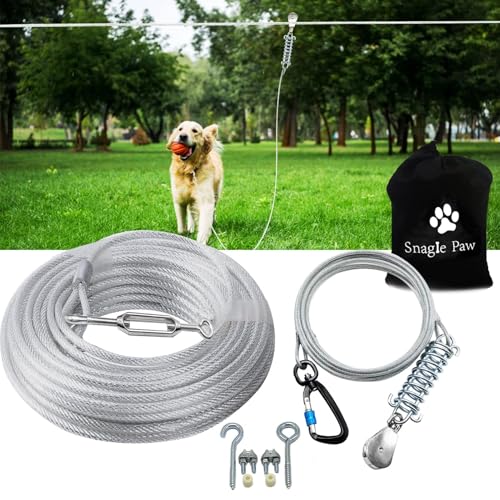
The 100-foot run cable is the key distinction, while the 10-foot pulley runner lead keeps the tether length fixed. The vinyl coating is intended to protect the cable from rain and rust, and a turnbuckle is included to limit sag and help the pulley travel. The maker rates the system for dogs up to 250 pounds and places its shock-absorbing spring on the runner lead. That is a different arrangement from systems with the spring on the tie-out cable, so consider where you want the cushioning in the line. Its long span needs suitable attachment points and enough clearance from obstacles.
Bottom line: Pick this for a 100-foot run with one 10-foot runner lead.
50-ft Double-Shock Dog Trolley System

The extra elastic lead sets this 50-foot system apart: it is attached to the 10-foot tie-out cable in addition to the cable’s spring, according to the maker. That arrangement adds another flexible section, rather than extending the main runner span. The maker says the system is intended for dogs up to 250 pounds and describes a 360-degree swivel clip with a safety lock. The clip’s 600-pound pull figure is not the system’s working-load limit, so do not use it to determine a safe dog weight or anchor capacity. Its 50-foot run fits smaller spaces than the 100-foot options.
Bottom line: Choose it for a shorter run and an additional elastic lead.
50-ft Dog Trolley System

The simpler 50-foot configuration pairs a vinyl-coated run cable with a 10-foot tie-out lead and a turnbuckle. The turnbuckle helps manage cable sag, while the pulley runner moves along the span. The maker rates the system for dogs up to 250 pounds and places its shock-absorbing spring on the tie-out cable, rather than on the runner lead. That difference may matter if you are comparing where the line gives under tension. This option is more compact than the 100-foot alternatives, but the specifications do not identify the cable material beyond its vinyl coating; focus on span and lead layout when comparing.
Bottom line: Pick this when a 50-foot span and one 10-foot lead are sufficient.
How to choose a dog trolley system
Choose the cable length for the clear path available, then compare lead length and spring placement. The options here use 50-foot or 100-foot runner cables and 10-foot tie-out leads; one adds a 15-foot choice. Longer cable does not mean the dog can safely use every part of a yard, because trees, fences and other obstacles can snag a moving line.
A dog tethered overhead can still reach the ground, so keep the route away from stairs, pools, roads and objects that can wrap the lead. For a span over 50 feet, plan attachment points and clearance before selecting the 100-foot setup. Do not treat a clip’s pull strength or a maker’s dog-weight rating as proof that a tree, post, cable installation or complete system can safely hold that load.
Runner length and lead fit
Measure the usable distance between attachment points before choosing a 50-foot or 100-foot runner; leave room for the line to sag and for the pulley to travel without striking an obstruction. The cable length is not the same as a safe roaming radius, since the tie-out lead and dog’s reach add distance beyond the runner path.
The table compares the basic layouts, not safe installation limits. Use it to narrow the format, then position the run so the dog cannot reach hazards or become entangled.
| Need | Runner choice | Lead layout |
|---|---|---|
| Compact span | 50 ft | 10 ft lead |
| Longer span | 100 ft | 10 ft lead |
| Variable setups | 100 ft | 10 ft and 15 ft leads |
Shock absorption and cable materials
Shock absorption can sit at different points in a trolley system: one option puts its spring on the tie-out cable, while another describes a spring on the runner lead and one adds an elastic section as well. Placement changes which part of the line flexes under a sudden pull; it does not remove the need to keep the dog from building speed or hitting the end of the run.
Vinyl-coated cable is specified for two options, while another identifies a 5 mm stainless-steel runner cable. Coatings and stainless steel can resist corrosion, but outdoor exposure, abrasion and damaged fittings still call for inspection. Check the cable, pulley, clips, tie-out lead and attachment points before each use, and stop using any component that is frayed, kinked or bent.
Safe setup and supervision
A trolley setup is for supervised outdoor use, not unsupervised confinement. Keep the path clear of branches, furniture, fence gaps and other places where a moving line or tether can wrap; do not route it over a pool, driveway or near a road. A dog can also become tangled if the lead is long enough to reach an obstacle at either end.
Attach the system only to sound, appropriate structural points and use the manufacturer’s installation guidance for the specific hardware. Weight ratings do not account for dynamic force from a running dog, anchor strength, spacing, weathering or installation quality. Never leave a dog tethered in extreme heat or cold, and provide access to water and shade during outdoor activity.
Frequently Asked Questions
How much clearance does a dog trolley need?
Keep the full travel path clear, including the area reachable by the tie-out lead at each end. A 10-foot lead can extend the dog’s reach beyond the runner line, so move the path away from pools, roads, steps and snag points.
Can a dog stay on a trolley unsupervised?
No; supervise a dog on a trolley because a moving lead can snag or tangle, and a dog may reach hazards beyond the cable path. Do not use a trolley instead of a secure enclosure or leave a tethered dog exposed to heat or cold.
How often should I inspect an outdoor dog runner?
Inspect the cable, pulley, clips, lead and anchors before each use, especially after rain or heavy pulling. Stop using the system if the cable is frayed or kinked, a clip is bent, or an anchor has loosened.
Does a 250-pound rating mean the whole setup holds 250 pounds?
No; a maker’s dog-weight rating does not establish the safe capacity of the installed cable, anchors or surrounding structure. A dog running to the end of a lead creates dynamic force, so install the system only as directed and do not infer a safe load from the clip figure.
What is the difference between a runner cable and a tie-out lead?
The runner cable forms the overhead path, and the tie-out lead connects the dog to a moving pulley on that path. In these options, runner lengths are 50 or 100 feet and lead lengths range from 10 to 15 feet.