
Best Dual Betta Fish Tank: 3-Gallon Divided Tanks Compared

iPriro 3-Gallon Nano Glass Aquarium is the best fit for most people seeking a dual betta fish tank because it is a 3-gallon glass aquarium supplied with a divider and shield. Choose iPriro 3-Gallon Ultra-Clear Glass Aquarium if adjustable lighting matters; the other aquarium kits do not specifically include a betta divider.
We earn a commission if you buy through links on this page. As an Amazon Associate I earn from qualifying purchases. Products are compared on manufacturer specifications, not hands-on testing.
- Best overall: iPriro 3-Gallon Nano Glass Aquarium – A 3-gallon glass tank includes a divider and shield for separating two bettas.
- Best for adjustable light: iPriro 3-Gallon Ultra-Clear Glass Aquarium – Its 3-gallon glass tank includes a separator and adjustable light.
- Best for a heater kit: eWonLife 3-Gallon Plastic Aquarium Kit – Its 3-gallon kit includes a 25W heater, filtration, and water-changing accessories.
| Product | Best for | Length | Included equipment | Shop |
|---|---|---|---|---|
| iPriro 3-Gallon Nano Glass Aquarium | Divided glass setup | 12.6 in | Filter, LED, divider, shield | Check Price on Amazon |
| iPriro 3-Gallon Ultra-Clear Glass Aquarium | Adjustable lighting | 12.6 in | Filter, LED, divider, shield | Check Price on Amazon |
| eWonLife 3-Gallon Plastic Aquarium Kit | Heater included | 14.96 in | 25W heater, filter, LED, changer | Check Price on Amazon |
Dual betta fish tanks compared
Compare tank capacity, footprint, and included equipment before choosing a divided setup for two bettas.
iPriro 3-Gallon Nano Glass Aquarium

For a specifically divided betta setup, this 3-gallon glass aquarium includes a separator plate and shield alongside a hanging filter, LED light, and lid. Its 12.6-by-6.3-inch footprint is narrower than the other 3-gallon tanks here. The maker says the divider is intended for hosting two bettas; remember that a divider partitions the tank but does not create extra water volume. This choice suits buyers prioritizing a glass enclosure with separation hardware. The compact capacity means stable water conditions require attentive maintenance.
Bottom line: Pick this if a glass tank with a dedicated divider is your priority.
iPriro 3-Gallon Ultra-Clear Glass Aquarium
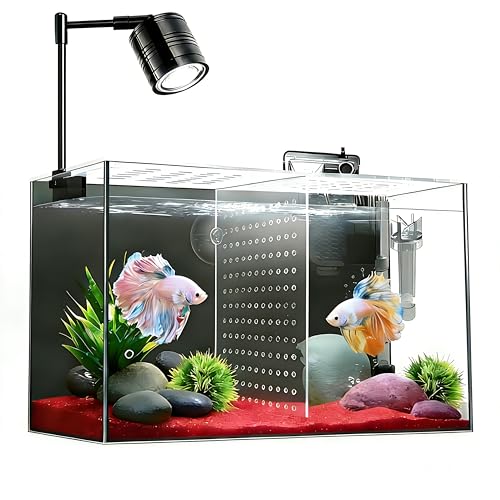
Compared with a basic fixed-light arrangement, this 3-gallon glass aquarium specifies an adjustable light and includes a separator plate and shield for a divided betta setup. It shares a 12.6-by-6.3-inch footprint with the other iPriro tank, and the maker identifies a hanging filter, lid, and LED light as part of the kit. The adjustable-light option is useful if you want to change the illumination. Its 3-gallon capacity remains modest for two separated fish, so it is less suitable for anyone seeking large individual swimming areas.
Bottom line: Choose this when adjustable illumination is the deciding feature.
eWonLife 3-Gallon Plastic Aquarium Kit

Unlike the divided glass options, this 3-gallon plastic kit centers on included equipment: a 25W heater, rear filtration with adjustable pump, LED thermometer, timed LED light, water changer, and net. Its 14.96-by-7.87-inch footprint is longer and wider than the divided iPriro tanks. The kit suits someone assembling a basic heated aquarium, but the product features do not identify a divider for keeping two bettas apart. Treat it as a single-tank alternative rather than a ready-made dual-betta enclosure.
Bottom line: Pick this for the broader starter-equipment bundle, not a divided setup.
How to choose a dual betta fish tank
A divided tank needs a secure, opaque barrier as well as enough water volume and filtration for its occupants. A clear divider can leave bettas in view of each other, which may prompt stress displays; choose an opaque barrier or add an opaque cover if fish remain agitated. A divider also reduces swimming space and does not double the tank’s capacity. For two bettas, prioritize an aquarium larger than these 3-gallon options when space allows, with separate compartments and gentle filtration that will not create a strong current.
Check that water can circulate through each compartment without creating a gap large enough for a fish to cross. A heater must warm both sides evenly, and each fish needs access to the surface because bettas breathe air there.
Tank capacity and divider fit
A 3-gallon tank holds 3 gallons total, not 3 gallons per side after a divider is installed. The barrier, equipment, and substrate further reduce usable water volume, while a narrow compartment limits turning and swimming room. These constraints make a small divided aquarium more demanding to maintain than a larger setup.
Measure the shelf or counter before choosing: the divided tanks here are 12.6 inches long and 6.3 inches wide. Leave room for the filter and access for routine cleaning, and confirm the divider can be installed with the specific tank dimensions. A tight divider fit matters because even a small opening can let fish pass through.
Betta tank equipment and water care
Warm, stable water matters for bettas; a common target is 76–82°F, with a thermometer used to verify conditions rather than relying on a heater setting alone. A filter supports biological filtration, but new filters need time to establish beneficial bacteria, so a newly assembled tank is not automatically ready for fish. Test ammonia and nitrite, which should remain at 0 ppm in an established aquarium.
Small tanks can accumulate waste quickly because they contain little water to dilute it. Use a partial water change on a regular schedule, remove uneaten food, and avoid washing filter media under untreated tap water, which can damage beneficial bacteria. Gentle flow is preferable because bettas may struggle in a strong current.
Divided tanks compared with alternatives
A divided aquarium is designed to house fish separately within one enclosure, while an undivided starter kit has no physical separation specified. The choice should follow the intended occupants, not just the included accessories: a heater and filter do not substitute for a secure barrier. The table summarizes what these types offer.
| Setup type | Useful when | Key check |
|---|---|---|
| Divided glass aquarium | You need separate compartments | Barrier opacity, fit, and circulation |
| Undivided starter kit | You need heating and basic equipment | No barrier is identified for two bettas |
| Small nursery or hatching box | Temporary fry separation is needed | Not a substitute for a full aquarium |
A nursery box is intended for short-term separation or fry protection, not as a permanent home for two adult bettas. For a dual setup, select a full aquarium with compartments that cannot be breached and enough space for each fish.
Frequently Asked Questions
Can two bettas live in one divided tank?
Two bettas can be separated in one aquarium only when the barrier is secure and prevents contact. An opaque divider is preferable if either fish reacts to seeing the other, and the entire aquarium’s water volume is shared between the compartments.
Is a 3-gallon tank enough for two bettas?
A 3-gallon tank offers 3 gallons total before equipment and a divider take up space. That leaves limited room per fish, so a larger aquarium with separate areas is a more practical choice when space permits.
What temperature should a betta tank maintain?
A common betta aquarium target is 76–82°F, kept stable with a heater and checked using a thermometer. Temperature can differ between compartments if water circulation is restricted, so check both sides.
How often should a small betta tank be cleaned?
Small aquariums generally need frequent partial water changes, often about 20–30% weekly in an established tank. Test ammonia and nitrite and increase maintenance if either rises above 0 ppm.
Can bettas see through a tank divider?
A clear divider lets bettas see each other, and persistent flaring or pacing is a reason to block the view with an opaque barrier. The divider should still allow suitable water circulation while preventing contact.