
Best Floor Exercise Bike Pedals for Seated Movement

For most people, AGM Mini Exercise Bike is the best floor exercise bike pedal because its 12.6-inch height and adjustable foot straps make it practical for seated leg movement.
Choose RYGEO Mini Pedal Exerciser if low-intensity adjustable resistance and a lightweight design matter more than a display, or XVCAS Foldable Under Desk Pedal Exerciser if folding storage is the priority.
We earn a commission if you buy through links on this page. As an Amazon Associate I earn from qualifying purchases. Products are compared on manufacturer specifications, not hands-on testing.
- Best overall: AGM Mini Exercise Bike – Its 12.6-inch height and adjustable straps support compact floor use.
- Best for simple resistance: RYGEO Mini Pedal Exerciser – A tension knob adjusts resistance for low-intensity cycling.
- Best for storage: XVCAS Foldable Under Desk Pedal Exerciser – The frame folds for storage in a small space.
| Product | Best for | Height | Length | Display | Shop |
|---|---|---|---|---|---|
| AGM Mini Exercise Bike | Compact floor use | 12.6 in | 15.98 in | LCD screen | Check Price on Amazon |
| RYGEO Mini Pedal Exerciser | Simple resistance | — | — | — | Check Price on Amazon |
| XVCAS Foldable Under Desk Pedal Exerciser | Folding storage | 14.6 in | 19.7 in | LCD display | Check Price on Amazon |
Floor Exercise Bike Pedals Compared
Compare footprint and features to find a seated pedal exerciser suited to your space and routine.
AGM Mini Exercise Bike
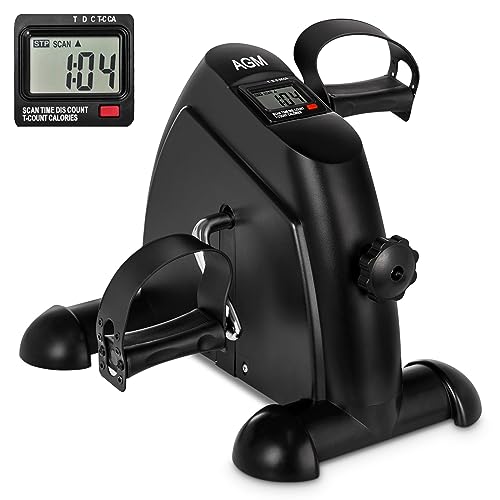
With a 12.6-inch height, this compact pedal exerciser suits seated leg movement in spaces where vertical clearance matters. The maker says it can also be placed on a tabletop for arm exercise, and its LCD screen displays workout time, count, speed and estimated calories. Adjustable, non-slip foot straps help keep feet positioned during pedaling. The 15.98-inch length is useful to check against chair placement and available floor space. This model is a fit for people who want tracking and strap adjustment, but the numeric display may not matter to buyers who only need a basic pedal motion.
Bottom line: Choose this if a compact height, adjustable straps and workout tracking are priorities.
RYGEO Mini Pedal Exerciser

A tension knob is the defining feature of this mini pedal exerciser, letting the maker’s low-intensity design accommodate a range of light cycling effort. The maker says the unit is intended for both leg and arm exercise, so it can be placed on the floor for seated pedaling or on a table for arm movement. Its weight is about 4.2 lb, making portability a distinguishing point. This suits buyers seeking a simple, lightweight option without a display feature; the dimensions are not given, so confirm it will fit your intended floor space before ordering.
Bottom line: Pick this for lightweight portability and adjustable low-intensity resistance.
XVCAS Foldable Under Desk Pedal Exerciser

Folding is the key distinction of this pedal exerciser, which is designed to tuck away under a desk or beside a sofa when not in use. It measures 19.7 inches long, 14.6 inches high and 9 inches wide, so compare that footprint with the space between your chair and desk before setting it up. The maker says its LCD tracks time, count, speed in RPM and estimated calories, and describes adjustable pedal straps and resistance. This model suits users who value storage flexibility and tracking, but its length may be limiting in a tight seated setup.
Bottom line: Choose this when folding storage and display tracking matter more than a shorter footprint.
How to choose floor exercise bike pedals
Start with seated clearance and the kind of movement you want: a pedal exerciser needs room for the unit and for your knees to travel above it. Measure the gap from floor to desk underside and the distance from chair front to desk; a 12.6-inch unit may suit a lower space than a 14.6-inch one, but knee clearance depends on your leg length and chair position. For a first setup, leave roughly 2 inches around the frame so it does not bump furniture as you pedal. Choose a display only if time, count or speed tracking will help you maintain a routine; resistance adjustment matters more when you want to vary effort.
Fit and placement for a seated pedal exerciser
Place the pedals directly in front of the chair, with knees comfortably bent at the farthest point of the stroke and feet able to stay strapped in. Measure the entire footprint: a 19.7-inch length can reach farther under a desk than a 15.98-inch model, while the user’s chair and knee movement need extra space beyond the frame. Smooth floors can let a small exerciser creep, so use a firm, level surface and stop if it shifts. For arm use, place a unit on a stable table at a height that keeps shoulders relaxed; do not use a loose or wobbly surface.
Resistance, displays and folding designs
Most mini pedal exercisers use a simple crank and adjustable resistance rather than the broad gearing range of a full stationary bike. A knob lets the user increase drag in small steps, but begin at a low setting and prioritize smooth motion over speed, especially when returning to activity. An LCD may show elapsed time, revolutions or estimated calories; calorie figures are estimates, not precise energy measurements. Folding frames can simplify storage, but unfold and lock the frame fully before pedaling and check that all contact points rest evenly on the floor. This comparison table maps common needs to useful features.
| Need | Feature to prioritize | Trade-off |
|---|---|---|
| Low-clearance space | Shorter unit height | Knee room still depends on chair position |
| Routine tracking | LCD time or count display | Calories are estimates |
| Limited storage | Folding frame | Set up and lock before each use |
| Light effort changes | Adjustable resistance | Start low and raise gradually |
Safe use and common setup mistakes
Pedal exercisers are for seated movement, not standing or high-force cycling; a light frame can tip or slide when loaded aggressively. Start at the lowest resistance and a slow cadence, keep both feet secured by straps, and stop if the frame moves or causes discomfort. Anyone using a pedal exerciser during recovery after surgery should follow a clinician’s activity limits, since the products’ recovery-oriented wording does not establish a safe exercise plan. Common mistakes include placing the unit too far away, which can overextend the knees, or too close, which crowds the stroke. Reposition the chair until knees remain comfortably bent throughout each revolution.
Frequently Asked Questions
How much space do floor pedal exercisers need?
The frame footprint is only part of the space needed; allow extra room for chair position and knee travel. Measure the under desk height and chair-to-desk gap before choosing, then leave roughly 2 inches around the unit so it can move without striking furniture.
Can a mini pedal exerciser be used for arms?
Many mini exercisers can be placed on a stable tabletop for arm pedaling as well as on the floor for leg use. Set the unit at a height that keeps shoulders relaxed, and avoid a loose or unstable table.
Are the calories on a pedal exerciser accurate?
An LCD calorie figure is an estimate rather than a precise measurement of energy use. Time, count or speed readings are more useful for tracking repeat sessions under similar settings.
How should I start using a floor pedal exerciser?
Begin seated at the lowest resistance and use a slow, smooth cadence for a short session. Increase effort gradually only if the frame stays stable and the movement remains comfortable; recovery after surgery should follow clinician guidance.
How do I stop a pedal exerciser from sliding?
Use the unit on a firm, level floor and begin with gentle pedaling, since forceful strokes can move lightweight frames. Stop and reposition the setup if the frame shifts, and do not pedal while standing.