
Best Golf Club Shaft Epoxy: 3 Cure Times Compared

Brampton PRO-FIX Long Cure suits most club builders because its 20-minute work life leaves time to assemble a full set in one session. Choose Brampton PRO-FIX Quick Cure for a faster one-hour cure or Brampton PRO-FIX Rapid Cure when you need a 30-minute repair for a single club; those shorter windows leave less time to mix and position parts.
Golf shaft epoxy bonds the shaft to the clubhead, so the work life and cure time determine how many clubs you can handle and when the repaired club can be used.
We earn a commission if you buy through links on this page. As an Amazon Associate I earn from qualifying purchases. Products are compared on manufacturer specifications, not hands-on testing.
- Best overall: Brampton PRO-FIX Long Cure – Its 20-minute work life supports building a full set in one session.
- Best for a fast multi-club repair: Brampton PRO-FIX Quick Cure – Its five-minute work life allows up to three clubs per mix, with a one-hour cure.
- Best for one-club repairs: Brampton PRO-FIX Rapid Cure – Its three-minute work life is designed for a single club, and it is ready in 30 minutes.
| Product | Best for | Work life | Cure time (minutes) | Kit size | Shop |
|---|---|---|---|---|---|
| Brampton PRO-FIX Long Cure | Full-set assembly | 20 minutes | — | 0.85 oz | Check Price on Amazon |
| Brampton PRO-FIX Quick Cure | Fast multi-club fixes | 5 minutes | 60 minutes | 4 oz | Check Price on Amazon |
| Brampton PRO-FIX Rapid Cure | Single-club repair | 3 minutes | 30 minutes | 0.85 oz | Check Price on Amazon |
Golf Club Shaft Epoxy Compared
Choose a cure schedule that matches how many clubs you can prepare and bond within one work session.
Brampton PRO-FIX Long Cure

The longest work life among these choices makes this epoxy the fit for assembling several clubs in one session. Its 20-minute window gives more time to mix and position components than the five- and three-minute alternatives. Brampton says the formula is engineered for golf-club impact and swing speeds over 130 mph, and identifies it for shafts, heads, drivers, putters, and irons. The tradeoff is timing: the facts give no cure time, so confirm when a bonded club is ready before planning its use.
Bottom line: Pick this when you need a 20-minute work window for a full set.
Brampton PRO-FIX Quick Cure

The four-ounce kit and five-minute work life suit a short repair session involving as many as three clubs per mix. Brampton says this medium-viscosity epoxy fully cures in one hour and is engineered for swing speeds exceeding 125 mph. Its compatible materials include steel, titanium, graphite, wood, and plastics. Compared with the 20-minute option, the shorter working window calls for having the parts ready before mixing; it is less suited to a full set built at a deliberate pace.
Bottom line: Choose this for a few prepared repairs when a one-hour cure matters.
Brampton PRO-FIX Rapid Cure
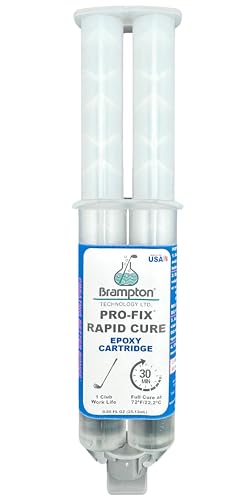
The shortest work life and cure time here are aimed at repairing one club quickly. Brampton gives this epoxy a three-minute work life and says it is ready in 30 minutes; its application covers golf shafts and heads across drivers, putters, and irons. Brampton also says the bond is engineered for swing speeds up to 120 mph. The limitation is the narrow work window: a three-minute mix leaves little room for multiple clubs or slow alignment, so prepare one repair at a time.
Bottom line: Pick this when one club needs a rapid repair and the components are ready.
How to Choose Golf Club Shaft Epoxy
Choose golf club epoxy by work life first, then cure time: a longer window gives more time to mix and align, while a faster cure shortens the wait. These options span 3, 5, and 20 minutes of work life, making batch size the clearest decision point. For one club, a three-minute window can be workable if the shaft and head are ready before mixing; for a full set, a 20-minute window allows a more measured sequence. A product’s advertised cure time is not automatically its work life, so do not confuse the two. The five-minute option is positioned for up to three clubs per mix. Use the maker’s cure schedule for the actual repair before putting the club back into play.
Golf Epoxy Work Life and Cure Time
Work life is the period after mixing when epoxy can still be applied and positioned; cure time is the wait until the bond is ready. The three choices provide work lives from 3 to 20 minutes, but only two give specific cure times: 30 minutes and 1 hour. A 30-minute or one-hour ready time should not be treated as an invitation to extend the working window. Room temperature can affect epoxy behavior; cooler conditions generally slow curing, while warmer conditions speed it, so use the product’s instructions for the temperature and mixing ratio. Keep the club supported and undisturbed during curing, and do not swing it until the maker’s cure period has elapsed.
Match Epoxy to the Number of Clubs
Match the work window to the amount of work: the single-club product has a 3-minute window, the multi-club option allows up to three clubs per mix in 5 minutes, and the long-cure product gives 20 minutes for a full set. Have the shaft, head, and work area ready before combining components; preparation prevents spending the limited open time searching for tools. Golf epoxy repairs typically require clean, properly prepared bonding surfaces, and residue or loose material can weaken adhesion. Avoid mixing more than can be applied during the work life. The practical rule is simple: if one repair cannot be positioned confidently in 3 minutes, choose a longer-work-life formula rather than rushing alignment.
| Repair need | Work-life fit |
|---|---|
| One club, quick turnaround | 3 minutes; 30-minute cure |
| Up to three clubs per mix | 5 minutes; 1-hour cure |
| Full-set assembly | 20 minutes |
Prepare and Cure a Shaft Bond
Careful surface preparation and full curing matter because a shaft-to-head bond must withstand repeated impact. Remove old adhesive from the bonding area and prepare surfaces as directed by the epoxy maker; avoid damaging a graphite shaft while cleaning it. Keep the mixing ratio accurate and blend the resin and hardener thoroughly, since uneven mixing can leave soft or weak spots. A snug shaft fit matters too: a large gap should not be treated as a reason to rely on extra adhesive. Wear gloves, protect the work surface, and keep epoxy away from skin and eyes. If fit or cure timing is uncertain, confirm the manufacturer’s instructions before assembly.
Frequently Asked Questions
How long should golf shaft epoxy cure?
The cure time depends on the formula: the quick-cure option gives one hour and the rapid-cure option gives 30 minutes. The long-cure option’s cure time should be confirmed before scheduling play.
How much epoxy do I mix for one club?
Mix only enough for the repair you can complete within the epoxy’s work life, which ranges from 3 to 20 minutes across these choices. Prepare the shaft and head first so the mixture is not sitting while you get tools.
Can golf epoxy bond graphite shafts?
The quick-cure formula names graphite among its compatible materials. For any shaft, clean and prepare the bonding surface carefully, since abrasion that damages graphite fibers can compromise the shaft.
Can I use regular hardware-store epoxy on golf clubs?
Golf-club-specific formulas are engineered for the impact between shaft and head, while general-purpose epoxies may not be designed for that repeated load. Choose an adhesive explicitly intended for golf repairs and observe its work and cure times.
What happens if I swing before epoxy fully cures?
An early swing can stress a bond before it reaches its intended strength, risking shaft or head separation. Wait through the maker’s full cure period; a 30-minute ready time is not the same as a 3-minute work life.