
Best Golf Wrist Hinge Trainer: 4 Aids Compared

SKLZ Wrist Hinge Golf Swing Trainer suits most golfers because its swing-lock mechanism helps set wrist hinge at the top of the backswing, and it works for either handedness. Choose a wrist brace instead if you want a wearable aid that holds the lead wrist in position; the sizing and handedness rules vary by model.
We earn a commission if you buy through links on this page. As an Amazon Associate I earn from qualifying purchases. Products are compared on manufacturer specifications, not hands-on testing.
- Best overall: SKLZ Wrist Hinge Golf Swing Trainer – Its swing-lock mechanism supports adjustments and club changes, and the trainer works for right- and left-handed golfers.
- Best for size options: GAIARENA Wrist Hinge Trainer, Large – It offers three wrist sizes from 6.3 to 10.2 inches and identifies which wrist right-handed golfers should wear it on.
- Best for adjustable support: Adjustable Golf Wrist Brace with Splint – The one-size brace has an internal support strip and is described for left- or right-handed golfers.
| Product | Best for | Handedness | Wrist fit | Feedback style | Shop |
|---|---|---|---|---|---|
| SKLZ Wrist Hinge Golf Swing Trainer | Two-way practice | Right- and left-handed | — | Swing lock | Check Price on Amazon |
| GAIARENA Wrist Hinge Trainer, Large | Measured wrist fit | Right-handed golfers | 7.1–8.6 in | Lead-wrist brace | Check Price on Amazon |
| Golf Swing Trainer Wrist Hinge Brace | Portable practice | — | — | Adjustable Velcro brace | Check Price on Amazon |
| Adjustable Golf Wrist Brace with Splint | Support-strip feedback | Left- or right-handed | One size | Internal support strip | Check Price on Amazon |
Golf Wrist Hinge Trainers Compared
Choose based on how you want wrist position feedback, whether the trainer fits your wrist, and which hand you play with.
SKLZ Wrist Hinge Golf Swing Trainer

Unlike the wearable braces, this trainer uses a swing-lock mechanism that can be adjusted for setup and club changes. SKLZ says it helps set wrist hinge at the top of the backswing and encourages an early wrist set for clubface alignment and on-plane swings. A rubber grip is intended to secure the aid to the arm and provide feedback during range sessions. It works for either handedness and is designed to fit in most golf bags. Choose another style if you specifically want a brace with a wrist-size range; no wrist measurement is given for this model.
Bottom line: Pick this if you want a swing-lock aid that accommodates either handedness.
GAIARENA Wrist Hinge Trainer, Large

Unlike the swing-lock trainer, this brace is sized by wrist circumference and is specifically identified for right-handed golfers. The large size covers 7.1 to 8.6 inches, with overlap against the medium and XL ranges, so measure around the wrist before choosing. GAIARENA says the brace covers the lead wrist and helps keep it straight during the swing to build muscle memory. Its guidance places it on the left wrist for a right-handed golfer. The key limitation is handedness: golfers who swing left-handed should choose a trainer that explicitly supports their orientation.
Bottom line: Choose this if you are right-handed and your wrist measures within its large-size range.
Golf Swing Trainer Wrist Hinge Brace
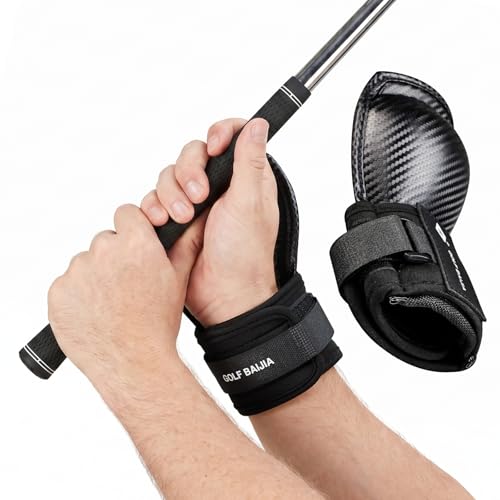
This brace stands out for its adjustable Velcro strap and portable practice focus rather than a size range or handedness rule. The maker says it helps train wrist-hinge timing, direction and angle, and says it targets habits such as early release and wrist flipping. The carbon-fiber-pattern design is described as lightweight, with breathable construction. It is intended for indoor practice, range warm-ups, course preparation and travel.
Bottom line: Pick this for portable practice if its fit and orientation suit your swing.
Adjustable Golf Wrist Brace with Splint

Unlike the other options, this adjustable brace has an internal support strip and is expressly described for left- or right-handed golfers. The maker says the strip restricts wrist motion to support swing-position practice, and describes the brace as one size. Its dimensions are 15.7 by 7.1 by 0.31 inches, which describe the item rather than a wrist circumference range. The limitation is that a support strip may feel more restrictive than a trainer focused on setting or sensing hinge; if you have an existing wrist injury, ask a health professional before using a motion-restricting aid.
Bottom line: Choose this if you want a one-size brace with an internal support strip.
How to Choose a Golf Wrist Hinge Trainer
Choose by feedback style first: a swing-lock aid guides a setup position, while a brace applies feedback by covering or restricting wrist movement. Golf wrist hinge changes with grip, club and swing, so a trainer should cue a repeatable motion rather than force every golfer into one exact angle. A useful decision rule is to select a model with a hand orientation if you play left-handed or right-handed and want clear placement guidance; only some options specify this. Also decide whether you need a wrist-size range: measure wrist circumference with a flexible tape, then compare it with the model’s size band before ordering. A band that overlaps another size may still fit either choice, so prioritize comfort and secure positioning.
Aid type matters more than styling for practice:
| Trainer style | Feedback | Choose when |
|---|---|---|
| Swing-lock trainer | Setup and hinge-position cue | You want adjustment and club changes |
| Wrist brace | Wearable position or motion cue | You want a brace-style aid |
Wrist Fit and Handedness
Measure the wrist circumference where the brace will sit, because a wearable trainer’s size band is more useful than guessing from glove size. The GAIARENA large covers 7.1 to 8.6 inches and overlaps its medium and XL ranges; choose based on a snug but comfortable fit rather than assuming the largest size is best. Right-handed golfers generally use the left hand as the lead hand, while left-handed golfers generally lead with the right, but the product’s own hand-orientation guidance should decide brace placement. The SKLZ trainer says it works for both handednesses; another brace identifies left- or right-handed use. A brace without a hand rule or measurement band needs a fit check before practice.
Do not cinch a brace so tightly that it causes numbness, tingling or pain. A training aid should not substitute for medical care, and a motion-restricting brace deserves extra caution if your wrist is injured or recovering.
Using a Wrist Hinge Aid in Practice
Use short practice blocks to focus on one cue, such as setting the wrists during the backswing, rather than trying to change grip, posture and swing path at once. A hinge trainer can provide a physical cue, but it does not assess ball flight or replace instruction; alternate a few slow rehearsal swings with normal swings to check whether the motion transfers. Begin with half swings and a short iron before building to a full swing, since shorter swings make it easier to notice wrist position. Stop if the brace shifts, pinches or restricts circulation. Remove any trainer before playing a shot unless its instructions expressly allow use during that swing; practice aids are not automatically suitable for on-course use.
Common Wrist Hinge Trainer Mistakes
The most common mistake is treating a wrist aid as a universal swing correction. A brace that holds the lead wrist straight can cue one position, but a golfer who wants to train wrist set timing may prefer a trainer designed around that cue. Another mistake is overlooking hand orientation: on a right-handed swing the left hand is usually the lead hand, and the reverse applies to left-handed swings. A third is choosing by a size label without measuring; wrist circumference bands can overlap, so use the actual measurement. Finally, do not force a wrist into painful range to match a device. Stop practice for discomfort and seek appropriate medical advice if pain persists.
Frequently Asked Questions
Which wrist should a golf hinge trainer go on?
For a right-handed golfer, the left wrist is usually the lead wrist; for a left-handed golfer, it is usually the right. Follow the trainer’s orientation, since some models specify only one handedness.
How should I measure my wrist for a golf brace?
Wrap a flexible tape around the wrist where the brace will sit and compare the circumference with the product’s size band. For example, the large GAIARENA size covers 7.1 to 8.6 inches, overlapping adjacent sizes.
Can I use a wrist hinge trainer if my wrist hurts?
Do not use a motion-restricting brace to push through pain. Stop if you feel pain, numbness or tingling, and ask a health professional before using a support device with an existing or recovering wrist injury.
Should I hit full shots with a wrist hinge trainer?
Start with slow rehearsals and half swings before progressing to full swings, so you can notice the wrist cue without adding speed immediately. Use a trainer for actual shots only if its instructions allow it.
Does a wrist hinge trainer fix a golf slice?
A hinge aid alone cannot guarantee a straighter shot, because ball direction and curve also depend on clubface and swing path at impact. Use it to practice its specific wrist-position cue, then assess shots without the aid.