
Best Hydrangea Support Cage: 4 Sizes Compared

For a hydrangea that needs taller support as it grows, Threaded Lock Plant Support Stakes, 25-Inch is the most adaptable choice: its threaded design adjusts between 14 and 25 inches high. Choose a different size if your plant needs a wider enclosure, since the options range from 10 to 20 inches across.
A hydrangea support cage is a stake-and-ring frame that helps keep stems upright. Set it around the plant before stems begin to lean, and size it to the shrub rather than forcing crowded stems into a narrow ring.
We earn a commission if you buy through links on this page. As an Amazon Associate I earn from qualifying purchases. Products are compared on manufacturer specifications, not hands-on testing.
- Best overall: Threaded Lock Plant Support Stakes, 25-Inch – The 10-inch-wide support adjusts between 14 and 25 inches high as stems grow.
- Best for wide shrubs: Sunnychicc Round Peony Cages, 20 × 30 Inches – Its round cage measures 20 inches across and 30 inches high.
- Best for multiple plants: K-Brands Half-Round Support Stakes, 10 × 24 Inches – The 12-pack includes 10-inch-wide, 24-inch-high half-round supports.
| Product | Best for | Pack and shape | Width × height | Material | Shop |
|---|---|---|---|---|---|
| Threaded Lock Plant Support Stakes, 25-Inch | Adjustable height | 6; semicircular ring | 10 × 14 or 25 in. | 4.5 mm alloy steel | Check Price on Amazon |
| Sunnychicc Round Peony Cages, 20 × 30 Inches | Wide shrubs | 4; round | 20 × 30 in. | 4 mm iron wire | Check Price on Amazon |
| K-Brands Half-Round Support Stakes, 10 × 24 Inches | Several plants | 12; half-round | 10 × 24 in. | Steel core; plastic coating | Check Price on Amazon |
| LEOBRO Plant Support Stakes, 10 × 15.8 Inches | Short plants | 6; cage support | 10 × 15.8 in. | Steel core; plastic coating | Check Price on Amazon |
Hydrangea Support Cages Compared
Compare the cage footprint and height with your hydrangea’s spread and the stem height that needs support.
Threaded Lock Plant Support Stakes, 25-Inch

The adjustable height sets this support apart: use the shorter 14-inch setup or add the threaded rod for 25 inches. Each 10-inch-wide cage has a semicircular ring and detachable parts, so it suits a single plant that needs support at different heights or compact storage between seasons. The product maker says the threaded lock is designed to prevent wobbling, and the powder coating resists rust. Its 10-inch width is narrower than the 20-inch round cage, so it may not suit a hydrangea with a broad spread.
Bottom line: Choose it when adjustable height matters more than a wide footprint.
Sunnychicc Round Peony Cages, 20 × 30 Inches

The 20-inch round footprint is the widest among these supports, giving this four-pack a different role from the narrower rings. Each cage has a grid top and three legs, with a 30-inch height for taller stems. The 4 mm iron wire has a coating intended to resist rust, according to the product maker. This is a better fit for a hydrangea whose stems need support across a broad area; for a small plant or tight planting space, the 20-inch diameter may take up more room than necessary.
Bottom line: Pick it for a hydrangea that needs a wide, tall support frame.
K-Brands Half-Round Support Stakes, 10 × 24 Inches
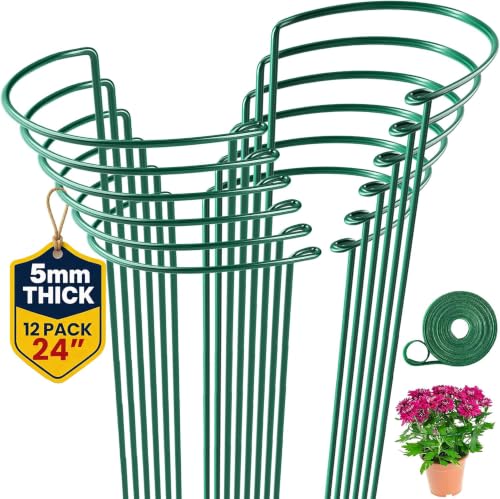
The 12-piece count distinguishes this set, which provides more individual supports than the other options. Each half-round cage measures 10 inches wide and 24 inches high, a shape that can be placed along a plant edge or paired around stems. The product maker says its steel core and plastic powder coating provide rust resistance. Because each support is only 10 inches across and half-round, check that its shape and footprint suit the plant’s placement; it is not the same enclosing shape as a full circular cage.
Bottom line: Choose it when you need several half-round supports for multiple plants.
LEOBRO Plant Support Stakes, 10 × 15.8 Inches

The 15.8-inch height makes this six-piece set the shortest option here, suited to lower stems rather than a tall shrub. Each support measures about 10 inches wide and uses a 4 mm steel core with a plastic powder coating. The product maker says the coating is weather-resistant and rustproof. Its shorter height may not reach stems that have already grown tall or begun to lean, so choose a taller frame when the support needs to extend farther up the plant.
Bottom line: Pick this set for low stems that fit within a 15.8-inch support height.
How to Choose a Hydrangea Support Cage
Choose a cage by matching its width to the shrub’s spread and its height to the stems that need support. The options here span 10 to 20 inches wide and 14 to 30 inches high, so measure the plant before selecting a frame. A cage that is too narrow can crowd stems, while a frame that is too short may not reach stems that lean higher up.
Hydrangea stems need room to grow through and around supports; the frame should guide stems rather than pull them into a tight bundle. Set supports in place before stems flop, because pushing a frame through dense, mature growth can damage stems. For an expanding plant, select an adjustable or taller support instead of assuming a short cage will remain suitable.
Hydrangea Cage Size and Placement
Measure the shrub’s width at the point where its stems need support, then compare that measurement with the cage’s diameter or width. A 20-inch round support covers more area than a 10-inch support, while a half-round frame covers only part of the plant. Leave enough space for stems to emerge naturally without pressing them against the ring.
Install the frame early in the growing season, before stems become heavy or begin to bend. Place the legs around the outer portion of the plant, keeping them clear of the crown and major stems. A simple decision rule is to use a wider frame when the plant’s supported spread exceeds the 10-inch footprint; do not force a broad shrub into a narrow support.
Round and Half-Round Hydrangea Supports
Round cages surround the stems, while half-round supports brace a plant from one side or can be arranged around a group of stems. Choose a round frame when support is needed around the whole shrub; choose a half-round design when access or placement along an edge favors an open side. Height and width matter as much as shape: available options in this group run from 14 to 30 inches high.
| Plant situation | Support type | Fit cue |
|---|---|---|
| Stems need bracing on all sides | Round cage | Match diameter to supported spread |
| Plant sits by an edge or needs open access | Half-round support | Place open side toward access |
| Plant height may change | Adjustable cage | Select a setup tall enough for the stems |
Do not assume that a taller cage is automatically better: an oversized frame can be awkward around a compact plant, and an open-sided support does not enclose stems like a round ring.
When to Install and Adjust a Hydrangea Cage
Install a support before the plant’s stems begin to lean, commonly as spring growth starts. Early placement lets stems grow through the frame instead of requiring the gardener to bend established stems into position. As the plant grows, check that stems are not pinched against wires or crowded into one section of the ring.
Hydrangea species and cultivars differ in mature size and stem habit, so use the plant’s own spread and height rather than a one-size schedule. A cage does not replace pruning or correct planting-site selection. Keep supports stable in the ground, and adjust a modular frame before the plant becomes too dense to reach safely through its foliage.
Frequently Asked Questions
When should I put a cage around a hydrangea?
Install a hydrangea cage as spring growth begins, before stems start to lean. Early placement lets new stems grow through the frame rather than forcing bent stems into position later.
How wide should a hydrangea support cage be?
Choose a cage that matches the shrub’s spread where stems need bracing; the options here are 10 or 20 inches wide. If the supported spread exceeds a 10-inch footprint, do not squeeze the plant into that narrower frame.
Will a plant cage damage hydrangea stems?
A cage can damage stems if they are bent sharply or pinched against the frame. Position it before stems flop, and leave room for stems to grow through without forcing them into a tight bundle.