
Glass Bead for Blasting: 4 Media Sizes Compared

For a glass bead for blasting, choose #12 Glass Beads, Extra Fine when a finer 140–230 mesh abrasive fits the job; the named product type is glass beads used to clean or finish surfaces with impact rather than cutting them. Choose a coarser option if you need a larger mesh range, or a larger package if you need more media on hand.
We earn a commission if you buy through links on this page. As an Amazon Associate I earn from qualifying purchases. Products are compared on manufacturer specifications, not hands-on testing.
- Best overall: #12 Glass Beads, Extra Fine – Its 140–230 mesh range is the finest option and it is intended for cleaning, finishing, and peening.
- Best for larger supply: Fine Glass Bead Blast Media, 53 lb – The 53-pound container is substantially larger than the 10-pound options.
- Best for coarser media: #8 Glass Beads, Medium – Its 70–100 mesh range is the coarsest option.
| Product | Best for | Mesh or micron range | Package weight | Stated use | Shop |
|---|---|---|---|---|---|
| #12 Glass Beads, Extra Fine | Fine surface finishing | 140–230 mesh | 10 lb | Cleaning, finishing, peening | Check Price on Amazon |
| Fine Glass Bead Blast Media, 53 lb | Larger media supply | 90–150 microns | 53 lb | Blast media | Check Price on Amazon |
| #8 Glass Beads, Medium | Coarser bead cleaning | 70–100 mesh | 10 lb | Cleaning, finishing, peening | Check Price on Amazon |
| #10 Glass Beads, Medium | Midrange bead size | 100–170 mesh | 10 lb | Blasting abrasive media | Check Price on Amazon |
Glass Bead for Blasting Options
Compare the particle ranges and package sizes against the finish and volume your project calls for.
#12 Glass Beads, Extra Fine

#12 Glass Beads, Extra Fine is the finest mesh option here, with round glass beads in a 140–230 US mesh range. The maker describes it for cleaning metal parts without changing tolerances, blending machine marks, sealing pores, and peening; the product also says it contains no free silica and can be recycled many times. A 10-pound package suits smaller jobs or users who want a fine media on hand. Its limitation is volume: projects consuming more media may be better matched to the 53-pound package.
Bottom line: Choose this for fine work where its 140–230 mesh range fits the surface and process.
Fine Glass Bead Blast Media, 53 lb
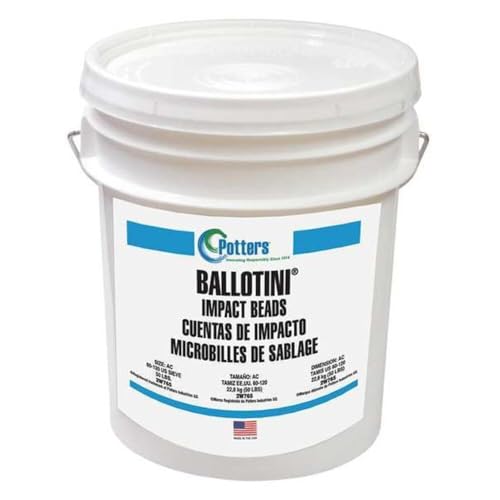
Fine Glass Bead Blast Media, 53 lb stands apart by offering a 53-pound container, over five times the weight of the other packages. Its nominal particle diameter is 90–150 microns, a different measurement from the mesh ranges given for the other choices; do not assume the ranges are directly interchangeable without a conversion reference. The package is suited to users who need more media available for repeated or larger jobs. The specifications do not identify a specific finishing or cleaning purpose, so this is less targeted if a particular result is the deciding factor.
Bottom line: Pick this when package volume matters most and the micron range suits your setup.
#8 Glass Beads, Medium

#8 Glass Beads, Medium has the coarsest specified mesh range among these choices: round beads at 70–100 US mesh. The maker describes it for cleaning and prepping metal without changing tolerances or adding ferrous pollutants, as well as blending machine marks and peening. Its 10-pound package is the same size as the other mesh-rated choices, so choose it for its particle range rather than greater quantity. The coarser range may not suit work that calls for the finer 140–230 mesh media.
Bottom line: Choose this when a 70–100 mesh bead range suits the job.
#10 Glass Beads, Medium

#10 Glass Beads, Medium occupies a middle position by its 100–170 mesh range, between the coarser 70–100 mesh and finer 140–230 mesh options. It comes in a 10-pound package and is identified as blasting abrasive media for cabinets or blasting guns in its product name. That makes the size range its main differentiator when a project needs a compromise between those stated mesh spans. The specifications give less specific intended-use guidance than some alternatives, so choose it based on the mesh range your process calls for.
Bottom line: Pick this when a 100–170 mesh range is the match for your process.
How to Choose Glass Beads for Blasting
Start with the surface result and the media range your blaster can handle; mesh and micron figures describe particle size in different units. In this group, the mesh options run from 70–100 to 140–230, while one option gives a 90–150 micron diameter instead. Finer media generally supports lighter finishing, while coarser media removes material more readily, but the exact result also depends on pressure, nozzle, distance, and substrate. Use the manufacturer’s recommended media range for the cabinet or gun. If your setup calls for a defined mesh range, avoid substituting a micron-only specification without checking a conversion chart for the relevant sizing standard.
Mesh and Micron Sizes Compared
Mesh numbers indicate how many openings per linear inch a sizing screen has, so higher mesh numbers generally correspond to smaller particles. Microns measure diameter directly: 1 micron is one-millionth of a meter. Screen standards and particle distributions can differ, so a range is not a single exact particle size. Use the table to compare only the measurements; do not treat micron and mesh numbers as equivalent without a reliable conversion reference.
| Need | Range to compare | Package |
|---|---|---|
| Finest mesh range | 140–230 mesh | 10 lb |
| Middle mesh range | 100–170 mesh | 10 lb |
| Coarsest mesh range | 70–100 mesh | 10 lb |
| Largest package | 90–150 microns | 53 lb |
Match Blasting Media to the Surface
Glass beads are spherical abrasive media commonly used for cleaning and peening rather than sharp-edged cutting. Bead blasting can leave a more uniform, satin-like appearance than angular abrasives, but the finish depends on bead size, pressure, and the metal’s starting condition. For a surface where preserving dimensions matters, the maker’s claim for the selected media is only one factor: first try a small, inconspicuous area and inspect the result. Avoid blasting delicate coatings or thin parts without confirming that the pressure and media are appropriate; impact can alter a surface even when the abrasive is spherical.
Safe Handling and Blaster Setup
Blasting creates airborne dust and particles, so use an enclosed, properly functioning cabinet where appropriate, wear eye and respiratory protection, and keep others clear of the work area. Use the nozzle, pressure, and media range specified for the equipment; a mismatch can clog a feed system or damage the workpiece. The maker of one option recommends a nozzle angle of 45–60 degrees, but that recommendation should not be generalized to every media or tool. Keep media dry and sift out broken particles and debris when reusing it; damaged beads can change the finish and feed behavior.
Frequently Asked Questions
What does a higher mesh number mean for glass beads?
A higher mesh number generally means smaller particles because the sizing screen has more openings per inch. Screen standards vary, so compare ranges measured under the same standard when possible.
Can I substitute micron-rated beads for mesh-rated beads?
Only after confirming a suitable conversion for the sizing standard and particle distribution. Microns measure diameter, while mesh describes a screen opening count, so the numbers cannot be compared directly.
Are glass beads suitable for peening metal parts?
Glass beads can be used for peening, and one maker describes its media for reducing tensile stress and increasing fatigue limit. Suitability depends on the part material, media size, and process parameters.
What angle should I hold a blasting nozzle?
One maker recommends a 45–60 degree nozzle angle for efficient cleaning with its media. Follow the guidance for the particular abrasive and blaster, since nozzle angle affects impact and finish.
How do I protect myself during bead blasting?
Use a closed cabinet when the setup allows, plus eye and respiratory protection, because blasting can generate airborne particles. Keep the work area clear and use equipment within its specified pressure and media limits.