
Best Paper for Oil Pastels: 4 Pads Compared by Surface

For most oil pastel artists, GR DZPLUS 9 × 12 Oil Pastel Pad is the best starting point because its 9 × 12-inch sheets have two usable textures and 123 lb paper. Choose Strathmore 400 Series Pastel Pad, 9 × 12 for assorted paper colors or GR DZPLUS 5.9-inch Square Oil Pastel Pad for compact square studies; choose MEEDEN 8 × 8 Oil Pastel Pad if you want a smaller, heavier pad with an oil-resistant barrier.
We earn a commission if you buy through links on this page. As an Amazon Associate I earn from qualifying purchases. Products are compared on manufacturer specifications, not hands-on testing.
- Best overall: GR DZPLUS 9 × 12 Oil Pastel Pad – The 9 × 12-inch sheets offer two texture options on 123 lb paper.
- Best for oil resistance: MEEDEN 8 × 8 Oil Pastel Pad – The maker says its embedded tracing paper blocks oil and water penetration.
- Best for assorted colors: Strathmore 400 Series Pastel Pad, 9 × 12 – The pad contains assorted-color paper in a 9 × 12-inch format.
| Product | Best for | Sheet size | Paper weight | Surface | Shop |
|---|---|---|---|---|---|
| GR DZPLUS 9 × 12 Oil Pastel Pad | Versatile studies | 9 × 12 in | 123 lb | Dual texture | Check Price on Amazon |
| MEEDEN 8 × 8 Oil Pastel Pad | Oil-resistant storage | 8 × 8 in | 140 lb | Fine texture | Check Price on Amazon |
| Strathmore 400 Series Pastel Pad, 9 × 12 | Colored paper | 9 × 12 in | 80 lb | Subtle texture | Check Price on Amazon |
| GR DZPLUS 5.9-inch Square Oil Pastel Pad | Compact square work | 5.9 × 5.9 in | 123 lb | Dual texture | Check Price on Amazon |
Paper for Oil Pastels Compared
Compare each pad’s format, weight and surface to match the paper to your work.
GR DZPLUS 9 × 12 Oil Pastel Pad

The 9 × 12-inch format and two texture choices make this pad the most adaptable option here. Each of its 30 sheets is 123 lb (200 g/m²), acid-free and pH-neutral; one side has a heavier texture, while the other is lighter. The maker says the paper suits oil, hard and soft pastels as well as graphite, colored pencil and charcoal. Choose it if you want room for larger studies and the option to switch surface feel. Its ivory paper is a limitation if you need white or assorted-color sheets.
Bottom line: Choose this pad for a larger working area and two surface options.
MEEDEN 8 × 8 Oil Pastel Pad

The 8 × 8-inch square format sets this pad apart, and its 140 lb (300 g/m²) sheets are the heaviest among these options. The fine-textured paper is acid-free. The maker says embedded oil-resistant tracing paper helps block oil and water penetration, which may suit artists concerned about stacking finished work. This pad is smaller than the 9 × 12-inch choices, so it offers less room for broad compositions. Pick it for square-format work and the added barrier rather than for a large drawing surface.
Bottom line: Choose it for square studies and the maker-described oil-resistant barrier.
Strathmore 400 Series Pastel Pad, 9 × 12
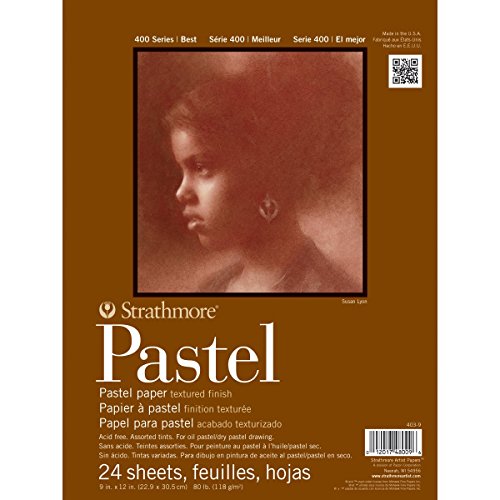
Assorted-color sheets distinguish this 9 × 12-inch pad from the ivory and white options. Its 24 sheets weigh 80 lb and have a subtle texture that the maker says is ideal for oil pastel and suitable for soft or hard pastel. That surface gives pastel marks some tooth without committing you to the pronounced dual-sided texture of GR DZPLUS 9 × 12 Oil Pastel Pad. The lighter paper weight may matter if your work involves firm pressure or substantial layering. Choose this pad when a colored ground is important to the composition.
Bottom line: Choose it when assorted paper colors matter more than heavier stock.
GR DZPLUS 5.9-inch Square Oil Pastel Pad

The 5.9 × 5.9-inch square sheets are the compact-format choice in this group. This 50-sheet pad uses 123 lb (200 g/m²), acid-free, pH-neutral paper with a heavier texture on one side and a lighter one on the other. The maker says it is suitable for oil, hard and soft pastels, plus graphite, colored pencil and charcoal. Its small surface suits studies or work designed around a square composition, but it leaves less room than a 9 × 12-inch sheet for broad scenes. The pastel-colored paper is also distinct from white or ivory grounds.
Bottom line: Choose it for small square pieces and two texture choices.
How to choose oil pastel paper
Start with texture and format: a textured surface gives oil pastel pigment tooth to catch on, while a smoother surface can make fine lines easier to control. Heavier paper can feel more substantial under pressure, but weight alone does not tell you how much texture a sheet has. Compare the surface descriptions as well as the pound rating. If you want room for a large study, choose a 9 × 12-inch sheet; if your work is deliberately compact, a square pad may fit better. A practical rule is to choose a sheet at least as large as your intended finished drawing, so you do not have to crop the composition to fit the paper.
What paper weight and texture mean
Paper weight is one part of a surface choice, not a guarantee of a particular pastel effect. These pads range from 80 lb to 140 lb, and the two heavier options are identified as 200 g/m² and 300 g/m². Texture also varies: one option has a subtle texture, another has fine texture, and the dual-surface pads provide a heavier and a lighter side. Try the less textured face for controlled marks and the more textured face when you want the surface to show through. Do not assume that all paper called pastel paper has the same tooth; the named surface is a more useful comparison than the category label alone.
The table compares format and texture, two practical choices that affect how a sheet suits a drawing.
| Need | Paper choice |
|---|---|
| Large, flexible studies | 9 × 12 in with dual texture |
| Assorted-color grounds | 9 × 12 in, assorted colors |
| Compact square studies | 5.9 × 5.9 in |
| Heavier square paper | 8 × 8 in, 140 lb |
Choosing a paper size for your composition
Choose the sheet dimensions around the finished artwork rather than the pad’s outside measurements. The options here include 9 × 12-inch rectangles and square formats of 5.9 × 5.9 inches and 8 × 8 inches. A 9 × 12-inch sheet gives more room in one direction for a landscape or portrait composition; square paper encourages a balanced frame. For a small study, a 5.9-inch square reduces the working area, while an 8-inch square gives more space without switching to a rectangle. Before starting, mark the intended image boundary lightly so the drawing fits the sheet and leaves any margin you want.
Handling and storing oil pastel drawings
Oil pastel marks can remain soft and transfer when a drawing touches another surface, so avoid stacking finished sheets face to face. Let the work rest flat and separate it from adjacent artwork with a protective sheet; the paper pad itself should not be treated as a fixative or a barrier unless its maker describes that feature. One pad here is made with an embedded oil-resistant tracing-paper layer, but that claim applies to that pad only. Acid-free paper can help with long-term paper stability, yet it does not make pastel pigment immune to light, dust or physical abrasion. Store finished work flat, dry and away from direct sunlight.
Frequently Asked Questions
Does heavier paper hold oil pastel better?
Heavier paper can provide a more substantial base, but texture also affects how oil pastel marks sit on the sheet. Among these options, weights range from 80 lb to 140 lb; compare tooth and intended format along with weight.
Which side of dual-texture pastel paper should I use?
Use the heavier-textured side when you want more visible tooth, and the lighter side for a less pronounced surface. The dual-texture pads here offer both faces on each sheet.
Can oil pastels be used on colored paper?
Yes, oil pastel can be used on colored paper, and the ground becomes part of the composition. Assorted-color sheets can change how the pastel colors appear, so test a small mark on the chosen ground before beginning a finished piece.
How should I store oil pastel drawings?
Keep drawings flat and prevent the marked surfaces from rubbing together, since soft pastel marks can transfer. Separate works with a protective sheet and store them away from direct sunlight and damp conditions.