
Best Professional Silent Dog Clippers Compared by Coat

For professional silent dog clippers, oneisall Professional 9,000-RPM Clippers is the strongest fit for coat grooming because its maker specifies a 9,000-RPM motor, five speeds and a 5-in-1 blade.
We earn a commission if you buy through links on this page. As an Amazon Associate I earn from qualifying purchases. Products are compared on manufacturer specifications, not hands-on testing.
- Best overall: oneisall Professional 9,000-RPM Clippers – Five speeds, 9,000 RPM and a 5-in-1 blade are aimed at coat grooming, including thick hair.
- Best for quiet trimming: oneisall X2 Gold Clippers – Its maker rates the clipper below 50 dB and provides two speeds.
- Best for thick coats: oneisall Thick-Coat Clippers – The stainless steel blade and 6,800-RPM motor are specified for thick coats.
| Product | Best for | Motor speed | Blade | Shop |
|---|---|---|---|---|
| oneisall Professional 9,000-RPM Clippers | Thick coat grooming | 9,000 RPM | 5-in-1 DLC | Check Price on Amazon |
| oneisall X2 Gold Clippers | Quiet coat touch-ups | 2 speeds | Ceramic | Check Price on Amazon |
| oneisall Thick-Coat Clippers | Dense coat trimming | 6,800 RPM | Stainless steel | Check Price on Amazon |
Professional Silent Dog Clippers
Compare the coat clippers by their noise ratings, motor speeds and blade designs.
oneisall Professional 9,000-RPM Clippers

For coat clipping, this model combines the highest motor speed among the coat clippers here with five speed settings and a 5-in-1 DLC blade. The maker also specifies a five-hour runtime, cordless use, an LED light, eight metal combs and a carrying case. Those features suit groomers handling varied coat lengths or longer sessions. The limitation is that its noise rating is up to 50 dB, not a lower guaranteed figure; noise-sensitive pets may be better matched to a model with an explicitly lower rating.
Bottom line: Choose this for adjustable speed and a kit aimed at thick or matted coats.
oneisall X2 Gold Clippers
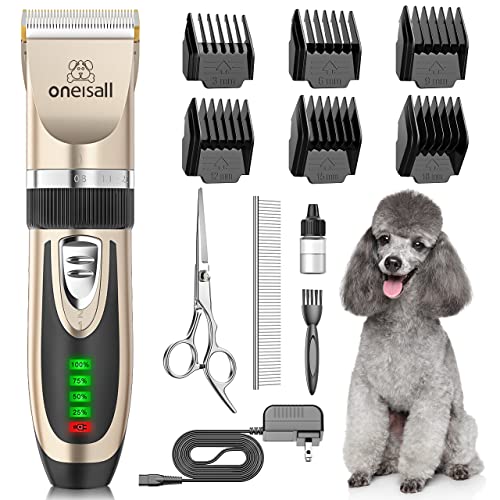
The X2 Gold prioritizes a specifically stated noise level below 50 dB and a two-speed cordless clipper format. Its ceramic blades are maker-described as durable, and the product name and features also identify a detachable design, waterproof construction and battery-level display. It suits owners who want a simpler coat clipper with a noise ceiling below the 50 dB threshold. The trade-off is fewer speed choices than the five-speed professional model, so buyers seeking fine adjustment for different coat sections may prefer that broader range.
Bottom line: Pick this for a below-50-dB claim and a two-speed coat clipper.
oneisall Thick-Coat Clippers

This clipper distinguishes itself with a detachable stainless steel blade, a 6,800-RPM motor and ten guide combs. Its maker positions the blade and motor for thick, double and curly coats, while the noise claim is below 55 dB. Cordless rechargeable operation and IPX7 waterproofing are also identified. It is a practical match for dense-coat work where blade material and comb range matter. The noise ceiling is higher than the X2 Gold’s, so a particularly sound-sensitive dog may call for the quieter stated option instead.
Bottom line: Choose this for thick coats and a broad guide-comb selection.
How to choose silent dog clippers
For coat grooming, compare noise rating, blade type and motor speed rather than relying on the word “silent.” The coat clippers here claim below 50 dB, up to 50 dB or below 55 dB; those are maker claims, not a guarantee that every dog will tolerate the sound. Decibels are logarithmic, so a small numerical difference does not translate directly into a simple percentage reduction in perceived loudness. Blade material and combs matter too: guide combs set a starting coat length, while the blade does the cutting. Choose a lower stated noise ceiling for a sound-sensitive dog, then match speed and blade to the coat. If the main job is nails, choose a grinder instead of a hair clipper.
Dog nail grinders versus coat clippers
Nail grinders smooth claw edges with an abrasive bit or wheel; coat clippers cut fur with a blade. The distinction decides which products fit the job: a grinder cannot trim a coat, and a coat clipper is not a nail trimmer. Nail grinders in this group include three grinding bits or a diamond wheel, while coat clippers use ceramic, stainless steel or DLC blades. Introduce grooming gradually and make short nail-grinding contacts, because heat can build up where an abrasive tool touches a claw. Keep fur and loose material away from moving blades, and stop if a pet becomes distressed.
| Grooming task | Tool type | What to compare |
|---|---|---|
| Trim coat hair | Hair clipper | Blade, speed, combs and noise claim |
| Shorten or smooth claws | Nail grinder | Bit or wheel, guard, speed and handling |
Match blade and combs to coat thickness
Thick, curly or double coats call for a clipper explicitly geared to dense hair, plus a blade and motor combination suited to that workload. Here, one model specifies a stainless steel blade and 6,800 RPM, while another specifies a 5-in-1 DLC blade and 9,000 RPM; these are different designs, not direct proof that one will suit every coat better. Guide combs help control length, but they do not remove mats. Never force a clipper through a tight mat or pull the coat against the skin; ask a groomer or veterinarian for help when mats are close to skin. For a coat only needing small areas or touch-ups, a simpler two-speed model may be easier to match to the task.
Reduce noise and grooming risks
A decibel rating describes sound output under some conditions, not a pet’s individual response. A calm introduction is useful: let the dog see the turned-off tool, then briefly hear it at a distance before bringing it near the coat or nails. Clippers and grinders can warm during use; pause regularly and check the working area with your hand before continuing. For nail grinding, avoid the quick, the living tissue inside the claw; pale claws may make it easier to see, while dark claws require extra caution and small increments. Stop if the dog pulls away, pants heavily or struggles, and seek professional help rather than restraining a distressed animal.
Frequently Asked Questions
Are dog clippers below 50 dB silent?
No; below 50 dB is a maker-stated noise level, not silence. Dogs vary in sound sensitivity, so introduce the running tool gradually and stop if the dog shows distress.
Can dog hair clippers trim a dog’s nails?
No; hair clippers cut fur, while nail grinders abrade claw material. Use a tool made for nails and take small steps near the quick, the sensitive tissue inside the claw.
Which clipper feature matters for thick dog coats?
Blade design and motor capability matter alongside speed and comb selection. A clipper explicitly specified for thick coats is a better starting point than choosing by RPM alone.
How should I introduce a clipper to a nervous dog?
Start with the tool switched off and let the dog inspect it without pressure, then run it briefly at a distance. Move closer only while the dog stays calm; stop if the dog struggles or shows distress.
Do guide combs cut through dog mats?
No; guide combs control cutting length but do not safely solve tight mats. Do not force a blade through a mat close to skin; get professional grooming help if it cannot be separated gently.