
Best Quiet Dog Blow Dryer: 5 Options Compared

For most people seeking a quiet dog blow dryer, HomeRunPet Dog Dryer is the clearest fit because its maker advertises a 43 dB operating level alongside 99 speed settings. Choose a different style if you need a stretchable 7-foot hose, a handheld travel dryer, or prefer a model with several heat options.
Forced-air dog dryers use a stream of air to move water from the coat, rather than relying only on heated air.
We earn a commission if you buy through links on this page. As an Amazon Associate I earn from qualifying purchases. Products are compared on manufacturer specifications, not hands-on testing.
- Best overall: HomeRunPet Dog Dryer – Its maker advertises 43 dB operation and 99 adjustable speeds.
- Best for hose reach: SHELANDY Groomer Partner – The stretchable hose extends up to 7 feet, with four nozzle types.
- Best for travel: Jellyfish Handheld Dog Dryer – At 1.23 pounds, the handheld dryer is the lightest option here.
| Product | Best for | Airflow controls | Format | Shop |
|---|---|---|---|---|
| HomeRunPet Dog Dryer | Noise-sensitive dogs | 99 speeds | Hose dryer | Check Price on Amazon |
| SHELANDY Groomer Partner | Long hose reach | Variable 65–135 mph | Hose dryer | Check Price on Amazon |
| DUMOS Dog Dryer Kit | Three heat modes | Adjustable | Hose dryer | Check Price on Amazon |
| EGFKI 5.2 HP Dog Dryer | Thick coat airflow | Max 72 m/s | Hose dryer | Check Price on Amazon |
| Jellyfish Handheld Dog Dryer | Portable grooming | 62 m/s | Handheld | Check Price on Amazon |
Quiet Dog Blow Dryers Compared
Compare the noise claims, controls and form factor to find a dryer suited to your dog and grooming setup.
HomeRunPet Dog Dryer

HomeRunPet Dog Dryer stands apart with a specific noise figure: its maker claims 43 dB operation. The dryer also offers 99 speed levels and three temperature settings, plus a 6.5-foot hose for holding the motor away from a dog during grooming. Its features include negative-ion technology and high-velocity forced air. This combination suits owners who prioritize a noise level and fine airflow adjustment. A decibel number alone does not tell you how a particular dog will respond; sound distance, room acoustics and the individual dog’s sensitivity can all matter.
Bottom line: Choose this if a noise rating and many speed adjustments are your priorities.
SHELANDY Groomer Partner

SHELANDY Groomer Partner is distinguished by its stretchable hose, which reaches up to 7 feet, and a specified airflow range of 65 to 135 mph. The 2,400-watt dryer has two heat settings and includes four nozzle types, giving owners options for different coat areas and drying approaches. It may suit a home grooming station where hose reach matters more than a decibel rating. The maker mentions noise-reduction technology but provides no sound level here, so buyers who need a measurable noise claim should weigh that limitation against the reach and controls.
Bottom line: Pick this if a long stretchable hose matters more than a numeric noise rating.
DUMOS Dog Dryer Kit
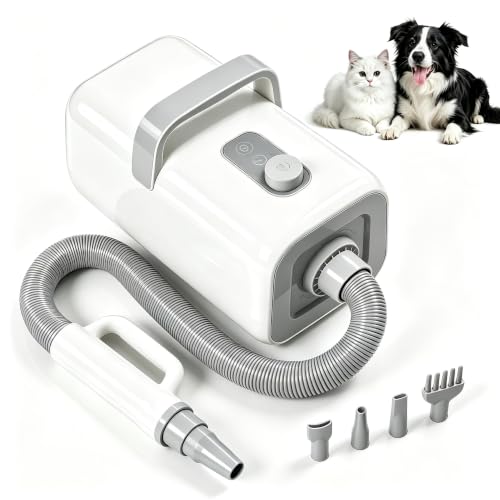
DUMOS Dog Dryer Kit differentiates itself with three named heat modes—cool, warm and hot—and adjustable wind speed. Its maker describes noise-dampening technology and aerodynamic air ducts, but does not provide a decibel figure in the specifications. Low speed is intended for more delicate areas such as faces and ears, while higher speed targets thicker coats. This setup may appeal to households that want distinct heat choices rather than a quantified sound rating.
Bottom line: Choose this for distinct cool, warm and hot settings.
EGFKI 5.2 HP Dog Dryer

EGFKI 5.2 HP Dog Dryer emphasizes strong airflow for thick coats, with a maker-claimed maximum wind speed of 72 meters per second and adjustable speed and temperature. Its temperature range is 95°F to 135°F, and a built-in temperature-control protection system is designed to stop the dryer if it gets too hot. Four nozzles are included. The emphasis here is airflow and temperature control, not quantified quietness: no decibel rating appears in the specifications. Buyers prioritizing a measurable noise level may prefer a model with a figure; those focused on coat-drying force may find this configuration more relevant.
Bottom line: Pick this when airflow for a thick coat outweighs a quantified noise rating.
Jellyfish Handheld Dog Dryer

Jellyfish Handheld Dog Dryer is the portable option: it is a handheld dryer weighing 1.23 pounds, with two speeds and four temperature levels. The maker claims air velocity of 62 meters per second and lists temperatures from 68°F to 176°F. Three nozzle types are included, although the product name refers to four temperature settings rather than four nozzles. This format suits travel or compact home grooming better than a hose-based setup.
Bottom line: Choose this for a lightweight handheld dryer for home or travel.
How to Choose a Quiet Dog Blow Dryer
Start with the sound information: a decibel rating gives a more concrete comparison than a general “low-noise” claim. A difference of 10 dB is perceived roughly as twice as loud, though a dog’s response also depends on pitch, distance and temperament. For a noise-sensitive dog, begin with the dryer at its lowest airflow and keep the motor farther away when the hose allows it. Match speed control to coat: lower airflow offers more control around the face and ears, while a dense double coat may need stronger airflow. Heat is optional for moving water; avoid directing hot air at one patch of skin, and keep the nozzle moving.
A practical rule: if a numeric noise level is essential, favor a model that gives one rather than relying on a general quietness claim.
Dog Dryer Types and Their Tradeoffs
Hose-style forced-air dryers place the motor away from the coat and direct air through a nozzle; handheld dryers put the motor and airflow source in your hand. Hose length affects how freely you can position the nozzle, while handheld weight matters during longer grooming sessions. Forced air can remove water without needing high heat, an advantage for owners who want to limit heat exposure. A low sound rating and high airflow are separate qualities: do not assume one guarantees the other.
This comparison can help match the dryer format to the grooming task.
| Need | Useful feature | Tradeoff to consider |
|---|---|---|
| Reduce sound uncertainty | Numeric decibel claim | Dog response varies |
| Reach around a grooming area | Long or stretchable hose | Requires room for the dryer unit |
| Pack for trips | Light handheld format | Motor stays in hand |
Safe Drying Around a Dog’s Face and Skin
Use low airflow near the eyes, ears and muzzle, and never aim a strong stream directly into the ear canal or face. Hot air can burn skin, especially when held close or focused in one spot; keep the nozzle moving and check the coat and skin frequently. A dryer’s temperature control does not replace supervision. For dogs that startle at sound or airflow, introduce the machine while it is off, then use brief low-speed intervals from a distance. Stop if the dog shows distress rather than forcing a full drying session.
Thick coats also need attention at the roots: separate the coat as it dries so damp areas do not remain hidden beneath the surface.
Frequently Asked Questions
How loud is 43 dB for a dog dryer?
A 43 dB claim is a concrete sound-level reference, but the perceived volume changes with distance and room acoustics. A sensitive dog may still react to the motor’s pitch or sudden airflow, so start farther away at low speed.
Can I dry my dog without using heat?
Yes, forced air can move water from a coat without relying on heat. Use cool or unheated airflow when available, keep the nozzle moving, and avoid lingering on one area.
Should I use a dog dryer on my dog’s face?
Use only low airflow near the face, and never direct air into the eyes, nose or ears. Many dogs tolerate drying better when you avoid the head or use a towel there.
How do I dry a dog with a thick double coat?
Work in sections so airflow reaches beneath the outer coat, and check near the skin for remaining dampness. Stronger airflow can help move water, but keep the nozzle moving and use low speed in sensitive areas.
Is a handheld dog dryer easier to travel with?
A handheld dryer can be easier to pack because it combines the motor and nozzle in one unit. Weight and cord arrangement still matter for travel, and a hose-style dryer may be easier to hold away from a sound-sensitive dog.