
Best RC Motor Cooling Fan: 3 Options by Fit

The 30 mm cooling fan with a 24 mm mounting pattern suits most RC motor setups here because it is specified for 540/550 motors and reaches up to 28,000 RPM. Choose a different option if you need two fans, an 8–12V supply, or an adjustable mount for a 54–58 mm motor.
We earn a commission if you buy through links on this page. As an Amazon Associate I earn from qualifying purchases. Products are compared on manufacturer specifications, not hands-on testing.
- Best overall: 30 mm 540/550 Cooling Fan – Its 24 mm mounting-hole fit and 540/550 motor compatibility cover common smaller RC setups.
- Best for a two-fan set: 35 mm 8.4V Fan 2-Pack – The package contains two 35 mm fans rated for 8.4V.
| Product | Best for | Motor diameter fit | Fan speed | Power | Shop |
|---|---|---|---|---|---|
| 30 mm 540/550 Cooling Fan | Common 540/550 motors | 540/550; 24 mm holes | Up to 28,000 RPM | — | Check Price on Amazon |
| 35 mm 8.4V Fan 2-Pack | Two-fan 36 mm setups | 36 mm; 3650–3674 | Up to 21,000 RPM | 8.4V | Check Price on Amazon |
| 30 mm 36 mm Motor Cooling Fan | 36 mm motors | 36 mm; 540/550, 3650–3674 | Up to 28,000 RPM | 8.4V | Check Price on Amazon |
RC Motor Cooling Fans
Match the fan to the motor diameter, mount, and available power before choosing by speed.
30 mm 540/550 Cooling Fan
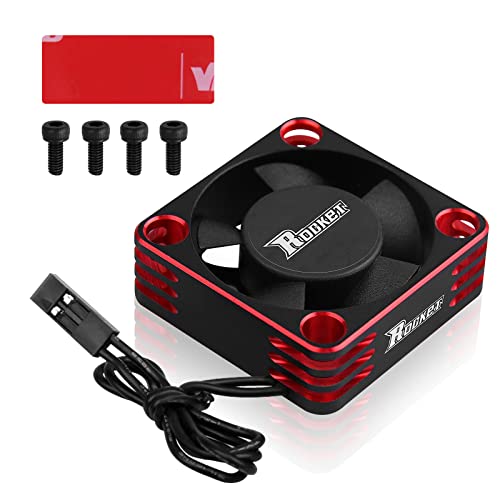
The 30 mm fan is the broadest fit for common 540/550 setups among these choices, and it also targets 1/8, 1/10, and 1/12 scale cars. The maker says it reaches up to 28,000 RPM and is intended to help dissipate motor heat. Its red-and-black heatsink measures 1.18 by 1.18 by 0.39 inches, and the maker says its plug has no positive or negative pole distinction.
Choose it when your mount has 24 mm holes. It is not the right pick for a 54–58 mm large-scale motor.
Bottom line: Pick this for a 540/550 setup with 24 mm mounting holes.
35 mm 8.4V Fan 2-Pack

The two-fan pack is the only option here that supplies a pair, making it useful when you need two matching cooling units. The maker specifies 8.4V and recommends a 2S LiPo; it also identifies 3650–3674 brushless motors with a 36 mm diameter. The fans measure 1.38 by 1.38 by 0.39 inches.
Choose it for a 36 mm motor when its voltage fits your power setup. Its maximum speed is lower than the 28,000 RPM options, and the recommendation for 2S means buyers using other battery voltages should verify electrical compatibility first.
Bottom line: Pick this if you need two 35 mm units and an 8.4V-compatible setup.
30 mm 36 mm Motor Cooling Fan
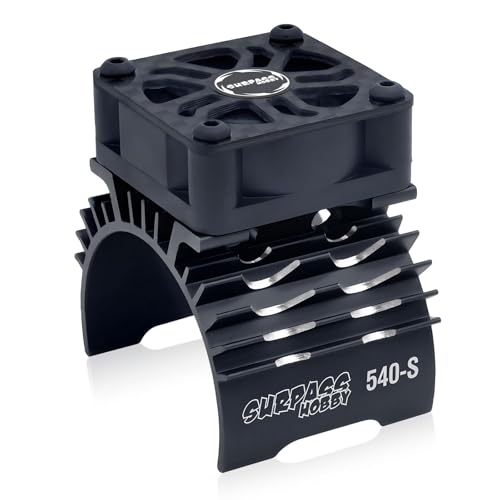
This single 30 mm fan combines a 28,000 RPM maximum with compatibility across 540/550 and several 36 mm brushless motor sizes, including 3650, 3660, 3670, and 3674. The maker says it can be powered from the receiver through its JST 2-pin plug, and says the plug is reverse-polarity protected.
Choose it when you need one fan for a 36 mm motor rather than the two-unit pack. Confirm the available supply and connector before ordering, since compatibility with a receiver connection is the specific power method given.
Bottom line: Pick this for one fan serving a 36 mm motor size.
How to choose an RC motor cooling fan
Start with motor diameter and mounting pattern, then check voltage and connector. RC motor labels such as 540 or 550 identify a motor size class, but the physical can diameter and the fan’s mount still need to match. Brushless motors also use numeric designations such as 3650, where the first two digits generally indicate a 36 mm diameter and the next two indicate a 50 mm length. Measure the motor can rather than relying only on its label. If the motor measures 36 mm, choose a fan explicitly rated for that diameter; a 54–58 mm mount is for a different class. Confirm voltage compatibility before connecting power, because an incorrect supply can damage electronics.
RC fan size and mounting fit
Measure across the motor can and the available mounting holes before choosing a heatsink fan. The products span a 24 mm mounting pattern, a 36 mm motor fit, and an adjustable 54–58 mm mount, so those measurements are not interchangeable. Fan dimensions also matter where the chassis, body, or wiring limits clearance; leave room for airflow around the fan inlet and outlet instead of pressing it against a body panel. A tight clearance can restrict airflow even when the mount technically fits. A useful decision rule is to choose a unit specifically matched to the measured motor diameter, then compare its package dimensions against the space available on the car.
RC motor fan types and power needs
Small motor fans typically attach close to the motor can, while large-scale assemblies use wider mounts to cover a larger diameter. A fan’s RPM figure is a maximum speed specification, not a guaranteed temperature reduction: motor load, gearing, airflow, and ambient temperature all affect heat. Supply voltage matters just as much. A fan specified for 8.4V is not automatically suitable for every LiPo pack; a 2S LiPo is nominally 7.4V, while a 3S pack is 11.1V. A separate 8–12V design has a broader stated range. Check the fan’s required voltage and connector against the source before wiring, and do not assume a receiver port can safely supply any fan.
| Need | Choice rule | Check first |
|---|---|---|
| 540/550 motor | Use a 540/550-compatible fan | Mount pattern |
| 36 mm motor | Use a fan specified for 36 mm | Voltage and connector |
| 54–58 mm motor | Use an adjustable large-motor mount | 8–12V supply range |
Installing and maintaining an RC cooling fan
Mount a fan securely and keep its blades clear of wires, bodywork, and debris. A fan that rubs or is blocked can stall, draw excess current, or lose cooling effectiveness; disconnect power before adjusting the mount or clearing debris. Brushless motors can run hot under heavy gearing, high current, or poor airflow, so a cooling fan does not make an unsuitable gear ratio safe. Inspect the fan and wiring after dusty or wet running, and remove dirt that can obstruct the blades or heatsink fins. Replace a fan if its blades are damaged or it no longer spins freely. Leave enough clearance around the motor for air to pass through the fan rather than trapping hot air beneath a body shell.
Frequently Asked Questions
How do I measure an RC motor for a cooling fan?
Measure the motor can diameter across its widest cylindrical section, not the shaft. A can near 36 mm calls for a fan rated for 36 mm motors, while a 54–58 mm motor needs a larger mount.
Can I run an 8.4V RC fan on a 3S battery?
A 3S LiPo is nominally 11.1V, which exceeds 8.4V. Use a suitable regulated supply or choose a fan whose specified input range covers the battery voltage.
Does a higher RPM RC fan always cool better?
No; RPM alone does not establish cooling performance. Airflow restriction, fan size, motor load, and the path for hot air to escape all affect cooling.
Where should a motor cooling fan get power?
Use only a power source and connector compatible with the fan’s voltage requirements. Receiver ports have current limits, so verify the radio system and fan draw before powering a fan from the receiver.
How often should I clean an RC motor fan?
Inspect the blades and heatsink after dusty or grassy runs, and clear debris whenever airflow is obstructed. Disconnect the battery before cleaning or adjusting the fan.