
Best Rear Surround Speakers: 4 Models Compared

The Polk T15 is the best rear surround speaker choice for most rooms because it is explicitly intended for rear-channel use and can mount on a wall. Choose the Fluance pair instead for bipolar wide dispersion, or the Klipsch R-41SA if you want Atmos-enabled speakers that can also serve as surrounds.
Rear surrounds reproduce effects behind or beside the listening position; placement and speaker type determine whether sound feels localized or spread across a wider area.
We earn a commission if you buy through links on this page. As an Amazon Associate I earn from qualifying purchases. Products are compared on manufacturer specifications, not hands-on testing.
- Best overall: Polk Audio T15 Bookshelf Speakers – Designed for rear use and wall mounting, with a 5.25-inch driver.
- Best for wide dispersion: Fluance Elite SXBP2 Bipolar Surround Pair – Its bipolar radiation pattern is designed for broad surround imaging.
- Best for Atmos flexibility: Klipsch R-41SA Atmos Speakers – The Atmos-enabled pair can also be used as surround speakers.
| Product | Best for | Use | Dispersion or design | Height | Shop |
|---|---|---|---|---|---|
| Polk Audio T15 Bookshelf Speakers | Wall-mounted rear use | Rear, front, or left-right | Bookshelf, wall-mountable | 10.7 in | Check Price on Amazon |
| Fluance Elite SXBP2 Bipolar Surround Pair | Broad surround imaging | Surround speakers | Bipolar radiation | 10.2 in | Check Price on Amazon |
| Klipsch R-41SA Atmos Speakers | Atmos-capable surrounds | Atmos-enabled or surround | Tractrix horn, LTS tweeter | 7.5 in | Check Price on Amazon |
| Klipsch RP-502S Surround Pair | Klipsch surround systems | Surround speakers | 90° × 90° Tractrix horn | 18 in | Check Price on Amazon |
Best rear surround speakers
Compare these rear-channel options by intended role, radiation pattern, and cabinet height.
Polk Audio T15 Bookshelf Speakers

For a conventional rear-channel setup, the Polk T15 is explicitly described for rear use and can also work as front or left-right speakers. Each passive speaker has a 0.75-inch tweeter and 5.25-inch Dynamic Balance driver; the pair measures 10.7 inches high. Its wall-mountable cabinet suits rooms where stands would get in the way, but the specifications do not establish an included mounting bracket, so confirm mounting hardware if that affects your setup.
Bottom line: Choose these for straightforward rear-channel flexibility and wall mounting.
Fluance Elite SXBP2 Bipolar Surround Pair

The Fluance Elite SXBP2 differs from conventional bookshelf speakers with a bipolar radiation pattern intended to create wide surround imaging. The pair uses engineered MDF cabinetry and has a black ash finish; each cabinet is 10.2 inches high. This design suits listeners seeking a more diffuse field around the seating area rather than sharply localized effects. Its role is surround sound, but the product facts do not establish wall mounting or Atmos use, so those needs may make another option a better match.
Bottom line: Pick this pair when broad, bipolar surround coverage is the priority.
Klipsch R-41SA Atmos Speakers
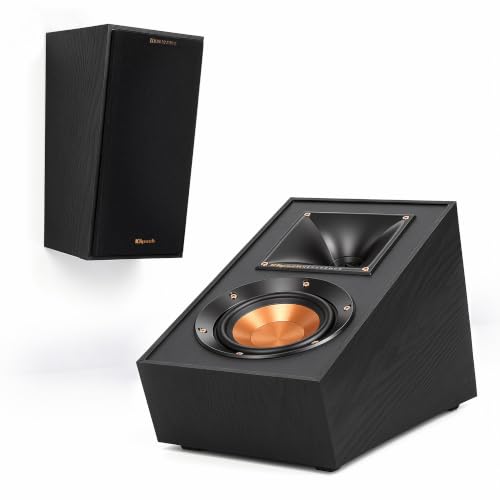
The Klipsch R-41SA is the option here that combines Dolby Atmos capability with surround use, so it suits a system that may use the speakers for either role. Its 90-by-90-degree Tractrix horn and Linear Travel Suspension aluminum tweeter are specified features, and the cabinet is 7.5 inches high. The smaller height can help where cabinet space is tight, but the product facts do not give placement dimensions or mounting methods; confirm your intended installation before choosing it.
Bottom line: Choose these when Atmos capability and surround flexibility matter.
Klipsch RP-502S Surround Pair

The Klipsch RP-502S is purpose-built as a Reference Premiere surround pair and stands out here for its Tractrix horn and vented titanium tweeter design. The speaker body is 18 inches high, so it needs more vertical space than the smaller Polk and R-41SA options. Klipsch describes the horn and tweeter technologies as supporting smoother high-frequency reproduction. This pair suits a room with space for larger surround cabinets, but buyers with limited placement room should favor a more compact option.
Bottom line: Pick this pair if you have room for larger dedicated surrounds.
How to choose rear surround speakers
Choose rear surrounds by matching their radiation pattern and placement to the room, not by driver size alone. A direct-radiating bookshelf speaker is a practical choice when you want effects to come from a defined position; a bipolar design spreads output from multiple faces for a broader, less pinpoint field. For rooms with limited floor space, look for a model described as wall-mountable, then confirm how it attaches and whether its terminals remain accessible.
Keep left and right surrounds at comparable distances from the main seat when possible, and angle direct-radiating speakers toward the listening area. If seating is against the back wall, side placement can be more practical than placing speakers directly behind heads. Choose a speaker explicitly suitable for the intended channel; Atmos-enabled models may have a separate overhead role.
Direct, bipolar, and Atmos speaker roles
Direct-radiating speakers concentrate sound toward the listening area, while bipolar surrounds radiate in more than one direction for a wider sense of ambience. Atmos-enabled speakers are designed for height effects, though a model may also be designated for surround use. These labels describe different roles, not interchangeable performance guarantees.
Use this guide to match a room goal to a speaker type:
| Room need | Speaker approach | Reason |
|---|---|---|
| Defined effects from a specific location | Direct-radiating surround | More localized sound direction |
| Broader, less pinpoint surround field | Bipolar surround | Multiple radiation directions |
| Height effects plus surround flexibility | Atmos-enabled surround-capable model | One speaker type supports either designated role |
For this group, the Fluance is bipolar, while the Klipsch R-41SA is Atmos-enabled and also described for surround use.
Rear surround placement and clearance
Place surround speakers beside or slightly behind the main listening area, with left and right speakers positioned symmetrically when the room allows. A common home theater starting point is around ear height or modestly above it, often roughly 1 to 2 feet above seated ear level for side surrounds; room layout and the receiver’s setup guidance can shift that target. Avoid burying a speaker behind thick curtains or inside a closed cabinet, which can obstruct its output.
Measure cabinet height, width, and depth against the available wall or stand space before buying. Cabinet height alone does not establish the clearance needed for cables or brackets. For wall installation, confirm the mounting method and keep the speaker securely supported; do not assume every wall-mountable model includes hardware.
Receiver setup and safe listening
Most passive rear surrounds connect to an AV receiver’s surround-channel speaker outputs with speaker wire; they do not connect directly to a television. Set the receiver’s speaker configuration to match the actual layout, then run its level and distance calibration from the primary seat. A receiver’s calibration can balance channel levels, but it cannot correct a speaker blocked by furniture or placed asymmetrically.
Use a receiver and speaker combination within their compatible operating limits, and turn the system off before changing wiring. Keep wire polarity consistent at both ends so the positive and negative terminals match. Begin calibration at a moderate listening level; prolonged loud playback can damage hearing even when the system sounds clean.
Frequently Asked Questions
How high should rear surround speakers be placed?
A useful starting point is around ear height or 1 to 2 feet above seated ear level for side surrounds. Raise them only as room layout requires, and keep left and right placement reasonably symmetrical.
Should rear surround speakers face the couch?
Direct-radiating surrounds are commonly aimed toward the listening area for localized effects. Bipolar speakers spread sound more broadly, so follow the model’s intended orientation and avoid blocking either radiating face.
Can bookshelf speakers work as rear surrounds?
Yes, passive bookshelf speakers can serve as rear channels when they connect to an AV receiver and are suitable for the room. Check that the receiver supports the speaker load and that the cabinet can be placed securely.
What is the difference between bipolar and regular surrounds?
A regular direct-radiating speaker focuses output from its forward-facing drivers, while a bipolar design radiates in multiple directions. Bipolar models are often chosen for a broader ambient field rather than tightly localized effects.
Do rear surrounds need a subwoofer?
Rear surrounds do not require a separate subwoofer to reproduce their channel, but a subwoofer handles deep bass in many home theater systems. Receiver bass management commonly redirects low frequencies below a crossover near 80 Hz, adjusted for speaker capability and room setup.