
Charcoal Cabin Air Filters: 4 Models Compared

For Toyota and Lexus vehicles in the model-year ranges, Puroma CP285 / CF10285, 2-pack is the option to check because its fit list covers many older models and it includes two filters. A charcoal cabin air filter uses activated carbon alongside filtration media; choose another option if your vehicle is covered by a different fit range, especially a Honda or GM model.
We earn a commission if you buy through links on this page. As an Amazon Associate I earn from qualifying purchases. Products are compared on manufacturer specifications, not hands-on testing.
- Best overall: Puroma CP285 / CF10285, 2-pack – Covers a wide range of Toyota and Lexus models and includes two filters.
- Best for newer Toyota and Lexus: Puroma CP157 / CF12157 – Its fit list reaches newer Toyota models such as the 2026 Camry and Corolla.
- Best for Honda and Acura: Puroma CP134 / CF10134, Honda Acura – Fits numerous Honda and Acura models, including select Accords, CR-Vs, and MDXs.
| Product | Best for | Filter dimensions | Pack count | Vehicle coverage | Shop |
|---|---|---|---|---|---|
| Puroma CP285 / CF10285, 2-pack | Older Toyota Lexus | 8.43 × 7.60 × 1.18 in | 2 filters | Select Toyota and Lexus | Check Price on Amazon |
| Puroma CP157 / CF12157 | Newer Toyota Lexus | 8.46 × 7.24 × 1.06 in | — | Select Toyota and Lexus | Check Price on Amazon |
| Puroma CP134 / CF10134, Honda Acura | Honda Acura vehicles | 9.20 × 8.30 × 1.20 in | 1 filter | Select Honda and Acura | Check Price on Amazon |
| Spearhead Breathe Easy BE-966 | Select GM vehicles | 9.45 × 8.07 × 1.22 in | — | Select GM, Acura, Honda | Check Price on Amazon |
Charcoal cabin air filters
Match the filter to your vehicle’s exact model year before comparing dimensions or pack size.
Puroma CP285 / CF10285, 2-pack

For a broad selection of older Toyota and Lexus models, this Puroma filter covers vehicles including the Toyota Camry (2007–2017), RAV4 (2006–2018), and Lexus GX460 (2010–2023). The package contains two filters, which may suit a buyer replacing more than one vehicle’s filter or keeping a spare. Its dimensions are about 8.43 × 7.60 × 1.18 inches. The main limitation is fit: the coverage is model-year specific, and the long compatibility list does not make it universal. Check your exact model year and replacement-filter number before choosing it.
Bottom line: Choose it for a Toyota or Lexus model when the two-filter pack suits your needs.
Puroma CP157 / CF12157

For newer Toyota and Lexus vehicles, this Puroma option lists fit for models such as the Toyota Camry (2018–2026), Corolla (2019–2026), and Lexus NX350 (2022–2026). Its dimensions are about 8.46 × 7.24 × 1.06 inches, making it shorter in width and height than some alternatives here. The fit list also includes select Subaru and Mazda vehicles, but verify the exact year and trim because compatibility can differ within a model line. The product name describes two cabin filters, though a pack count is not clear in the specifications.
Bottom line: Pick it when your newer Toyota, Lexus, or other vehicle matches the fit range.
Puroma CP134 / CF10134, Honda Acura

Honda and Acura coverage distinguishes this Puroma filter from the Toyota- and GM-focused options: its fit list includes Honda Accord (2003–2022), CR-V (2007–2016), and Acura MDX (2007–2020). The filter measures about 9.20 × 8.30 × 1.20 inches, and the product name identifies one filter. It also provides replacement reference numbers that can help cross-check a match. Its main constraint is the vehicle range; for example, the CR-V coverage ends at 2016, so a newer CR-V owner should not assume fit based on the model name alone.
Bottom line: Choose it for a Honda or Acura only when your exact model year is covered.
Spearhead Breathe Easy BE-966
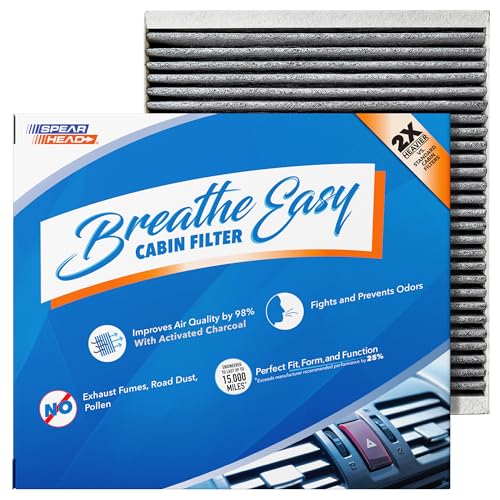
GM fit coverage is the key distinction for the Spearhead BE-966, which lists vehicles including the Chevrolet Equinox (2018–2025), Cadillac XT5 (2017–2025), and Buick Enclave (2018–2025), as well as select Acura and Honda models. It measures about 9.45 × 8.07 × 1.22 inches. Spearhead says its activated-carbon filter lasts up to 25% longer; that is a maker claim, not a universal replacement interval. The fit list excludes some variants, including the 2014 Cadillac CTS coupe, so confirm both the specific model year and body style.
Bottom line: Choose it for a covered GM vehicle when its exact model and body style match.
How to choose a charcoal cabin air filter
Start with the vehicle’s exact year, make, model, and trim; a cabin filter is a fit-specific replacement, not a universal size. Activated carbon adsorbs some odor-causing compounds and gases, while the filter media captures airborne particles; carbon does not mean the filter removes every gas or odor. Most cabin filters are replaced about every 12,000 to 15,000 miles or once a year, while dusty or polluted driving can call for more frequent changes. Check your owner’s manual for the vehicle-specific interval and replacement procedure. A practical rule: if your vehicle’s year falls outside a product’s range, select a different fit rather than relying on dimensions alone.
Cabin filter dimensions and vehicle fit
Dimensions help confirm a match, but they do not replace a vehicle fit check because filter shape, frame, and seating can differ even when measurements look close. Compare the old filter’s length, width, and thickness with the replacement and verify the part number against the vehicle manual or parts catalog. When replacing a filter, note the airflow arrow before removing the old one; the arrow generally points in the direction of airflow through the filter, but the vehicle’s housing markings should decide orientation. A filter forced into a mismatched slot can leave gaps or bend the frame, reducing proper sealing. If model-year coverage is close to a boundary, confirm the part number before ordering.
What activated carbon does in a cabin filter
Activated carbon works by adsorption: odor and gas molecules can attach to the carbon’s porous surface as air passes through the filter. The carbon layer complements particle filtration but is not the same thing as a high-efficiency particle rating, and a charcoal filter should not be assumed to block every pollutant. Carbon capacity is finite, so odor control can decline as the material accumulates compounds; replacement timing depends on the vehicle’s schedule and driving environment. Avoid choosing by the word “charcoal” alone: confirm vehicle fit, dimensions, and the exact replacement reference. Never drive with a filter that prevents the HVAC system from operating normally; a poorly seated or damaged filter should be corrected.
Cabin filter replacement and common mistakes
Many cabin filters sit behind the glove box or under the dashboard, but location and access vary by vehicle. Before removing panels, check the owner’s manual for the access method; pulling a glove box or trim piece without releasing its stops can break plastic tabs. Inspect the old filter’s airflow arrow and orientation, then seat the replacement flat without folding the media. A filter that is visibly clogged, damaged, or overdue for the vehicle’s interval should be replaced, not shaken out and reused. Do not confuse the cabin filter with the engine air filter: the cabin filter serves the passenger HVAC airflow, while the engine filter serves engine intake air.
Frequently Asked Questions
How often should a charcoal cabin air filter be changed?
A common interval is about every 12,000 to 15,000 miles or once a year. Dusty roads, heavy traffic, and frequent HVAC use can shorten that interval, so use the vehicle manual’s schedule as the baseline.
Does activated carbon remove every cabin odor?
No; activated carbon can adsorb some odor-causing compounds and gases, but it does not remove every odor or pollutant. Carbon capacity is finite, so odor control may diminish with use.
Can I choose a cabin filter by dimensions alone?
No; confirm the filter’s fit for your exact vehicle year, make, model, and trim as well as its dimensions. A similar-sized filter may have a different frame or fail to seat and seal correctly.
Which way should the cabin filter airflow arrow point?
The arrow usually points in the direction air flows through the filter, but the housing marking or vehicle manual should determine orientation. Note the old filter’s position before removal and seat the replacement flat.
What is the difference between a cabin filter and an engine air filter?
A cabin filter cleans air moving through the passenger HVAC system, while an engine air filter protects the engine’s intake airflow. They have different locations, shapes, and vehicle-specific part numbers.