
Best Sewer Jetter for Pressure Washer: 3 Kits Compared

ZOFINE 100-Foot Sewer Jetter Kit is the best sewer jetter for a pressure washer for most buyers because its 100-foot hose and four sewer-nozzle styles provide long reach and options for different access needs.
Choose 100-Foot Sewer Jetter Kit with Storage Bag if you want gloves and a storage bag in the kit; buyers should confirm the hose connection matches their pressure washer before ordering.
We earn a commission if you buy through links on this page. As an Amazon Associate I earn from qualifying purchases. Products are compared on manufacturer specifications, not hands-on testing.
- Best overall: ZOFINE 100-Foot Sewer Jetter Kit – Its 100-foot hose and four sewer nozzle styles provide long reach and multiple tip options.
- Best for broad cleaning uses: NIFUAL 100-Foot Sewer Jetter Kit – The kit is described for drains as well as siding, gutters, roofs and sinks.
- Best for included storage: 100-Foot Sewer Jetter Kit with Storage Bag – It includes a storage bag, strap, gloves and two marking rings.
| Product | Best for | Nozzle assortment | Shop |
|---|---|---|---|
| ZOFINE 100-Foot Sewer Jetter Kit | Nozzle variety | 4 sewer nozzles | Check Price on Amazon |
| NIFUAL 100-Foot Sewer Jetter Kit | General cleaning | 3 sewer nozzles | Check Price on Amazon |
| 100-Foot Sewer Jetter Kit with Storage Bag | Organized storage | 4 nozzle styles | Check Price on Amazon |
Sewer Jetter Kits for Pressure Washers
Compare hose reach, pressure ratings and included accessories before matching a kit to your washer.
ZOFINE 100-Foot Sewer Jetter Kit
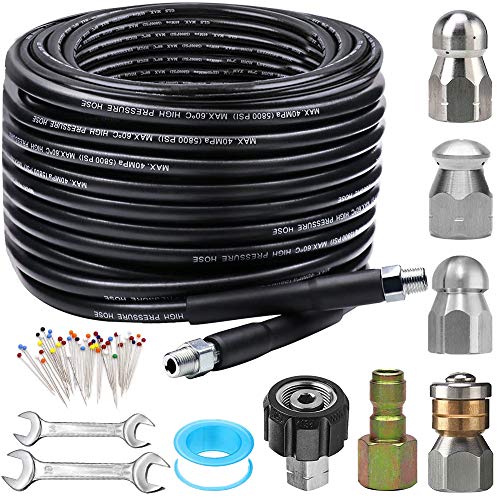
The four sewer-nozzle styles set this kit apart: button nose, rotating, side-hole and corner tips offer choices for different drain paths. The kit includes a 100-foot hose, an M22 female-to-1/4-inch female NPT coupler, a 1/4-inch quick-connect plug, two spanners, tape and nozzle pins. The maker says the reinforced hose is suitable for gas and electric pressure washers up to 5,800 PSI. This is a fit for buyers who want several specialized tips in one kit, but its connector arrangement should be checked against the washer and gun before purchase.
Bottom line: Pick this if nozzle options and long reach matter more than a storage bag or gloves.
NIFUAL 100-Foot Sewer Jetter Kit

The maker presents this kit for more than drain cleaning, naming siding, sinks, gutters, roofs, wash basins, floor drains and toilets among its uses. It includes a 100-foot hose, corner, rotating and button sewer nozzles, two wrenches, waterproof tape and pins for clearing clogged nozzles. The maker gives a maximum working pressure of 5,800 PSI and a temperature range of 40°F to 140°F. This may suit a household buyer looking for varied cleaning uses, while those needing a connector adapter should verify the included fittings against their washer.
Bottom line: Choose this for a kit pitched at both drains and other household wash tasks.
100-Foot Sewer Jetter Kit with Storage Bag

The storage extras distinguish this kit: a bag and strap come alongside two gloves, a microfiber cloth and marking rings. Its 100-foot hose is supplied with mushroom-nose, rotating, pointed and spray nozzles, plus an adapter, quick-connect plug, two wrenches, tape and nozzle pins. The maker specifies a 5,800 PSI working-pressure limit and 11,000 PSI burst pressure. Choose it if keeping accessories together matters; the named adapter is M22 female to M22-14mm male, so buyers should confirm the fitting path suits their pressure washer.
Bottom line: Pick this for bundled storage and handling accessories, after checking the adapter fit.
How to choose a pressure washer sewer jetter
Match the jetter’s working-pressure limit to the washer’s rated pressure, not its advertised peak or burst figure. These kits specify a 5,800 PSI maximum working pressure, and the hose must also connect to the gun through the correct adapter or quick-connect plug. A sewer jetter hose carries water to a rear-facing or specialty nozzle; the water jets help propel the hose while breaking up soft obstructions. For an unknown or incompatible connector, confirm the washer’s outlet thread and plug type before ordering rather than assuming M22 fittings are interchangeable.
Reach is another practical filter: a 100-foot hose suits longer runs but adds bulk to feed, retrieve and store. Compare the drain access point and likely path length, leaving enough hose to handle turns without pulling the line taut.
Sewer jetter nozzle types and their uses
Nozzle shape changes how the jetter behaves in a line, so choose by access and the task rather than by nozzle count alone. Rear-facing jets help move a hose through a drain, while a forward-facing tip can direct flow at material ahead; rotating and side-hole designs distribute flow differently. Corner, pointed, mushroom or button-nose labels identify shape, but they do not by themselves establish the exact jet angle or orifice size. The ZOFINE kit names four sewer-tip styles, NIFUAL names three, and the third kit includes three sewer tips plus a spray nozzle.
A separate spray nozzle may help with surface washing, but a sewer nozzle is intended for drain access. Do not force a jetter into a tight bend: a kink can restrict flow and strain the hose.
Pressure washer sewer jetter safety and setup
High-pressure water can injure skin, so keep the nozzle pointed away from people and never check a suspected leak with a hand. Depressurize the washer before connecting or removing fittings, and use eye protection and gloves during drain work. Start with the washer off while making connections, secure the nozzle, then feed the hose gradually once water is flowing. Keep the hose under control at the access point and do not pull it back while pressure is engaged.
Use only a hose, fittings and nozzle within the washer’s rated pressure and temperature limits. A 5,800 PSI working limit is not permission to run a washer above its own rating; the lower equipment limit governs.
How to store and maintain a sewer jetter hose
Rinse residue from the hose and nozzle after drain work, then clear nozzle openings before storage so debris does not harden in a small orifice. Coil the hose loosely rather than sharply bending it, and keep it away from heat, sunlight and sharp edges that can damage the cover or reinforcement. Inspect the hose, couplings and nozzle before each use for cracks, bulges, leaks or loosened fittings; retire damaged pressure hose instead of patching it.
Store fittings together in a dry place, using a bag or strap if supplied. Never leave a pressurized hose unattended, and release trapped pressure before packing the equipment away.
Frequently Asked Questions
Can a sewer jetter fit any pressure washer?
No; the hose pressure limit and connector must both match the washer. Check the gun outlet and adapter thread, and do not use a jetter rated below the washer’s operating pressure.
What length sewer jetter hose should I choose?
A 100-foot hose offers substantial reach for longer drain runs, but it takes more effort to feed and retrieve than a shorter line. Measure the route from the access point and allow slack for handling without stretching the hose.
What does a rotating sewer jetter nozzle do?
A rotating nozzle directs water through moving jets rather than one fixed spray pattern. Its precise jet angle and orifice determine performance, so match the nozzle to the compatible hose and washer rather than assuming all rotating tips behave alike.
Can I use a sewer jetter in a toilet?
Only use a jetter if the hose and nozzle can pass the toilet’s bends without force. A 100-foot hose can be cumbersome in a bathroom, and high-pressure water can cause injury or splash contaminated water; protect eyes and keep people clear.
How should I clear a clogged jetter nozzle?
Depressurize and disconnect the equipment before clearing an opening, and use a suitable nozzle pin rather than a hand or improvised sharp tool. Flush the detached nozzle with clean water and inspect it for damage before reconnecting.