
Best Silent Dog Whistle to Stop Barking: 4 Picks

The 2-Pack Adjustable Stainless Steel Whistle is the strongest fit for most people because it combines an adjustable frequency with two whistles and stainless steel construction. A silent dog whistle is a high-frequency cue meant to get a dog’s attention; choose a different tool if you need an automatic bark detector or a guaranteed way to stop barking.
We earn a commission if you buy through links on this page. As an Amazon Associate I earn from qualifying purchases. Products are compared on manufacturer specifications, not hands-on testing.
- Best overall: 2-Pack Adjustable Stainless Steel Whistle – Two adjustable whistles use 304 stainless steel for home and recall training.
- Best for spare whistles: NIKIMORE 2-Pack Adjustable Whistle – The two-piece set includes adjustable frequency and lanyards.
- Best for multiple locations: KIVORA 4-Pack Adjustable Whistles – Four whistles provide spares for home, car, or sharing.
| Product | Best for | Pack size | Material | Shop |
|---|---|---|---|---|
| 2-Pack Adjustable Stainless Steel Whistle | Everyday training | 2 whistles | 304 stainless steel | Check Price on Amazon |
| NIKIMORE 2-Pack Adjustable Whistle | Portable training | 2 whistles | — | Check Price on Amazon |
| KIVORA 4-Pack Adjustable Whistles | Several locations | 4 whistles | 304 stainless steel | Check Price on Amazon |
| 2-Pack Adjustable Coated-Metal Whistle | Coated construction | 2 whistles | Rust-resistant metal, plastic coating | Check Price on Amazon |
Silent Dog Whistles to Stop Barking
These adjustable whistles differ most in pack size, construction, and how much is claimed about frequency control.
2-Pack Adjustable Stainless Steel Whistle

The 2-Pack Adjustable Stainless Steel Whistle stands out for its 304 stainless steel construction, while the other two-piece choices use less specific material descriptions. Each whistle has an adjustable screw so you can try different pitches and watch for your dog’s response; the set is intended for barking interruption and recall. Two pieces suit keeping one at home and another with training gear. A whistle does not teach a quiet command by itself: pair the cue with a reward when barking stops, and remember that a dog may not respond to every pitch or situation.
Bottom line: Choose it if you want two adjustable whistles with 304 stainless steel.
NIKIMORE 2-Pack Adjustable Whistle

The NIKIMORE 2-Pack Adjustable Whistle emphasizes portability, with two whistles and lanyards for keeping one close during training. Its adjustable screw lets you test pitches against your dog’s response, and the maker presents it for barking, recall, and other behavior cues. This is a practical match if you want a two-piece set for daily sessions without prioritizing a specified metal construction. Ultrasonic does not mean inaudible to every person, and a whistle is not a standalone behavior fix; use a consistent cue and reward the behavior you want.
Bottom line: Pick it for a portable two-whistle set with adjustable pitch.
KIVORA 4-Pack Adjustable Whistles

The KIVORA 4-Pack Adjustable Whistles is the only four-whistle set here, and its 304 stainless steel construction makes it useful for keeping separate whistles in several places. The maker claims a 200 Hz–22 kHz adjustment range and long-distance recall, but those performance claims should not be treated as guaranteed results. Four pieces are more than many owners need for one training routine, so this set suits people who want spares or plan to share. Do not rely on an advertised distance or instant bark interruption; teach the cue in a quiet setting before using it around distractions.
Bottom line: Choose it if you want four whistles for separate locations or sharing.
2-Pack Adjustable Coated-Metal Whistle
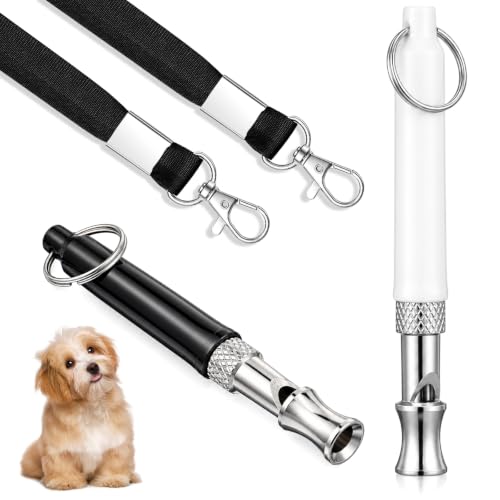
The 2-Pack Adjustable Coated-Metal Whistle differs by pairing rust-resistant metal with a protective plastic coating, rather than specifying stainless steel. Its adjustable pitch and lanyard make it a two-piece option for practicing barking cues alongside recall or basic commands. The specifications do not identify a frequency range, so this choice is better for someone who values the coated construction than a quantified tuning range. As with any whistle, success depends on pairing the sound with consistent training; it may not change barking driven by fear, pain, or unmet needs.
Bottom line: Pick it if a protective coating matters more than a tuning range.
How to choose a silent dog whistle for barking
Choose an adjustable whistle and train a repeatable quiet cue; the sound alone is not a dependable bark solution. Begin indoors when your dog is calm, use one short cue, and immediately reward a pause in barking. Once the response is consistent, practice with gradually greater distance and distractions. Avoid blowing repeatedly during a barking episode, which can become background noise instead of a clear signal. Barking can communicate alarm, frustration, fear, or a need, so first address the trigger rather than suppressing the sound. A whistle is a training aid, not a substitute for meeting the dog’s needs or getting veterinary advice for sudden behavior changes.
What adjustable frequency means
An adjustable screw changes the whistle’s pitch, but a dog’s response is the useful test—not a claim that one setting suits every breed. Start at a low volume and make small adjustments in a calm setting; stop if the dog shows distress or avoids the sound. Human hearing also varies, and ultrasonic products are not necessarily completely silent to every person. Keep the setting consistent once the dog responds, since changing pitch can weaken an established cue. No frequency range guarantees an immediate interruption, and the very broad range claimed for one option should not be read as proof of performance.
Use the whistle as a training cue
A whistle works best as a predictor of a rewarded behavior, not as a punishment. Teach a short quiet interval first: give the cue when barking pauses naturally, then reward the quiet moment; gradually extend the interval before rewarding. For recall, establish the whistle cue at close range in a low-distraction space before adding distance. Keep sessions brief and stop if the dog becomes anxious. Never use a whistle to startle a dog or to mask persistent barking caused by separation distress or environmental triggers. For a sudden increase in barking or signs of pain, consult a veterinarian rather than escalating the sound.
Common mistakes with bark-control whistles
The common mistake is expecting a whistle to stop every bark without changing the cause. A noise outside, separation distress, boredom, and attention-seeking call for different responses; identify when the barking happens before choosing a cue. Another mistake is adjusting the screw during every session, which gives the dog an inconsistent signal. Keep the pitch and pattern steady after you find a response, and reward the desired quiet behavior. Do not leave a whistle within reach for chewing, and keep sound exposure brief; dogs can hear high-frequency sounds people may not notice.
Frequently Asked Questions
Can a silent dog whistle stop a neighbor’s dog barking?
A whistle may cue a trained dog, but it cannot reliably stop an unfamiliar dog’s barking. The neighbor’s dog may not recognize the signal, so speak with the owner or address the trigger rather than repeatedly sounding it.
How do you find the right whistle pitch for a dog?
Adjust the screw in small steps in a calm setting and watch for an attentive, relaxed response. Keep the responding setting consistent and do not assume that breed alone predicts the right pitch.
Are ultrasonic dog whistles completely silent to people?
Not necessarily; human hearing varies, and some people may hear sounds others cannot. Keep the whistle brief and stop if the dog reacts with distress or avoidance.
How should you train a dog to respond to a whistle?
Pair one consistent whistle pattern with a reward when the dog performs the desired behavior. Start close to the dog in a quiet space, then add distance or distractions only after the response is reliable.
Can a whistle replace rewards when training a dog?
No; a whistle is a cue, while rewards help the dog learn which behavior earns reinforcement. Use the cue consistently and reward quiet or recall before gradually reducing rewards.