
Brake Cables for Bicycles: 5 Sets Compared by Fit

For a road-or-mountain-bike replacement kit, Shimano Road/MTB Cable and Housing Set is the best starting point because it includes both 1,000 mm and 2,050 mm inner cables plus 2,200 mm of housing. Choose another set if you need multiple replacements, a cable cutter or cables for a tandem; match each cable end to your brake lever before fitting.
We earn a commission if you buy through links on this page. As an Amazon Associate I earn from qualifying purchases. Products are compared on manufacturer specifications, not hands-on testing.
- Best overall: Shimano Road/MTB Cable and Housing Set – Includes two different inner-cable lengths and 2,200 mm of housing for road or mountain bikes.
- Best for multiple replacements: 4-Piece Universal Brake Cable Set – Supplies four 2,000 mm brake cables with barrel ends.
- Best for a repair kit: TFUTLT 103-Piece Brake and Shift Cable Kit – Includes six brake cables, 2,500 mm of brake housing and a cable cutter.
| Product | Best for | Brake cables | Brake housing | Cutter included | Shop |
|---|---|---|---|---|---|
| Shimano Road/MTB Cable and Housing Set | Road and MTB | 2 | 86.6 in | No | Check Price on Amazon |
| 4-Piece Universal Brake Cable Set | Barrel-end replacements | 4 | — | No | Check Price on Amazon |
| TFUTLT 103-Piece Brake and Shift Cable Kit | Full cable service | 6 | 98.4 in | Yes | Check Price on Amazon |
| weideer 107-Piece Brake and Shift Cable Kit | Cutter and spares | 6 | 98.4 in | Yes | Check Price on Amazon |
| Hapleby 10-Piece Premium Brake Cable Set | Tandem option | — | — | No | Check Price on Amazon |
Brake Cables for Bicycles
Compare cable counts, housing and kit contents, then confirm the cable-end style fits your brake lever.
Shimano Road/MTB Cable and Housing Set

This set is the only one here that identifies both road and mountain bikes as compatible and gives two different inner-cable lengths. It includes a 1,000 mm cable, a 2,050 mm cable, 2,200 mm of 5 mm housing, four ferrules and two cable tips. Shimano says the stainless-steel inner wires provide smooth movement and higher corrosion resistance. The two cable lengths can cover front and rear routing on many bikes, but the set does not include a cutter; measure the existing route and check the end style before installation.
Bottom line: Choose this set for a road or mountain bike when its two cable lengths and end styles match your setup.
4-Piece Universal Brake Cable Set
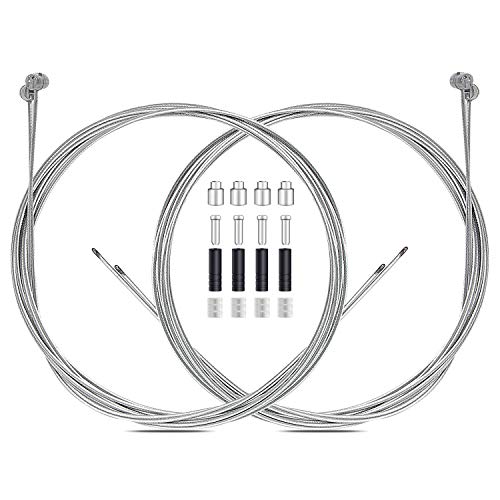
Four 2,000 mm brake cables make this set a fit for riders who want spare inner cables rather than a housing-and-cutter bundle. Each cable is 1.5 mm in diameter and has a barrel end; the set also includes O-rings, sheath ferrules and cable end caps. The length can be shortened to suit a route, but trimming requires a suitable cable cutter and careful finishing to avoid frayed strands. Confirm that a barrel end matches your lever before choosing it, since brake-lever cable heads are not interchangeable across every setup.
Bottom line: Pick this set when you need several long, barrel-ended inner cables and already have housing and cutting tools.
TFUTLT 103-Piece Brake and Shift Cable Kit

This kit adds a cable cutter and brake-housing length to its six 1.7 m brake cables, making it useful for a broader cable service. It also bundles six shift cables, 2 m of shift housing, O-rings, ferrules and end caps, so it includes parts beyond a brake-only repair. The brake cables are 66.9 inches each, while the brake housing totals 98.4 inches. The large assortment may be more than needed for one brake replacement, and cable-end compatibility still needs to be matched to the brake levers.
Bottom line: Choose this kit for a multi-cable service when you also need a cutter and assorted shift-cable parts.
weideer 107-Piece Brake and Shift Cable Kit

This 107-piece assortment combines six 1.7 m brake cables with a stainless-steel cutter, separate shift-cable parts and assorted cable ends. It includes 2.5 m of cable housing, listed for the kit as bicycle cable housing, plus 2 m of shift housing; the brake cables are 66.9 inches long. The cutter has a safety lock and is made to cut cable up to 5/32 inch. Because the kit covers both braking and shifting, it brings extra components for a single brake job; verify housing type and cable-end fit for the bike.
Bottom line: Pick this assortment if you want a cutter and both brake- and shift-cable spares.
Hapleby 10-Piece Premium Brake Cable Set
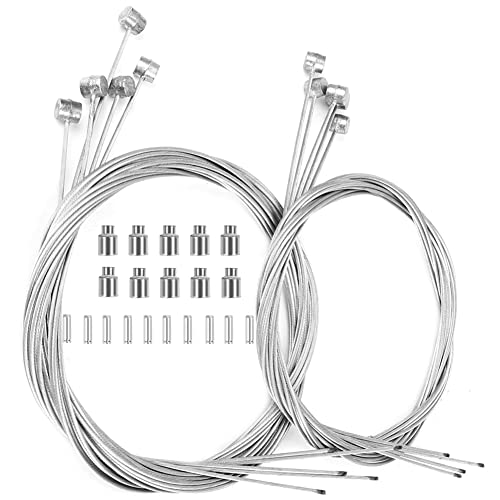
This set specifically says its different front and rear cable lengths can work on a tandem, a useful distinction when one standard-length pair is not enough. The zinc-coated cables have 19 wires each, and the kit includes sheath ferrules and end caps. The cable diameter is 1.4 mm. The cable lengths are not given as measurements, so compare each cable with the old route before cutting and confirm that the cable head fits the lever. A Dremel tool is suggested in the product features for cutting, but a dedicated cable cutter is preferable for clean, controlled trimming.
Bottom line: Choose this set for its tandem suitability if the cable lengths and ends match your existing routing.
How to choose a bicycle brake cable
Match the cable head to the lever first, then compare cable length and housing. Drop-bar road levers commonly use a pear-shaped cable head, while many flat-bar brake levers use a barrel-shaped head; the wrong head will not seat correctly. Inner cables are commonly around 1.5 mm in diameter, but confirm the size your brake system accepts. A replacement inner cable can often be cut to length, whereas a cable that is too short cannot be recovered. If you are replacing housing too, measure the old route before cutting and preserve broad curves rather than tight bends, which can increase friction. For a simple inner-cable swap, buy a housing bundle only if the existing housing is damaged, kinked or due for replacement.
Brake cable length and routing
Measure along the existing cable route, not in a straight line from lever to brake, and leave enough slack for full handlebar turns. A front cable is usually shorter than a rear cable because the rear route crosses more of the frame; tandem routing can require substantially more length. Housing needs clean, square cuts and correctly seated ferrules at its ends. Use this quick guide to compare the cable lengths with a measured route:
| Route or need | What to measure | Decision rule |
|---|---|---|
| Front brake | Lever to front brake, following the route | Choose a cable longer than the measured path so it can be trimmed |
| Rear brake | Lever to rear brake, following frame routing | Measure separately; do not assume front and rear lengths match |
| Tandem | Full route through the tandem frame | Confirm cable length before purchase; longer routing may be needed |
Never cut a replacement cable to the old cable’s frayed tip; use the intact routing length and retain enough tail for secure anchoring.
Brake-only sets versus mixed cable kits
A brake-only set is the more direct choice when you need inner brake cables, while mixed brake-and-shift kits add parts for servicing both systems. Brake and shift cables may look similar, but their ends and diameters can differ, so do not substitute one for the other. Housing also differs: brake housing must tolerate the forces generated by braking, while shift housing is built for gear-cable movement. When a kit includes both housing types, keep them separated and use the correct type at each control. Choose a mixed kit when you genuinely need shift cables or a cutter; otherwise, the extra pieces add sorting rather than improving brake fit.
Safe brake cable installation
A frayed or improperly anchored brake cable can compromise stopping, so inspect the full cable and housing before riding. A cable cutter designed for bicycle cables makes a cleaner cut than ordinary pliers; crushed housing ends can impede cable movement. After installation, seat the housing ends, tighten the cable at the brake, and check that the brake pads contact the rim or rotor correctly before riding. Squeeze the lever firmly several times and verify that the cable does not slip at its anchor. If a cable is frayed near the clamp, replace it rather than trimming and reusing the damaged section. Brake adjustment differs by brake type, so do not ride if the lever reaches the handlebar or the brake does not release freely.
Frequently Asked Questions
Are road and mountain bike brake cables interchangeable?
Some sets are marketed for both, but the cable head at the lever is the deciding factor. Drop-bar road levers commonly use pear-shaped heads, while many flat-bar levers use barrel-shaped heads; check the existing cable before replacing it.
How often should bicycle brake cables be replaced?
Inspect cables at least once a year and replace sooner if strands are frayed, corroded or binding. Frequent wet or gritty riding can accelerate wear, and any damage near the lever or brake anchor warrants replacement before riding.
Can I cut a bicycle brake cable with regular pliers?
A dedicated bicycle cable cutter is the better choice because it makes a cleaner cut and is less likely to crush housing. If the cable end frays, the strands can snag during installation or handling.
How much slack should a brake cable have?
Leave enough cable and housing slack for the handlebars to turn fully in both directions without pulling the brake. At the same time, avoid excess loops or tight housing bends that can interfere with smooth cable movement.
Do brake cables and shift cables use the same housing?
No; brake and shift housing are designed for different jobs and should not be treated as interchangeable. Use brake housing for brake controls, and keep any separate shift housing in a mixed kit for gear cables.