
Best UV Light for Uranium Glass: 5 Options Compared

The DARKBEAM dual-wavelength flashlight DARKBEAM Dual 365nm/395nm suits most uranium-glass hunters because it offers both 365nm and 395nm light, letting you compare how pieces fluoresce under each wavelength. Choose a simpler single-wavelength model if you only need a compact light for casual checks.
Uranium glass fluoresces under ultraviolet illumination, but visible violet spill from some 395nm lights can affect how a piece looks; use a dim room and avoid staring into the beam.
We earn a commission if you buy through links on this page. As an Amazon Associate I earn from qualifying purchases. Products are compared on manufacturer specifications, not hands-on testing.
- Best overall: DARKBEAM Dual 365nm/395nm – Its two selectable wavelengths, 365nm and 395nm, give more flexibility when checking glass.
- Best for 365nm output: TrixHub 365nm Rechargeable – The maker specifies a 365nm light and USB-C charging with a battery display.
- Best for two lights: Vansky 395nm 12-LED 2-Pack – The package includes two 395nm flashlights for keeping one in separate locations.
| Product | Best for | Wavelength | Charging | Size | Shop |
|---|---|---|---|---|---|
| DARKBEAM Dual 365nm/395nm | Flexible glow checks | 365nm and 395nm | Rechargeable | 6.3 × 1.1 in. | Check Price on Amazon |
| TrixHub 365nm Rechargeable | 365nm preference | 365nm | USB-C rechargeable | 5.8 × 1.26 in. | Check Price on Amazon |
| DARKBEAM 395nm Focusable Mini | Focused 395nm beam | 395nm | USB-C rechargeable | 3.6 × 0.8 in. | Check Price on Amazon |
| VMTENMV 395nm USB-C Mini | Simple portable checks | 395nm | USB-C rechargeable | 3.6 × 0.8 in. | Check Price on Amazon |
| Vansky 395nm 12-LED 2-Pack | Two-location use | 395nm | — | 2-pack | Check Price on Amazon |
UV Lights for Uranium Glass
Compare wavelength and form factor first, then pick the flashlight that suits your display or collecting routine.
DARKBEAM Dual 365nm/395nm
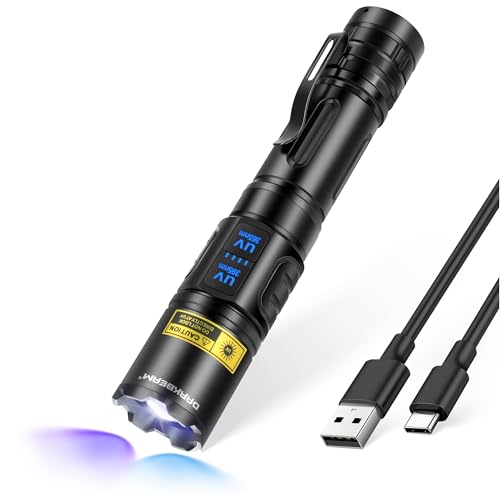
The switchable 365nm and 395nm output sets this flashlight apart from the single-wavelength choices. The maker describes it as rechargeable and suitable for uranium glass, rocks, stain detection, and resin curing. Its 6.3-inch length gives it a longer handheld form than the mini options. This is a good fit if you want to compare illumination modes while examining a collection. Its size is less convenient than a roughly 3.6-inch mini light for a small pocket, and the product calls for eye protection around UV output.
Bottom line: Choose this if you want both wavelengths in one rechargeable flashlight.
TrixHub 365nm Rechargeable
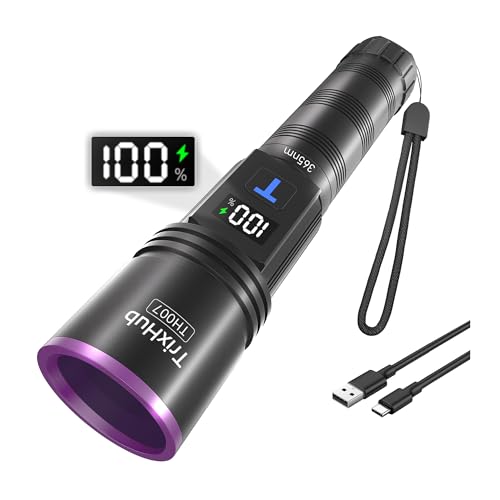
The TrixHub is the only single-wavelength 365nm option here, and it adds a battery-level display to USB-C charging. The maker gives it a 30W rating and describes it for uranium glass, rockhounding, resin curing, and leak detection. Its 5.8-inch body is shorter than the dual-wavelength model, though wider than the mini lights. It suits collectors who specifically want a 365nm flashlight and want to monitor charge level; it cannot switch to 395nm for comparing the two wavelengths.
Bottom line: Pick this for a rechargeable 365nm-only light with a charge display.
DARKBEAM 395nm Focusable Mini

The focusable beam and mini body distinguish this 395nm flashlight from the other single-wavelength models. It has USB-C charging, a built-in battery, and a power indicator; the maker describes it for uranium glass and leak detection. At 3.6 inches long, it is easier to carry than the longer dual-wavelength and 365nm lights. A 395nm choice is straightforward for casual fluorescence checks, but the beam does not offer a 365nm mode, and 395nm output may show more visible violet light than a 365nm lamp.
Bottom line: Choose this if portability and an adjustable 395nm beam matter most.
VMTENMV 395nm USB-C Mini

The VMTENMV combines a compact 395nm beam with USB-C charging and a built-in battery. The maker specifies one hour of continuous use at high power and describes the light for uranium glass and resin curing. Its 3.6-inch length makes it similarly portable to the other mini option. This is a practical pick for occasional checks when a single mode is enough. Its runtime is limited to the maker’s hour at high power, and the product warns against unscrewing the flashlight head.
Bottom line: Pick this for a rechargeable pocket-size 395nm light and short checking sessions.
Vansky 395nm 12-LED 2-Pack

The Vansky package is the only two-flashlight set, making it useful when you want one light near a display and another with your collecting gear. Each mini flashlight uses 12 LEDs at 395nm, and the maker includes uranium glass among its intended uses. The pair also targets stain detection and resin curing. This format fits households or collectors who want two lights on hand, but the specifications do not establish a rechargeable design, so confirm the battery format before ordering.
Bottom line: Choose the two-pack if you want a separate 395nm light for two places.
How to Choose a UV Light for Uranium Glass
Start with wavelength: 365nm lights emit less visible violet spill than 395nm lights, while both can make uranium glass fluoresce. A dual-wavelength flashlight is useful if you want to compare the effect directly; a single-wavelength model is simpler for routine checks. For judging glass color, work in a dim room and keep surrounding light consistent, because ambient light changes the apparent brightness. A flashlight’s wattage alone does not tell you how bright fluorescence will look at the glass: beam shape, distance, and ambient light also matter. Avoid looking into the UV beam, and do not use a flashlight as a substitute for a radiation measurement tool.
365nm Versus 395nm for Uranium Glass
Both wavelengths can reveal uranium-glass fluorescence, but they do not look identical to the eye. A 365nm lamp is near-invisible to human vision, so it tends to add less purple light to the scene; many 395nm lamps show a visible violet beam. Use 365nm when minimizing visible spill matters, and 395nm when a visible beam is acceptable and a compact light meets your needs. Compare pieces from the same distance in the same darkened setting rather than judging one under room light and another in darkness. Fluorescence strength varies by glass formulation and piece thickness, so a dim response does not by itself identify the material.
How to Check Uranium Glass Safely
Use a darkened area and direct the beam at the glass rather than toward your face; UV LEDs can injure eyes with direct exposure. Keep the light a few inches from the surface and move it steadily to inspect rims, bases, and molded details without prolonged exposure at one spot. Wear UV-blocking eye protection if you will use the flashlight repeatedly or at close range, and never let children point it at faces. UV glow alone is not proof of uranium content, since other glass additives can fluoresce under ultraviolet light. For certainty about radioactivity, use an appropriate radiation survey meter instead of relying on appearance.
What UV Glass Glow Can and Cannot Tell You
Uranium glass commonly fluoresces bright green under ultraviolet light, but glass color and glow intensity vary with uranium content, thickness, and other ingredients. A UV flashlight helps screen pieces in a collection; it cannot quantify uranium or distinguish every fluorescent additive. For a useful comparison, place candidate pieces together, darken the room, and illuminate them from the same distance and angle. Avoid treating a vivid glow as a safety reading: fluorescence is an optical response, not a measurement of radiation dose. If a piece’s composition matters, check it with a suitable instrument or have it assessed by a qualified specialist.
Frequently Asked Questions
Does uranium glass glow under 395nm UV light?
Many uranium-glass pieces fluoresce under 395nm light, often with visible violet spill from the flashlight itself. Test in a dim room and compare pieces at the same distance because glass formulation affects glow.
How far away should I hold a UV flashlight?
Start a few inches from the glass and keep the distance consistent across pieces. Moving closer increases illumination at the surface, but never aim the beam toward eyes.
Can a UV flashlight prove glass contains uranium?
No; fluorescence is a useful clue, not a definitive composition test. Other additives can glow, and a radiation survey meter is needed to measure radioactivity.
Is uranium glass safe to handle at home?
Brief ordinary handling is generally considered low risk, but avoid grinding, sanding, or eating from damaged or powdered glass. A UV flashlight does not measure radiation; use a survey meter if you need a radiation reading.