
BIUBLE Car Jump Starter: 4 Models Compared

The BIUBLE car jump starter suits drivers who want a 12-volt booster rated for up to 7.0-liter gas or 5.5-liter diesel engines, with 5,000A peak current. Choose a different unit if your vehicle exceeds that engine rating or you specifically want an integrated air compressor or the spark-proof and reverse-polarity protections.
We earn a commission if you buy through links on this page. As an Amazon Associate I earn from qualifying purchases. Products are compared on manufacturer specifications, not hands-on testing.
- Best overall: BIUBLE 5000A Jump Starter – Its engine limits cover up to 7.0-liter gas and 5.5-liter diesel engines.
- Best for tire inflation: 8000A Jump Starter with Air Compressor – It combines a jump starter with a 150-PSI air compressor.
- Best for connection safeguards: NOCO Boost GB40 1000A – It specifies spark-proof and reverse-polarity protection.
| Product | Best for | Peak current | Extra function | Shop |
|---|---|---|---|---|
| BIUBLE 5000A Jump Starter | Higher engine ratings | 5,000A | USB power bank; LED light | Check Price on Amazon |
| 8000A Jump Starter with Air Compressor | Inflation and boosting | 8,000A | Air compressor; blower | Check Price on Amazon |
| AstroAI S8 1500A Jump Starter | Compact 12V vehicles | 1,500A | Power bank; flashlight | Check Price on Amazon |
| NOCO Boost GB40 1000A | Protected connections | 1,000A | Power bank; 100-lumen light | Check Price on Amazon |
BIUBLE Car Jump Starter and Alternatives
Compare the engine ratings and added functions to find a jump starter that matches your vehicle and roadside needs.
BIUBLE 5000A Jump Starter
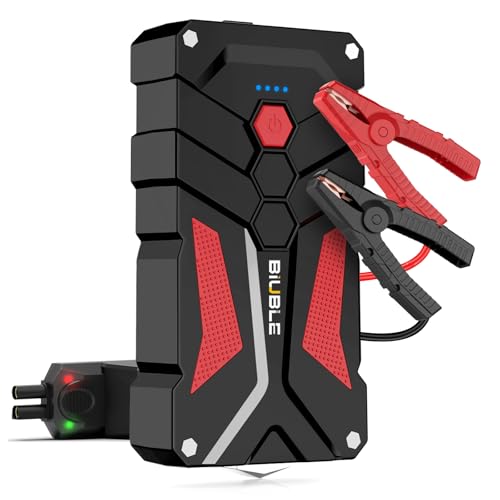
The BIUBLE stands out here for its 7.0-liter gas and 5.5-liter diesel engine limits, paired with 5,000A peak current. BIUBLE says it can provide up to 40 starts per charge and operate from -4°F to 140°F. Two USB outputs are rated at 5V/3A and 5V/2.4A, and the unit includes an LED light. It suits drivers who want a portable booster with phone-charging outputs. Its engine rating is the key limitation: drivers of larger engines should choose a unit rated for their vehicle instead.
Bottom line: Choose it if your engine falls within its limits and you want two USB outputs.
8000A Jump Starter with Air Compressor

The integrated air compressor is the main distinction, making this a combined jump starter and tire-inflation tool rather than a booster alone. Its peak current is 8,000A, and the product claims compatibility with all gas engines and diesel engines up to 16 liters. The compressor is rated to 150 PSI and includes preset and auto-shutoff functions; a blower is also included. This option suits drivers who want inflation capability alongside emergency starting. Its added functions mean more to manage than with a basic jump pack, so choose it only if those functions suit your needs.
Bottom line: Choose it if onboard inflation matters as much as jump-starting.
AstroAI S8 1500A Jump Starter

The AstroAI S8 has a lower stated engine ceiling than the BIUBLE, with ratings for 6.0-liter gas and 3.0-liter diesel engines. Its 1,500A peak current and 12-volt compatibility make it a fit for drivers whose vehicles stay within those limits. It also has a power bank, a three-mode flashlight and Auto-Sense Technology; the maker says a green light flashes when boost is needed below 9V. The engine ceiling is the deciding limitation, so it is not the right match for a vehicle above either stated rating.
Bottom line: Choose it for a 12-volt vehicle within its 6.0L gas or 3.0L diesel rating.
NOCO Boost GB40 1000A

The NOCO GB40 emphasizes connection safeguards, specifying spark-proof and reverse-polarity protection for 12-volt vehicles. Its 1,000A peak rating and engine limits of 6.0-liter gas and 3.0-liter diesel are lower than the BIUBLE’s, so compare those figures with your engine before choosing. NOCO says it can provide up to 20 starts per charge, and it includes a power bank and a 100-lumen LED flashlight with seven modes. This model suits drivers who prioritize the protections; its lower engine rating rules it out for larger engines.
Bottom line: Choose it if the connection protections are a priority and your engine fits its rating.
How to Choose a Car Jump Starter
Choose a jump starter rated for at least your engine’s fuel type and displacement; a peak-amp figure alone does not establish vehicle compatibility. Compare the gas and diesel limits separately, since a unit can support a larger gas engine than diesel engine. A 12-volt rating is also essential for a 12-volt vehicle. Higher peak current can be useful, but it does not replace checking those engine limits. If your vehicle exceeds either stated limit, select a unit whose rating covers that engine rather than assuming extra peak amps make it suitable. For a 12-volt car whose engine is within a model’s limits, use this comparison as a shortlist:
| Need | What to prioritize |
|---|---|
| Engine compatibility | Gas and diesel limits that meet or exceed your engine |
| Inflation capability | An integrated air compressor |
| Connection safeguards | Explicit spark-proof and reverse-polarity protection |
Do not treat an included light or charging port as evidence of engine compatibility.
Safe Jump-Starting for 12-Volt Vehicles
Correct polarity matters: connect positive to positive and negative to the designated negative point or vehicle ground, following the vehicle and booster instructions. Reverse polarity can damage electrical components; spark-proof and reverse-polarity protection are useful safeguards, not a reason to ignore clamp placement. Keep clamps from touching each other or moving engine parts. Do not jump a battery that is cracked, leaking, swollen or visibly frozen; replace or have it assessed instead. Turn off ignition and accessories before connecting, and remove the clamps in the sequence specified by the equipment instructions after the engine starts. If the starter cables or battery become unusually hot, stop and disconnect safely. A jump pack does not repair a failing battery or charging system, so recurring no-starts call for diagnosis.
Peak Amps, Engine Ratings and Cold Weather
Peak amps are a brief maximum-current rating, while the engine limit is the more practical compatibility check for buyers. Compare both the fuel type and displacement: diesel engines can require a different rating than gas engines of similar size. Cold temperatures slow battery chemistry and increase the effort needed to crank an engine, so a pack’s performance can be less dependable in the cold even when the engine is within its printed limit. Store and charge the unit within its own permitted temperature range, and keep it charged before travel. A booster cannot compensate for a damaged battery, corroded connections or an unrelated engine fault. If a vehicle will not start after one correct attempt, repeated cranking can drain the vehicle battery further; pause and seek diagnosis.
Frequently Asked Questions
Can a jump starter start a completely dead battery?
Some packs offer a boost mode for a battery with very low voltage, but a battery with no usable voltage may not accept a normal jump-start. A damaged, frozen or leaking battery should not be boosted; have it assessed instead.
How many amps should a car jump starter have?
Choose by the unit’s gas or diesel engine limit first, then compare peak current among models that cover your engine. Peak amps alone do not confirm compatibility, especially for diesel engines.
Can I use a jump starter on a diesel truck?
Yes, if the pack is rated for the truck’s diesel displacement and voltage. Check the diesel limit separately from any gas-engine rating before connecting it.
Why will a jump starter not work in cold weather?
Cold temperatures reduce battery output and make engines harder to crank, so a marginally charged pack may struggle. Keep the pack charged and within its permitted operating temperature, and do not try to jump a frozen battery.
How often should I recharge a jump starter?
Recharge it after use and check its charge before a trip or seasonal storage. Self-discharge and storage conditions differ by model, so use the manufacturer’s charging schedule rather than assuming a pack will remain ready indefinitely.