
Boat Wireless Kill Switches: 3 Options Compared

Mob+ Wireless Man Overboard System suits most boaters who want a wireless man-overboard system that supports up to four crew members. Choose OLAS Guardian Wireless Engine Kill Switch instead if smartphone connectivity and OLAS transmitter integration are priorities; RVBOATPAT 240A Battery Disconnect is a different kind of switch that disconnects battery power rather than serving as a wireless engine cut-off.
We earn a commission if you buy through links on this page. As an Amazon Associate I earn from qualifying purchases. Products are compared on manufacturer specifications, not hands-on testing.
- Best overall: Mob+ Wireless Man Overboard System – Supports up to four crew members and provides automatic engine stop.
- Best for app connectivity: OLAS Guardian Wireless Engine Kill Switch – Connects with a smartphone app and OLAS transmitters.
- Best for battery isolation: RVBOATPAT 240A Battery Disconnect – Provides a remote 12V battery disconnect with a voltage display.
| Product | Best for | Crew or app support | Switch function | Shop |
|---|---|---|---|---|
| Mob+ Wireless Man Overboard System | Multi-crew boats | Up to 4 crew | Automatic engine stop | Check Price on Amazon |
| OLAS Guardian Wireless Engine Kill Switch | App-connected boats | Smartphone and OLAS transmitters | Automatic engine stop | Check Price on Amazon |
| RVBOATPAT 240A Battery Disconnect | Battery isolation | — | Remote battery disconnect | Check Price on Amazon |
Boat Wireless Kill Switches
Compare wireless man-overboard engine-stop systems with a remote battery disconnect before choosing a safety setup.
Mob+ Wireless Man Overboard System

Four-person crew support sets this wireless man-overboard system apart for boats that carry more than one other person. Mob+ says it provides automatic engine stop, and its plug-and-play installation is intended to simplify setup. The system suits boaters who want crew mobility without relying on a tethered switch. Its capacity is limited to four crew members, so operators who regularly carry more should verify whether another setup covers everyone aboard. The dimensions are 2 1/16 inches in diameter and 3.5 inches high.
Bottom line: Choose this for a wireless man-overboard setup with support for up to four crew.
OLAS Guardian Wireless Engine Kill Switch

Smartphone and OLAS transmitter connectivity distinguish this wireless engine cut-off from the Mob+ system. The maker says the Guardian stops the engine when the skipper falls overboard, and its app supports iOS and Android. It is positioned as a retrofit for most outboard and inboard engines, making it a candidate for owners looking to add a wireless system to an existing boat. The compatibility claim is broad rather than a fit guarantee for every engine, so check compatibility for the specific engine and installation before choosing it.
Bottom line: Pick this if smartphone monitoring and OLAS transmitter compatibility matter most.
RVBOATPAT 240A Battery Disconnect
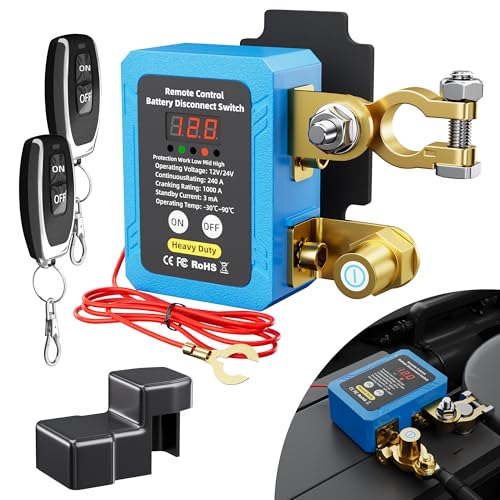
A remote battery disconnect rather than a wireless man-overboard engine stop makes this a different type of boat switch. RVBOATPAT specifies 12V operation, 240A continuous current and 1,000A instant current, plus an LED voltage display. The maker says it automatically cuts power below 11.8V and draws 3mA in standby. It may suit a boat owner seeking battery isolation, but it does not match the crew-tracking and automatic engine-stop purpose of the two wireless man-overboard systems. Confirm that a battery disconnect is the function your boat requires.
Bottom line: Choose this for remote battery isolation, not crew-based engine cut-off.
How wireless boat kill switches differ
A wireless man-overboard engine cut-off responds to a crew member moving out of connection range, while a battery disconnect interrupts battery power. These functions are not interchangeable: one is intended to stop the engine after a person goes overboard, and the other isolates electrical power. The Mob+ and OLAS Guardian are the two engine-stop options here; the RVBOATPAT unit is a remote battery disconnect. Before buying, decide whether the goal is engine shutdown, battery isolation, or both. For engine cut-off systems, consider who aboard needs to wear or carry a transmitter and how the system reconnects after an alarm. A remote battery switch does not provide the person-overboard function simply because its name includes “kill switch.”
How to choose crew and app support
Choose a system by the number of people it can support and whether app connectivity is useful aboard. That difference matters most on boats carrying several people or operators who want app alerts. Make a simple crew count before choosing: if more than four need coverage, do not assume the Mob+ supports them. For either engine-stop option, check the specific engine and installation compatibility before ordering, especially when retrofitting an inboard or outboard setup.
Engine cut-off requirements and safe use
Federal rules require operators of covered recreational vessels under 26 feet with engines of 3 horsepower or more to use an engine cut-off switch when the vessel is underway, subject to specified exceptions. A wireless system is one way to meet an engine cut-off need, but product choice alone does not establish that a particular installation meets the requirement. Keep the system maintained and make sure the operator knows how to activate and reset it. A kill switch is not a substitute for life jackets or safe boating practices. For a boat carrying passengers, explain which crew members need transmitters before departure and verify that the engine stops as intended during a controlled pre-departure check.
Wireless engine stop versus battery disconnect
Match the switch type to the job rather than relying on the shared “kill switch” wording. Engine cut-off systems are meant to stop propulsion in a man-overboard event; battery disconnects break electrical power to help isolate a battery. This choice table separates the three relevant options by function.
| Need | Suitable type | What to compare |
|---|---|---|
| Stop engine after person overboard | Wireless man-overboard system | Crew coverage and engine compatibility |
| Connect app or transmitters | App-connected engine cut-off | Phone platform and transmitter compatibility |
| Disconnect battery power | Remote battery disconnect | Voltage and current ratings |
Do not substitute a battery isolator for an engine cut-off system when the required function is person-overboard shutdown.
Frequently Asked Questions
Does a wireless boat kill switch stop the engine?
A wireless man-overboard engine cut-off is intended to stop propulsion when its trigger condition occurs. A remote battery disconnect instead interrupts battery power, so confirm the switch type matches the function you need.
How many crew can the Mob+ system support?
Mob+ supports up to four crew members. If more than four people need coverage, verify a suitable system before departure rather than assuming the capacity extends further.
Does the OLAS Guardian connect to a smartphone?
Yes, its maker says it connects to an iOS or Android app and OLAS transmitters. Check compatibility with the specific engine before selecting it as a retrofit.
Can I use a battery disconnect as a man-overboard switch?
No, a battery disconnect isolates electrical power rather than providing the crew-based engine cut-off function described for a man-overboard system. Choose by the required function, not by the shared “kill switch” wording.
When must a recreational boat operator use an engine cut-off switch?
Federal rules generally require operators of covered recreational vessels under 26 feet with engines of 3 horsepower or more to use an engine cut-off switch while underway, with specified exceptions. Verify how the rule applies to your vessel and operation.