
BUBBA Cordless Fillet Knife: 4 Models Compared

BUBBA Li-Ion Cordless Fillet Knife is the BUBBA cordless fillet knife choice here, with four removable Ti-Nitride-coated blades, a non-slip grip and a trigger guard. Choose another cordless fillet model if you want a kit with two battery packs or 8- and 10-inch blades; the BUBBA set instead includes four blades and a storage case.
A cordless electric fillet knife uses powered reciprocating blades to cut fish, so blade changes and cleaning require extra care around the moving edge.
We earn a commission if you buy through links on this page. As an Amazon Associate I earn from qualifying purchases. Products are compared on manufacturer specifications, not hands-on testing.
- Best overall: BUBBA Li-Ion Cordless Fillet Knife – Four removable coated blades, a non-slip handle, trigger guard and case make it the direct BUBBA match.
- Best for spare battery: WORKPRO 12V Cordless Fillet Knife – The set includes two rechargeable battery packs and 8- and 10-inch blades.
- Best for blade lengths: FLISSA 12V Cordless Electric Fillet Knife – Its two stainless-steel blades measure 8 and 10 inches, with two 2,000mAh battery packs.
| Product | Best for | Blade set | Battery setup | Grip or safety feature | Shop |
|---|---|---|---|---|---|
| BUBBA Li-Ion Cordless Fillet Knife | BUBBA fishing kit | 4 Ti-Nitride-coated blades | Lithium-ion; 1 battery | Non-slip grip; trigger guard | Check Price on Amazon |
| WORKPRO 12V Cordless Fillet Knife | Spare battery setup | 8- and 10-inch blades | 12V; two 2.0Ah packs | Rubber-coated grip; safety lock | Check Price on Amazon |
| KastKing Speed Demon Pro Li | Runtime priority | 2 blades | Lithium-ion; 2,500mAh | TPR non-slip handle | Check Price on Amazon |
| FLISSA 12V Cordless Electric Fillet Knife | Two-length blade kit | 8- and 10-inch stainless steel | 12V; two 2,000mAh packs | Non-slip handle; trigger guard | Check Price on Amazon |
BUBBA Cordless Fillet Knife and Alternatives
Compare blade sets, battery arrangements and handle features to find the cordless fillet knife that fits your fishing routine.
BUBBA Li-Ion Cordless Fillet Knife

The BUBBA is the only BUBBA cordless fillet knife in this group, and its four removable Ti-Nitride-coated stainless-steel blades set it apart from the two-blade alternatives. The 8.5-inch handle weighs 1.11 pounds, and an LED indicator shows battery life. A zippered case has a dedicated blade-storage section, and the maker includes a limited 1-year warranty. The non-slip grip and trigger guard suit anglers who want added hand control.
Bottom line: Pick this for the BUBBA name, four coated blades and a dedicated case.
WORKPRO 12V Cordless Fillet Knife

The WORKPRO stands apart with two removable battery packs rather than a single pack, so a second pack is available while the first is in use. It comes with 8- and 10-inch blades, a rubber-coated handle, a safety lock, a carry case and a 12V fast charger. The maker says a full charge takes one hour. At 1 pound without blades or battery, the handle is lightweight, but the complete kit will weigh more. This is a fit for anglers who value a spare pack and two blade lengths over the BUBBA set’s four coated blades; the maker does not establish runtime per charge.
Bottom line: Choose this if a second battery pack and two blade lengths matter most.
KastKing Speed Demon Pro Li

The KastKing distinguishes itself with a 2,500mAh lithium-ion battery and a maker-claimed continuous runtime of up to 1 hour and 40 minutes. Its high-torque motor is also a maker performance claim, while the TPR handle is a plain material specification; the balanced design is intended to support control during filleting. The Angler Pack includes two blades, one battery pack and a carry case. It may suit anglers who prioritize the battery capacity claim and a softer grip.
Bottom line: Pick this if its battery-capacity and runtime claims are your main deciding factors.
FLISSA 12V Cordless Electric Fillet Knife
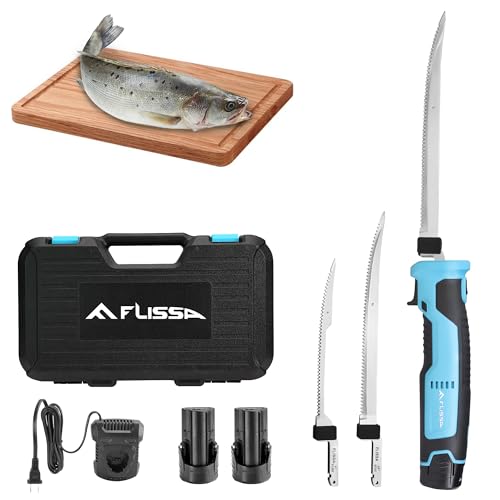
The FLISSA pairs two identified blade lengths, 8 and 10 inches, with two replaceable 2,000mAh lithium-ion packs. Its blades are stainless steel and removable, while the handle has a non-slip surface and trigger guard. The maker describes the motor as high-speed and high-torque; those are performance claims, not a runtime figure. This set suits anglers who want two battery packs and named blade lengths for different fish.
Bottom line: Choose this for two named blade lengths and two removable battery packs.
How to choose a cordless fillet knife
Choose by blade length, battery arrangement and handling features before comparing motor claims. Blades around 7 to 9 inches are common all-purpose lengths; a longer blade can cover more of a large fish in a pass, while a shorter blade is easier to control on smaller fish. For mixed-size catches, a kit with two blade lengths can reduce the need to force one blade into every task. Battery capacity in mAh is a charge-capacity measure, not a direct runtime guarantee, because load and cutting technique affect run time. If you plan to fillet multiple fish away from power, favor a kit with a spare removable battery. A non-slip grip and trigger guard can help maintain control, but they do not replace careful handling.
Use the table to match a practical need to the feature that addresses it.
| Need | Feature to prioritize |
|---|---|
| Different fish sizes | Two identified blade lengths |
| Long sessions away from power | Spare removable battery |
| Controlled grip | Non-slip handle and trigger guard |
Blade length and fish size
Blade length should suit the fish you most often clean, not simply be as long as possible. An 8-inch blade is a common versatile size; a 10-inch blade reaches farther along larger fish, while a shorter blade can be easier to maneuver around smaller fish and tight contours. These are practical selection guidelines, not guarantees of fit for every species. Keep the blade aligned with the backbone and use controlled strokes rather than twisting the reciprocating blade sideways, which can reduce control and strain the blade. When a kit does not identify its blade lengths, confirm the exact blade sizes before ordering if a particular length is essential. A two-length kit makes it easier to choose a blade to match the fish rather than using one blade for every cut.
Battery planning for cordless filleting
A spare battery is useful when a charging pause would interrupt a fishing session. Battery capacity is measured in amp-hours or milliamp-hours, but capacity alone does not establish how many fish a charge will handle; motor load, fish size and cutting pressure all affect consumption. A charger’s charge time is useful for planning downtime, though a fast charger cannot help if there is no power source nearby. Keep removable packs dry and use the charger intended for the knife’s battery system. For a long day away from a power outlet, choose a kit with a second pack or a clear runtime claim and carry the spare protected from water. Stop if a pack or charger becomes unusually hot, damaged or wet.
Cleaning and safe blade handling
Remove the battery or disconnect power before changing blades or cleaning an electric fillet knife. Reciprocating blades can move unexpectedly if the trigger is engaged, so keep fingers clear of the cutting edge and never hold a blade by its teeth. Remove the blades as designed, wash and dry them promptly after contact with fish, and store them in a protected case to limit corrosion and accidental cuts. Do not immerse the powered handle unless its maker specifically permits it; water intrusion can damage electrical components. Check blades for bends, chips or looseness before use, and replace a damaged blade rather than trying to straighten it while attached. A clean, dry blade and securely seated battery are basic checks before each filleting session.
Frequently Asked Questions
What blade length works for most fish?
An 8-inch blade is a practical all-purpose starting point for many anglers, while 10 inches can be more convenient on larger fish. Choose a shorter blade when control around small fish and tight contours matters more than reach.
Does a higher battery capacity mean longer runtime?
A higher mAh rating means more rated charge capacity, but it does not guarantee a proportional runtime increase. Fish size, cutting pressure and motor load change how quickly a cordless knife uses power.
How should I clean an electric fillet knife safely?
Remove the battery or disconnect power before removing blades for cleaning. Wash and dry blades promptly after fish contact, and keep the powered handle out of water unless its maker permits immersion.
Can I use one blade for every fish size?
One blade can handle a range of fish, but a shorter blade is often easier to control on small fish and a longer blade offers more reach on large fish. A two-length set lets you choose rather than forcing one length onto every job.